
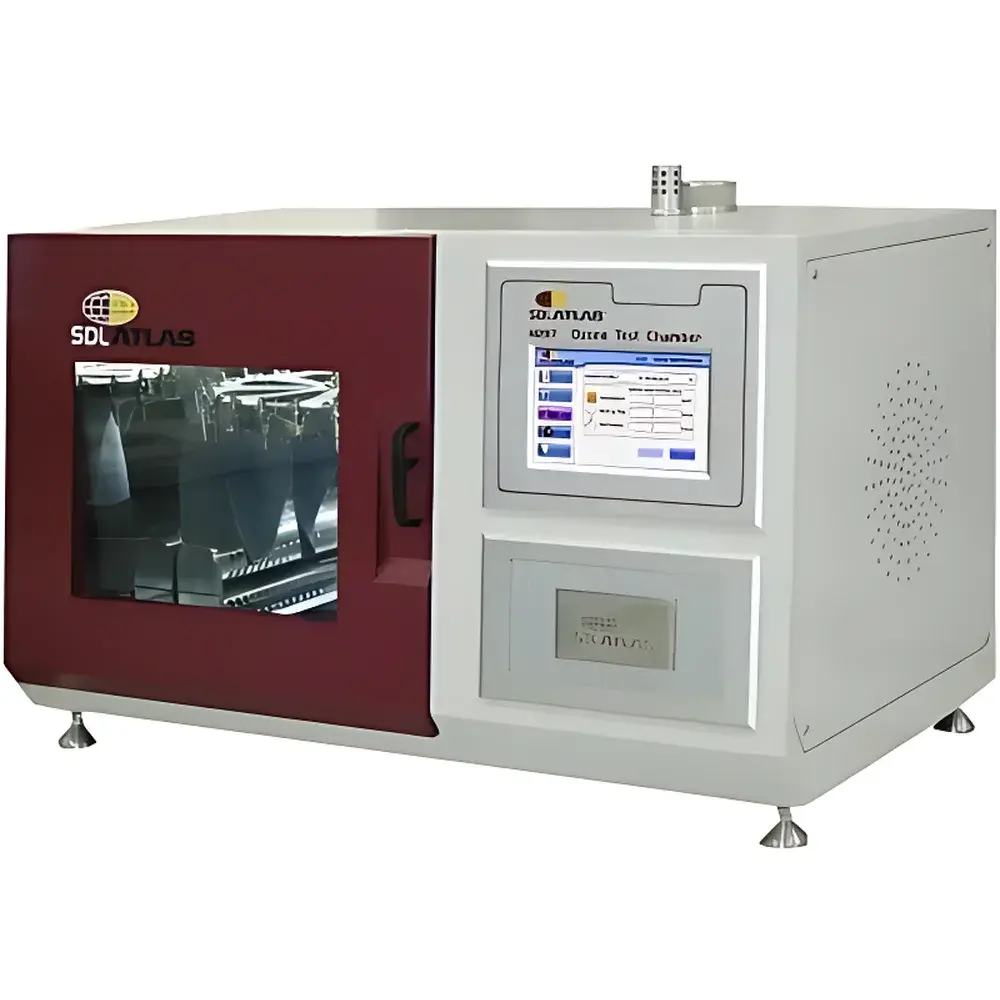
SDL Atlas M287 Advanced Ozone Fastness Tester
| Brand | SDL Atlas |
|---|---|
| Origin | Guangdong, China |
| Manufacturer Type | Manufacturer |
| Origin Category | Domestic (China) |
| Model | M287 |
| Price Range | USD 14,000 – 70,000 |
Overview
The SDL Atlas M287 Advanced Ozone Fastness Tester is an engineered solution for evaluating the ozone-induced color degradation resistance of textile materials—specifically dyed and printed fabrics, yarns, and leather—under controlled, reproducible atmospheric conditions. Based on the principle of accelerated aging via controlled ozone exposure, the instrument generates and maintains precise ozone concentrations (typically 50–300 ppb, configurable per ISO 105-G03, AATCC Test Method 109, and GB/T 14574) within a sealed, negatively pressurized test chamber. Unlike ambient-air-based systems, the M287 employs a closed-loop ozone concentration control architecture, integrating real-time electrochemical ozone sensing with proportional feedback to the high-output corona discharge generator. This ensures stability ±5% of setpoint over full test duration (up to 168 hours), critical for inter-laboratory comparability and regulatory compliance in global textile supply chain validation.
Key Features
- High-efficiency corona discharge ozone generator delivering stable output across 20–500 ppb range, with automatic power modulation to compensate for ambient temperature/humidity drift
- Touchscreen HMI with multilingual interface (English, Spanish, Turkish, Chinese) supporting intuitive test programming, real-time ozone ppm/ppb display, and event logging
- Closed-loop ozone concentration control system with integrated electrochemical sensor and PID-regulated generator output
- 24-position rotating specimen rack with independent sample clamping, ensuring uniform exposure geometry and eliminating edge-shadowing effects
- Integrated catalytic ozone destruct unit (ozone washer) using manganese dioxide catalyst, achieving >99.9% ozone conversion to ambient oxygen prior to exhaust release
- Interlocked chamber door with dual-safety verification: mechanical latch release only after ozone concentration falls below 0.05 ppm (per OSHA PEL), confirmed by redundant sensor readout
- Negatively pressurized test chamber (−15 to −25 Pa relative to lab ambient), monitored continuously and logged for audit trail integrity
- UV-blocking borosilicate viewing window (cut-off <320 nm) and internal LED illumination enabling visual assessment without exposure interruption
- Preheat function programmable up to 60 minutes, allowing thermal stabilization before ozone introduction—essential for simulating real-world storage or transport conditions
Sample Compatibility & Compliance
The M287 accommodates standard textile specimens per ISO 105-G03 (100 × 40 mm strips), AATCC 109 (25 × 50 mm), and custom formats up to 120 mm width. Specimen holders are stainless steel with non-reactive silicone gaskets to prevent migration artifacts. The system complies with key international standards including ISO 105-G03:2019, AATCC TM109-2023, GB/T 14574-2008, and JIS L 0849 Type II. Its design supports GLP-compliant operation: all critical parameters (ozone setpoint, actual concentration, chamber temperature, humidity, elapsed time, door status) are timestamped and stored internally with optional USB export. Audit-ready data logs meet FDA 21 CFR Part 11 requirements when paired with validated third-party LIMS integration.
Software & Data Management
The embedded controller firmware provides local data retention for ≥1,000 test records with full parameter traceability. Export options include CSV and PDF reports containing chamber environmental profiles, ozone deviation history, and operator ID (if configured). Optional Ethernet connectivity enables remote monitoring via secure HTTP/HTTPS API (RESTful endpoints for status polling and alarm notification). No cloud dependency—the system operates fully offline, preserving data sovereignty. Firmware updates are performed via encrypted USB stick with SHA-256 signature verification to ensure integrity.
Applications
- Quality assurance of reactive, vat, and azo dyes prone to ozone-fading during retail display or urban storage
- Validation of anti-ozone finishing agents (e.g., hindered amine light stabilizers—HALS) in technical textiles
- Comparative fastness ranking across fiber blends (cotton/polyester, nylon/elastane) under standardized ozone stress
- Supporting sustainability claims: quantifying ozone resistance as part of eco-labeling programs (e.g., OEKO-TEX® STANDARD 100 Class II)
- R&D screening for new pigment systems intended for outdoor applications (flags, awnings, automotive interiors)
FAQ
Does the M287 require external ventilation or ducting?
No. All exhaust air passes through the integrated catalytic ozone destruct unit; no fume hood or building exhaust connection is necessary.
What is the maximum allowable ambient humidity for reliable operation?
The instrument is rated for continuous operation at 50–70% RH and 20–25°C. Operation outside this range may affect ozone generation efficiency and sensor longevity.
Can test parameters be password-protected to prevent unauthorized modification?
Yes. Three-tier user access (Operator, Supervisor, Administrator) with configurable password policies and session timeout is supported.
Is calibration traceable to NIST or equivalent national metrology institutes?
Ozone sensor calibration certificates are provided with each unit, traceable to NPL (UK) standards via accredited third-party calibration laboratory (ISO/IEC 17025 certified).
How often does the ozone generator or catalyst require maintenance?
The corona cell requires cleaning every 500 operating hours; the MnO₂ catalyst cartridge is rated for 2,000 hours or 12 months—whichever occurs first—and is field-replaceable without tools.




