
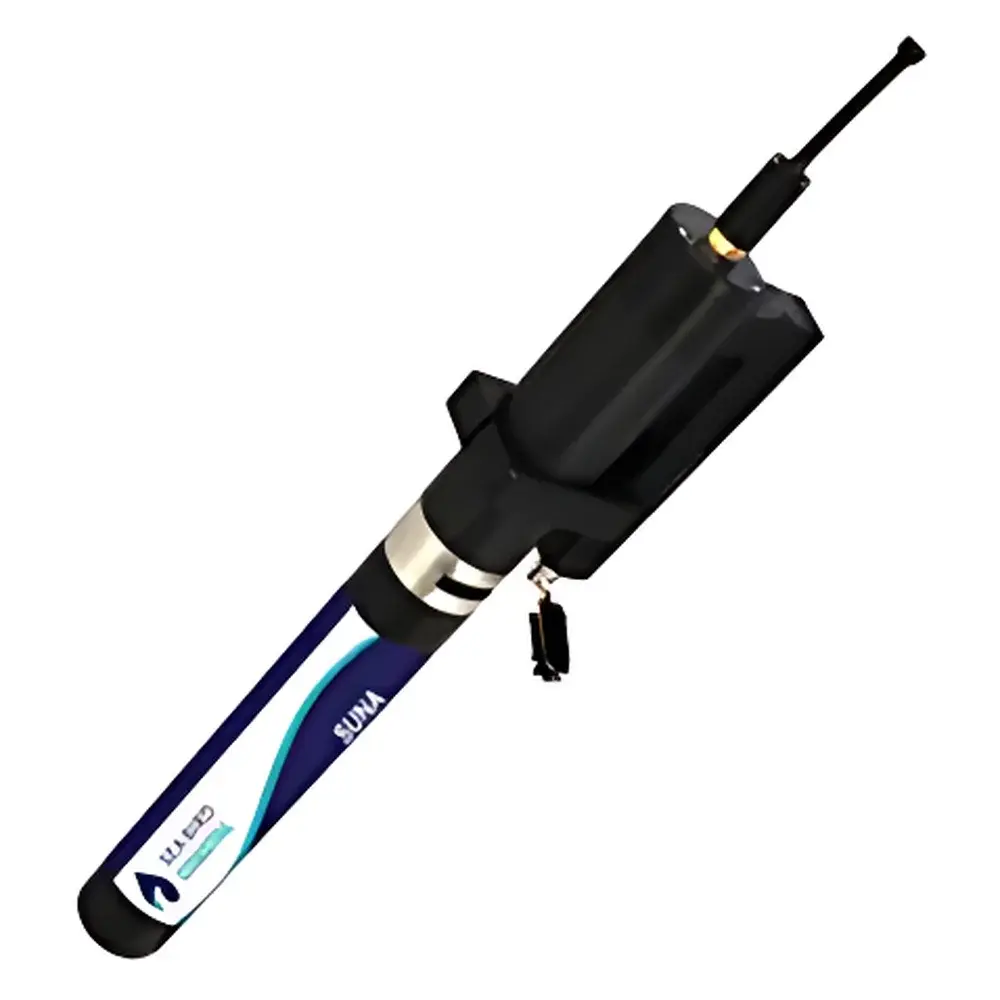
Sea-Bird Scientific SUNA V2 Submersible UV Nitrate Analyzer
| Brand | Sea-Bird Scientific |
|---|---|
| Origin | Imported |
| Manufacturer Type | Authorized Distributor |
| Model | SUNA V2 |
| Optical Path Length Options | 5 mm or 10 mm |
| Detection Range | 0.5–4000 µM NO₃⁻ (0.007–56 mg/L N) |
| Accuracy | ±2 µM (10 mm) or ±4 µM (5 mm), or ±10% of reading, whichever is greater |
| Short-Term Precision (3σ) | 0.3 µM (T-S-corrected freshwater/seawater) |
| Long-Term Drift | ≤0.3 µM/h (T-S-corrected) |
| Turbidity Tolerance | 625 NTU (10 mm), 1250 NTU (5 mm) |
| Wavelength Range | 190–370 nm |
| Lamp Lifetime | 900 h |
| Operating Voltage | 8–18 VDC (8–15 VDC with biofouling brush) |
| Power Consumption | 7.5 W at 12 VDC (0.625 A) |
| Housing Material | Polyoxymethylene (POM) and Titanium Alloy |
| Depth Rating | 500 m (standard) |
| Weight | 2.5 kg (standard) |
| Calibration Options | Freshwater and Seawater Modes |
| Data Interface | USB (PC/Mac compatible) |
| Software | SUNACom v3.x (Windows/macOS) |
Overview
The Sea-Bird Scientific SUNA V2 Submersible UV Nitrate Analyzer is a field-deployable, reagent-free in situ instrument engineered for high-fidelity, long-term nitrate (NO₃⁻) quantification in natural waters using ultraviolet absorption spectroscopy. It implements the ISUS (In Situ Ultraviolet Spectrophotometer) methodology originally developed at the Monterey Bay Aquarium Research Institute (MBARI), refined through collaboration with Satlantic’s optical engineering team to deliver robust performance across highly variable aquatic environments—from oligotrophic open ocean to turbid river plumes and CDOM-rich estuarine systems. Unlike wet-chemical analyzers, the SUNA V2 eliminates consumables, waste streams, and hydraulic complexity, relying instead on stable deuterium lamp illumination and high-resolution UV spectral acquisition (190–370 nm) to resolve nitrate’s characteristic absorption signature amid overlapping organic and inorganic interferences. Its dual-pathlength design (5 mm and 10 mm), adaptive optical compensation, and temperature–salinity (T–S) correction algorithms ensure metrological rigor under dynamic field conditions, meeting the analytical demands of regulatory monitoring programs, ecosystem research, and real-time water quality observatories.
Key Features
- Reagent-free operation: No chemical reagents, pumps, valves, or liquid waste—reducing maintenance frequency and environmental footprint.
- Dual optical pathlength options: Selectable 5 mm pathlength for high-flow, high-turbidity applications (e.g., storm runoff monitoring); 10 mm pathlength for enhanced sensitivity in clear waters.
- Intelligent sampling regulation: Real-time optical gain adjustment compensates for variable CDOM absorption, preserving signal-to-noise ratio across diverse coastal and inland waters.
- Integrated biofouling mitigation: Motor-driven titanium-bristle brush prevents surface biofilm accumulation, maintaining optical clarity over extended deployments (up to 500 m depth without brush; 100 m with brush).
- High-stability UV source: Deuterium lamp with 900-hour rated lifetime and onboard intensity monitoring enables drift-compensated spectral processing.
- Embedded data logging: Internal memory stores calibrated nitrate concentrations, raw spectra, temperature, pressure, and diagnostic parameters with user-configurable sampling intervals.
- Low-power architecture: Draws only 7.5 W at 12 VDC—compatible with buoy, mooring, AUV, and land-based telemetry platforms.
Sample Compatibility & Compliance
The SUNA V2 is validated for continuous in situ measurement in freshwater, brackish, and full-strength seawater (0–40 psu). Its accuracy specification—±2 µM (10 mm) or ±4 µM (5 mm), or ±10% of reading—is traceable to NIST-traceable nitrate standards and verified per ASTM D512-22 (Standard Test Method for Chloride Ion in Water) and ISO 15681-2:2016 (Water Quality — Determination of Phosphorus and Nitrogen Compounds — Part 2: Spectrophotometric Determination of Nitrate). The instrument complies with GLP data integrity requirements when used with SUNACom software, which supports audit trails, electronic signatures, and metadata tagging per FDA 21 CFR Part 11 guidelines. Its titanium–POM housing meets ISO 16145:2015 for submersible sensor corrosion resistance and is certified to IP68 for continuous underwater operation.
Software & Data Management
SUNACom v3.x is the official configuration, calibration, and data retrieval application for the SUNA V2. Built on cross-platform Qt libraries, it supports Windows 10/11 and macOS 12–14. SUNACom provides guided setup workflows—including multi-point freshwater and seawater calibration routines with T–S matrix correction—and enables real-time spectral visualization, baseline drift diagnostics, and firmware updates. All logged data export in CF-compliant NetCDF format, with embedded provenance metadata (instrument ID, calibration date, lamp hours, temperature-compensated absorbance values). Integration with LOBO (Long-term Ocean Biogeochemical Observatory) and other OGC-compliant data portals is supported via standardized CSV and JSON APIs. For automated networked deployments, SUNA V2 accepts ASCII serial commands over RS-232 or USB CDC, enabling seamless incorporation into SCADA, IOOS, and EU INSPIRE infrastructure.
Applications
- Long-term moored observatories tracking eutrophication dynamics in estuaries and continental shelves.
- Riverine nutrient flux studies during storm events and seasonal baseflow periods.
- Drinking water reservoir monitoring for compliance with WHO and EPA nitrate thresholds (≤10 mg/L NO₃⁻–N).
- Agricultural runoff assessment in tile-drained watersheds and irrigation return flows.
- Autonomous platform integration (gliders, profilers, AUVs) for synoptic nitrate profiling across thermoclines and haloclines.
- Validation of satellite-derived ocean color products (e.g., Sentinel-3 OLCI, VIIRS) through match-up in situ ground truthing.
FAQ
Does the SUNA V2 require daily calibration or reagent replacement?
No—calibration is performed pre-deployment using certified nitrate standards; no reagents, pumps, or consumables are required during operation.
Can the SUNA V2 operate in highly turbid rivers after heavy rainfall?
Yes—its 5 mm pathlength option and intelligent optical gain control enable reliable measurements up to 1250 NTU.
How is temperature and salinity variability handled in nitrate calculation?
The instrument applies real-time T–S correction using co-located CTD inputs or internal thermistor/salinity estimates, minimizing matrix effects per ISO 15681-2 Annex B.
Is raw spectral data accessible for post-processing or algorithm development?
Yes—SUNACom exports full 190–370 nm absorbance spectra with wavelength calibration, lamp intensity reference, and dark current subtraction applied.
What is the recommended maintenance interval for the biofouling brush?
Brush motor duty cycle is configurable; typical deployment cycles (e.g., monthly brushing for 30 s) extend maintenance intervals to ≥6 months in moderate biofouling environments.
Related Products







