
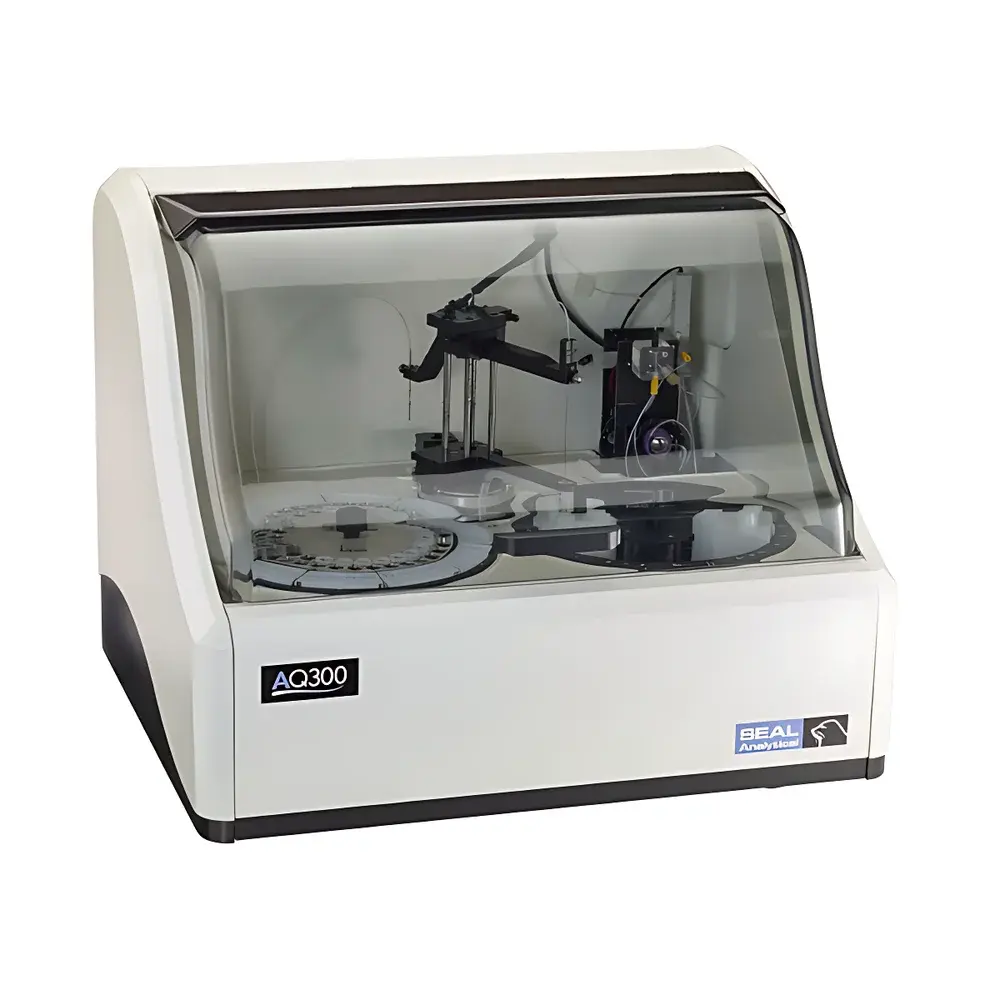
SEAL AQ300 Automated Discrete Analyzer
| Brand | SEAL |
|---|---|
| Origin | Imported |
| Model | AQ300 |
| Product Type | Discrete Analyzer |
| Wavelength Range | 350–880 nm |
| Sample Capacity | 80 or 120 positions |
| Reagent Positions | 26 |
| Cuvette Path Length | 10 mm |
| Light Source | Tungsten-Halogen Lamp |
Overview
The SEAL AQ300 Automated Discrete Analyzer is a compact, cost-optimized benchtop system engineered for high-precision, multi-parameter wet-chemical analysis of environmental matrices. Unlike continuous-flow or flow-injection systems, the AQ300 implements true discrete analysis—each sample and reagent combination is processed individually in a dedicated quartz cuvette, eliminating carryover and enabling strict method compliance with classical colorimetric, enzymatic, and ion-selective protocols. Its optical detection module employs a stable tungsten-halogen light source and a monochromator-based spectrophotometer operating across 350–880 nm, supporting standardized absorbance measurements per ASTM D1253, ISO 7890, USP , and EPA Methods 350.1, 353.2, 4500-NH₃ F, and 4500-NO₂ B. The 10-mm pathlength quartz flow cell ensures optimal sensitivity for low-concentration analytes while maintaining mechanical robustness under routine laboratory use.
Key Features
- True discrete analysis architecture: No shared fluidic lines; each reaction occurs in an isolated, optically calibrated quartz cuvette to eliminate cross-contamination—critical for co-analysis of ammonia, nitrate (cadmium reduction), and phenolic compounds.
- Compact footprint (W × D × H ≈ 75 × 65 × 55 cm): Designed for space-constrained laboratories without compromising analytical integrity or throughput.
- Flexible sample handling: Supports dual rack configurations—80-position or 120-position sample carousels—to accommodate variable daily workload profiles.
- 26 independent reagent positions with refrigerated storage capability (optional): Enables simultaneous deployment of complex multi-step methods requiring diverse reagents, buffers, and standards.
- Integrated thermal control: Maintains precise incubation temperatures (37 °C ± 0.3 °C) for enzyme-coupled assays such as total phosphorus and total Kjeldahl nitrogen.
- Automated calibration and QC: Built-in standard/supplemental calibration routines with drift correction algorithms compliant with ISO/IEC 17025 data integrity requirements.
Sample Compatibility & Compliance
The AQ300 is validated for aqueous environmental samples including raw and treated drinking water, wastewater effluents, surface and groundwater, soil leachates, and sediment pore waters. It meets regulatory acceptance criteria for method-defined parameters under EPA Contract Laboratory Program (CLP) guidelines and supports GLP-compliant workflows via full audit trail logging. All assay protocols adhere to internationally recognized standard methods—including APHA Standard Methods for the Examination of Water and Wastewater (23rd ed.), ISO 15681-1 (phosphate), ISO 11732 (ammonia), and EN ISO 11923 (nitrate/nitrite)—with documented linearity (R² ≥ 0.999), repeatability (RSD ≤ 1.5%), and spike recovery (85–115%) across defined concentration ranges.
Software & Data Management
Controlled by SEAL’s proprietary AQSoft v5.x platform, the system provides intuitive method editor functionality, real-time monitoring of robotic arm motion and photometric response, and automated report generation in PDF and CSV formats. Software architecture complies with FDA 21 CFR Part 11 requirements through electronic signatures, role-based access control, immutable audit trails, and secure data archiving. Raw absorbance data, calibration curves, QC charts, and instrument event logs are timestamped and exportable for third-party LIMS integration via ODBC or HL7 interfaces. All method files include embedded metadata (reagent lot numbers, expiration dates, analyst ID) to support traceability in regulated environments.
Applications
The AQ300 delivers reliable quantification across more than 20 EPA- and ISO-recognized parameters, including but not limited to: alkalinity (titrimetric endpoint detection), ammonium (indophenol blue), chloride (mercuric thiocyanate), cyanide (pyridine-barbituric acid), nitrate + nitrite (cadmium reduction followed by diazotization), orthophosphate (ascorbic acid reduction), total phosphorus (persulfate digestion), silica (molybdenum blue), sulfate (turbidimetric barium chloride), and total Kjeldahl nitrogen (acid digestion + indophenol detection). Its discrete format enables parallel processing of heterogeneous sample sets—e.g., mixing potable water, industrial effluent, and marine samples within a single run—without method interference or recalibration.
FAQ
How does discrete analysis differ from flow injection analysis (FIA)?
Discrete analysis processes each sample-reagent mixture in a physically isolated cuvette, whereas FIA relies on segmented carrier streams. This eliminates memory effects and allows rigorous validation of complex, multi-reagent chemistries.
Is the AQ300 suitable for GLP-regulated laboratories?
Yes—when configured with AQSoft’s Part 11-compliant mode, it supports electronic signatures, audit trails, and data integrity controls required for GLP and ISO/IEC 17025 accreditation.
Can the system perform digestion steps onboard?
No—digestion (e.g., persulfate oxidation for total phosphorus) must be performed externally; however, the AQ300 fully automates post-digestion colorimetric detection and quantification.
What maintenance is required for long-term optical stability?
Annual verification of lamp intensity, wavelength accuracy, and photometric linearity using NIST-traceable filters is recommended; quartz cuvettes are user-cleanable and replaceable.
Does the AQ300 support custom method development?
Yes—AQSoft includes a graphical method builder allowing users to define pipetting sequences, incubation times, mixing cycles, and measurement wavelengths without coding.




