
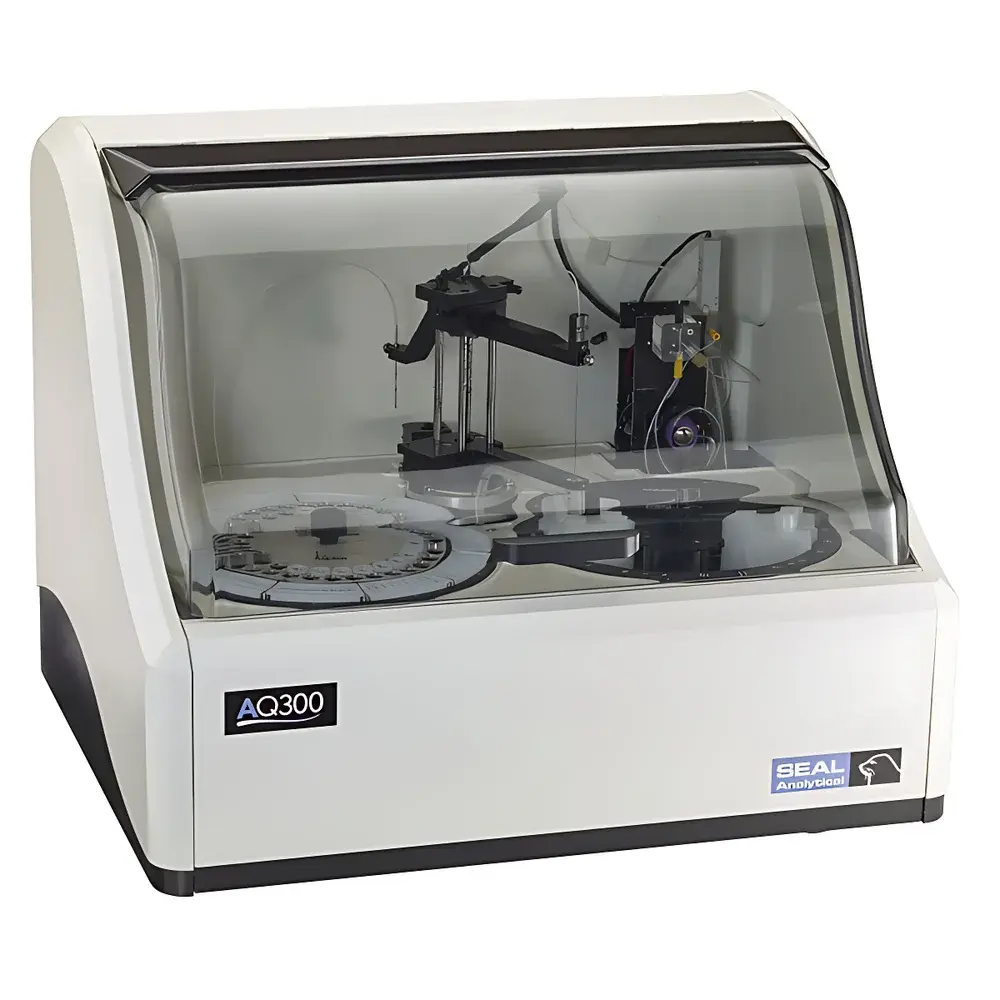
SEAL AQ300 Discrete Analyzer
| Brand | SEAL |
|---|---|
| Origin | USA |
| Model | AQ300 |
| Instrument Type | Discrete Analytical System |
| Sample Throughput | Up to 97 positions |
| Cuvette Pathlength | 10 mm |
| Optical Cell | Fixed-position fused quartz cuvette |
| Detection Principle | Photometric absorbance measurement |
| Reaction Control | Programmable incubation (seconds to minutes) |
| Compliance | EPA-approved methods, UK Blue Book validated, GLP/GMP-ready architecture |
| Automation Level | Fully unattended overnight operation |
| Reagent Consumption | Optimized for low-volume reagent use |
| Cross-contamination Mitigation | Post-measurement deep-cuvette wash cycle |
| Method Flexibility | Up to 7 analytes per sample, auto-standard curve generation, on-the-fly dilution and method switching |
Overview
The SEAL AQ300 Discrete Analyzer is a compact, high-precision photometric system engineered for environmental laboratories requiring rigorous, multi-parameter analysis of water, wastewater, soil extracts, and other aqueous matrices. Unlike continuous flow or flow injection systems, the AQ300 employs true discrete analysis: each sample and reagent combination is processed individually in a dedicated reaction well, followed by transfer to a stationary 10-mm-pathlength fused quartz cuvette for absorbance measurement. This architecture eliminates flow-path memory effects and ensures stoichiometric control over reaction kinetics—enabling complete chemical equilibration under programmable incubation (from seconds to >30 minutes). The fixed optical platform delivers superior signal-to-noise ratio and long-term photometric stability, directly contributing to lower method detection limits (MDLs) and inter-run reproducibility ≤1.5% RSD across routine environmental parameters.
Key Features
- Compact footprint (65 × 55 × 45 cm) optimized for space-constrained labs without compromising analytical integrity
- 97-position programmable sample carousel with independent vial-level addressing
- Fused quartz optical cuvette with 10 mm pathlength—chemically inert, UV-transparent, and thermally stable for consistent photometry
- Integrated syringe-driven liquid handling with sub-µL precision for sample, reagent, and standard delivery
- On-board reagent refrigeration (4–8 °C) and temperature-controlled reaction wells (ambient to 50 °C)
- Automated calibration: full standard curve generation, dynamic dilution (1:2 to 1:1000), and real-time slope/intercept validation
- No carryover or cross-contamination: post-read deep-wash protocol with dual-solvent rinse (water + acid or organic solvent)
- Method-switching capability within a single run—no hardware reconfiguration required
Sample Compatibility & Compliance
The AQ300 is validated for direct analysis of raw and filtered environmental samples—including surface water, groundwater, effluent, digested soil leachates, and sludge extracts—without pre-dilution in most cases. Its discrete architecture inherently supports heterogeneous sample types (e.g., turbid, particulate-laden, or high-salinity matrices) through customizable filtration and settling steps prior to aspiration. Methodologically, the system implements standardized protocols compliant with U.S. EPA Methods (e.g., 350.1, 353.2, 354.1, 365.4), UK Environment Agency Blue Book procedures, and ISO 15681-1/2 for orthophosphate, nitrate+nitrite, ammonia, silicate, sulfate, cyanide, phenols, and total Kjeldahl nitrogen. All data acquisition and audit trails conform to FDA 21 CFR Part 11 requirements when paired with SEAL’s optional LIMS-integrated software suite.
Software & Data Management
Control and data processing are managed via SEAL’s AQ Series Software—a Windows-based application supporting ICH-GCP, GLP, and GMP workflows. The interface enables full method scripting (reaction timing, heating profiles, mixing sequences), real-time monitoring of photometric baselines and peak integrals, and automated QC flagging (e.g., drift >2% per hour, blank absorbance deviation >0.01 AU). Raw absorbance values, calculated concentrations, calibration diagnostics, and instrument maintenance logs are stored in a relational SQL database with immutable timestamps and user-access audit trails. Export options include CSV, PDF analytical reports, and direct integration with laboratory information management systems (LIMS) via ASTM E1384-compliant HL7 or ODBC drivers.
Applications
The AQ300 delivers robust performance across regulatory and research-driven environmental testing domains. It is routinely deployed for nutrient speciation (NH₄⁺, NO₃⁻+NO₂⁻, PO₄³⁻, SiO₂, SO₄²⁻), toxicity-related analytes (CN⁻, phenolic compounds), and process indicators (alkalinity, chloride, TKDN). Its ability to execute EPA Method 354.1 (cadmium reduction for nitrate) and Method 350.1 (salicylate for ammonia) in parallel—without reagent interference—makes it uniquely suited for wastewater treatment plant compliance monitoring. Soil testing laboratories leverage its optimized digestion-compatible protocols for Mehlich-3 and Olsen extractions, while marine and limnological studies benefit from its low MDLs for trace nutrients in oligotrophic systems.
FAQ
Does the AQ300 support EPA-certified methods for drinking water analysis?
Yes—the system executes all U.S. EPA-approved colorimetric methods for inorganic nutrients and contaminants in drinking water, including Methods 353.2 (nitrate), 350.1 (ammonia), and 365.4 (phosphate), with documented performance verification reports available upon request.
Can the AQ300 analyze turbid or suspended-solid-containing samples?
Direct analysis is possible after optional inline filtration (0.45 µm) or centrifugation; the discrete format avoids clogging risks inherent in flow-based systems, and the software allows custom delay times for phase separation prior to aspiration.
What is the typical method detection limit (MDL) for ammonia using the AQ300?
Under standard operating conditions (10-mm cuvette, salicylate method), the MDL is 0.005 mg/L NH₃-N, verified per 40 CFR Part 136 guidelines.
Is remote monitoring and troubleshooting supported?
Yes—SEAL provides secure remote access via encrypted VNC session for technical support, with full logging of all remote interactions aligned with 21 CFR Part 11 Annex 11 expectations.
How does the AQ300 handle calibration verification during extended unattended runs?
The software inserts certified reference materials (CRMs) or lab-prepared QC standards at user-defined intervals (e.g., every 10th sample); failure triggers automatic alerting and optional run suspension until operator intervention.





