
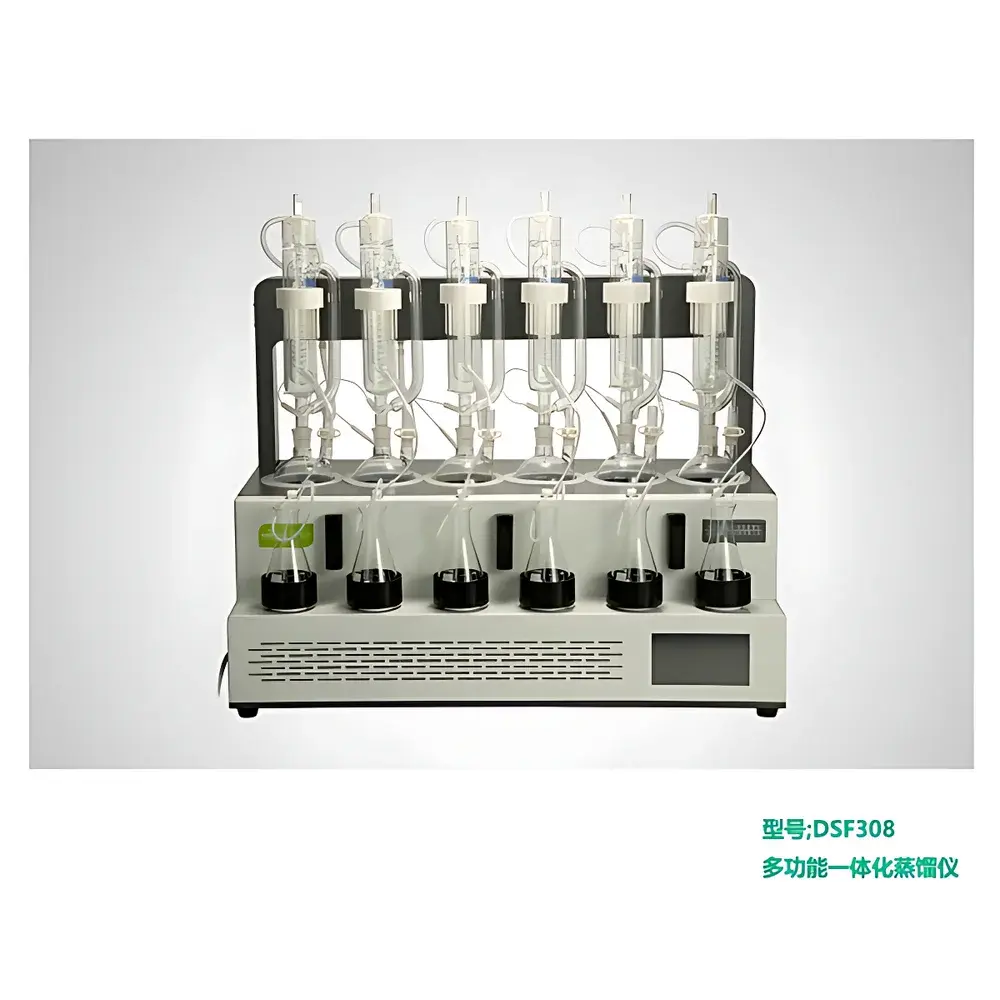
SENTE DSF308 Multi-Function Integrated Distillation System
| Brand | SENTE |
|---|---|
| Origin | Shandong, China |
| Manufacturer Type | Original Equipment Manufacturer (OEM) |
| Country of Manufacture | China |
| Model | DSF308 |
| Price Range | USD 2,800 – 7,000 (FOB Qingdao) |
Overview
The SENTE DSF308 Multi-Function Integrated Distillation System is an automated, modular laboratory distillation platform engineered for precision, safety, and regulatory compliance in environmental, food, agricultural, and industrial quality control laboratories. It implements classical wet-chemistry distillation principles—based on controlled thermal volatilization under atmospheric or reduced pressure—optimized for standardized methods including ISO 6439 (cyanide), ISO 6438 (phenols), ISO 5667-16 (ammonia nitrogen), EPA 410.4 (COD distillation pretreatment), AOAC 972.25 (SO₂), and USP (residual solvents). Unlike conventional open-bath or mantle-based setups, the DSF308 integrates microprocessor-controlled heating, vacuum-assisted condensation, real-time liquid-level sensing, and programmable endpoint detection into a single benchtop unit—eliminating manual intervention while maintaining full traceability and method fidelity.
Key Features
- Independent six-channel distillation architecture: Each channel operates with fully isolated temperature control, timing logic, and volume monitoring—enabling parallel processing of heterogeneous sample matrices without cross-contamination.
- Far-infrared ceramic heating modules: Molded, corrosion-resistant emitters with uniform thermal distribution (±1.5 °C stability across 30–300 °C range); certified to EU RoHS and CE directives for electromagnetic compatibility and electrical safety (EN 61326-1).
- Dual-stage vacuum-enhanced condensation system: Patented coaxial spiral condenser design with recirculating chiller interface (compatible with 5–25 °C coolant supply); achieves >92% condensate recovery efficiency even at high-volatility compound distillations (e.g., formaldehyde, ethanol, SO₂).
- Programmable distillate volume control: Precise volumetric endpoint detection via optical liquid-level sensors; user-defined setpoints from 1 mL to 500 mL per channel with ±0.5 mL repeatability (n=6, CV <1.2%).
- Integrated safety protocols: Anti-suckback valve actuation, boil-over suppression via dynamic power modulation, automatic power cutoff upon completion or anomaly detection (dry-run, overflow, sensor fault), and sealed vapor path routing compliant with OSHA 1910.1200 hazard communication standards.
Sample Compatibility & Compliance
The DSF308 supports aqueous, semi-solid (slurries, digested soils), and organic-aqueous mixtures typical in EPA Method 9060A (volatile phenols), ISO 11908 (cation exchange capacity), and GB/T 5009.48 (alcohol content in beverages). All wetted surfaces contacting distillates are constructed from borosilicate glass (DIN ISO 3585) and PTFE-sealed joints, ensuring inertness for acidic, alkaline, or oxidizing distillation media (pH 0–14, ≤80 °C condensate temp). The system meets GLP documentation requirements through built-in audit trail logging (user ID, timestamp, parameter changes, alarm events) and supports 21 CFR Part 11-compliant electronic signatures when paired with validated LIMS integration.
Software & Data Management
Control is executed via an embedded 7-inch capacitive touchscreen running SENTE DistillOS v3.2 firmware—supporting multi-language UI (English, Spanish, French, Chinese), method library storage (≥200 preloaded ASTM/ISO/GB templates), and export of CSV/Excel-compatible raw data logs (temperature ramp profiles, condensate volume vs. time, power consumption per channel). Optional Ethernet/Wi-Fi connectivity enables remote monitoring, centralized fleet management, and automated report generation aligned with ISO/IEC 17025 Clause 7.7 (result reporting). All calibration records, maintenance logs, and validation protocols (IQ/OQ/PQ) are stored locally with SHA-256 hash integrity verification.
Applications
The DSF308 delivers reproducible performance across regulated analytical workflows: ammonia nitrogen determination in wastewater (ISO 5667-16); cyanide speciation in electroplating effluents (ISO 6439); volatile phenol quantification in surface water (EPA 8041B); formaldehyde release testing in textiles (ISO 14184-1); alcohol content analysis in fermented beverages (OIV-MA-AS313-01); and sulfur dioxide recovery in fruit juice processing (AOAC 990.28). Its modular design accommodates custom adapter kits for non-standard receivers (e.g., gas-tight vials, impingers, cryo-traps), extending utility into air monitoring and VOC preconcentration applications.
FAQ
Does the DSF308 comply with ISO/IEC 17025 method validation requirements?
Yes—the system includes documented uncertainty budgets for volume delivery, temperature accuracy, and timing resolution, supporting full analytical method validation per ISO/IEC 17025:2017 Clause 7.2.2.
Can it be integrated into a LIMS environment?
Yes—via HL7 or ASTM E1384-compliant API interface; full bidirectional data exchange (sample ID assignment, result upload, instrument status polling) is supported.
What maintenance is required for the vacuum condenser system?
Annual inspection of vacuum pump oil and condenser gasket integrity is recommended; no routine cleaning of internal tubing is needed due to the automated rinse cycle feature.
Is third-party calibration certification available?
Yes—NIST-traceable calibration certificates (temperature, volume, timing) are provided upon request, with optional on-site verification by accredited metrology providers.
How is operator training delivered?
Remote instructor-led sessions (4 hours), bilingual SOP templates, and video-based troubleshooting guides are included with purchase; on-site training is available as an add-on service.



