
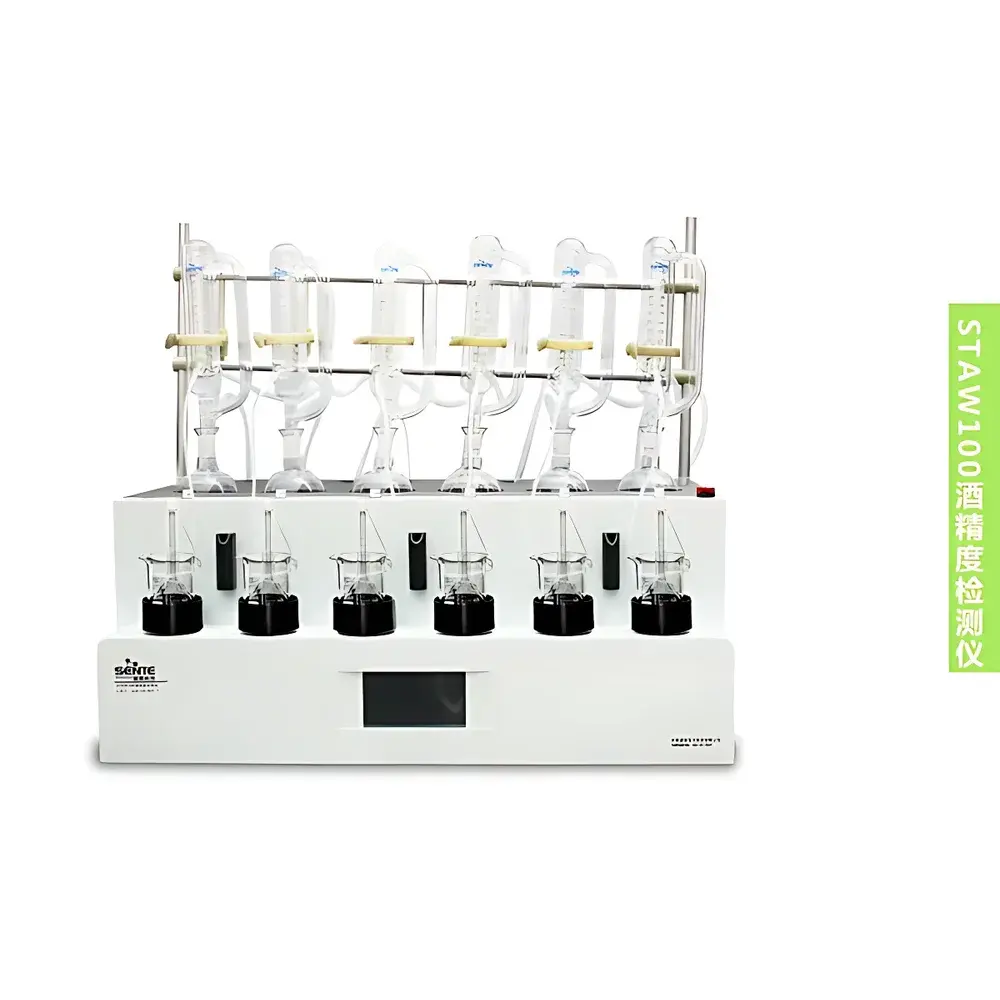
SENTE STAW100 Intelligent Alcohol Distillation Analyzer for Ethanol Content Determination per GB 5009.225-2016
| Brand | SENTE |
|---|---|
| Origin | Shandong, China |
| Manufacturer Type | Direct Manufacturer |
| Country of Origin | China |
| Model | STAW100 |
| Instrument Category | Beer-Specific Analyzer |
| Application | Laboratory Use |
| Distillation Time | 40 min |
| Ethanol Concentration Range | 0–65% v/v |
| pH of Condensate (Reference) | 7 |
| Dimensions (L×W×H) | 960 × 575 × 410 mm |
| Weight | 60 kg |
Overview
The SENTE STAW100 Intelligent Alcohol Distillation Analyzer is a purpose-built laboratory instrument engineered to perform precise and fully compliant ethanol concentration determination in alcoholic beverages—specifically designed to meet the procedural and performance requirements of the Chinese National Standard GB 5009.225–2016, “Determination of Ethanol Concentration in Alcoholic Beverages.” Unlike general-purpose distillation units, the STAW100 implements a closed-loop, thermally optimized distillation architecture grounded in classical volumetric distillation principles: ethanol is selectively volatilized from aqueous matrixes under controlled heating, condensed with high thermal efficiency, and collected quantitatively for subsequent density-based or hydrometric analysis. Its operational design prioritizes repeatability, operator safety, and analytical traceability—critical attributes for QC laboratories in breweries, distilleries, beverage R&D centers, and third-party food testing facilities operating under ISO/IEC 17025 or GB/T 27025 accreditation frameworks.
Key Features
- Integrated far-infrared ceramic heating modules (6 × 400 W) — patented by SENTE — delivering uniform, flameless thermal input with exceptional thermal stability and minimal thermal inertia; eliminates hot-spot formation and ensures consistent vaporization kinetics across sample batches.
- Self-contained compressor-based cooling system (imported unit) maintaining condenser jacket temperature ≤15 °C continuously; enables rapid, complete condensation of low-boiling ethanol vapors without carryover or loss.
- Dual-mode heating control: programmable transition between gentle micro-boiling (for initial volatile release) and full reflux boiling (for quantitative recovery), activated via touchscreen interface.
- Intelligent endpoint detection algorithm — monitors real-time condensate flow rate, temperature gradient at receiver interface, and time-integrated volume accumulation to terminate distillation automatically at the validated endpoint, preventing over-distillation and minimizing residual matrix interference.
- Vacuum-insulated dual-layer condenser assemblies — custom-engineered snake-shaped glass condensers with evacuated interstitial gap — suppress back-suction, eliminate bumping and frothing, and ensure laminar vapor flow path integrity.
- Auto-locking distillate receivers with integrated ice-bath stabilization (pre-chilled to 0–4 °C) — maintains collected fractions at standardized temperature prior to transfer, reducing ethanol volatility loss during handling.
- Comprehensive dry-run and overfill protection: real-time level sensing in both heating flasks and receivers triggers immediate power cutoff and audible alert, complying with IEC 61010-1 safety requirements for laboratory electrical equipment.
Sample Compatibility & Compliance
The STAW100 is validated for use with beer, wine, spirits, fermented malt beverages, and non-carbonated fruit-based alcoholic solutions within the 0–65% v/v ethanol range. It accommodates standard 500 mL round-bottom flasks and delivers distillates directly into calibrated 100 mL volumetric receivers—fully compatible with downstream analysis methods including pycnometry (GB 5009.225–2016 Annex A), digital densitometry (ASTM D4052), or refractometric correlation (AOAC 920.137). All wetted components are borosilicate 3.3 glass (DIN ISO 3585), chemically inert to ethanol–water mixtures and organic acids typical in fermented matrices. The system supports GLP-compliant documentation through timestamped operational logs and user-accessible calibration history—aligning with internal audit readiness for HACCP, FSSC 22000, and BRCGS Food Safety Issue 9 requirements.
Software & Data Management
The embedded 7-inch capacitive touchscreen runs a deterministic real-time OS with dedicated distillation workflow firmware. Each run generates a structured metadata record including date/time stamp, operator ID (via optional PIN login), setpoint parameters (heating mode, target duration, cooling setpoint), actual runtime, endpoint confirmation signal, and system fault flags. Data export is supported via USB 2.0 port in CSV format for integration with LIMS or Excel-based QA reporting. While not FDA 21 CFR Part 11–certified out-of-the-box, the firmware architecture includes audit-trail-enabling hooks (e.g., immutable event logging, user action timestamps) suitable for validation protocols under GMP-aligned environments upon site-specific qualification.
Applications
- Regulatory alcohol labeling verification for domestic and export markets requiring GB, GB/T, or joint-standard compliance.
- In-process QC in large-scale breweries: rapid batch verification pre-packaging to ensure consistency against declared ABV.
- Method validation studies comparing distillation-based ethanol quantification against GC-FID or enzymatic assays (e.g., AOAC 995.13).
- Research applications involving ethanol recovery optimization in novel fermentation substrates (e.g., rice wine, fruit mash, agave distillates).
- Training platforms in food science curricula—demonstrating fundamental distillation theory, thermal management, and standard method execution.
FAQ
Does the STAW100 comply with international standards beyond GB 5009.225–2016?
Yes—it adheres to core physical principles referenced in ISO 3696 (water purity for analysis), ISO 11097 (alcohol determination in wines), and ASTM D4052 (density measurement of ethanol solutions), enabling cross-method correlation where permitted by local regulatory authorities.
Can the system be used for non-alcoholic samples such as vinegar or soft drinks?
It is not recommended for high-acid or highly volatile non-ethanol matrices (e.g., acetic acid >4%) due to potential condenser corrosion and altered boiling behavior; its validation scope is strictly limited to alcoholic beverages per GB 5009.225–2016.
What maintenance intervals are required for the compressor cooling system?
The sealed refrigeration circuit requires no routine refrigerant servicing; annual inspection of condenser coil cleanliness and fan operation is advised per manufacturer guidelines.
Is third-party calibration support available?
SENTE provides factory calibration certificates traceable to CNAS-accredited reference standards; on-site calibration services are available through authorized regional partners in Asia-Pacific and select EU distributors.
How is method reproducibility verified during routine use?
Operators are instructed to run certified reference materials (e.g., NIST SRM 3108 ethanol/water solutions) biweekly; system performance is assessed via %RSD of recovered ethanol concentration across ≥6 replicates, with acceptance criteria ≤1.5% RSD at mid-range (20–40% v/v).






