
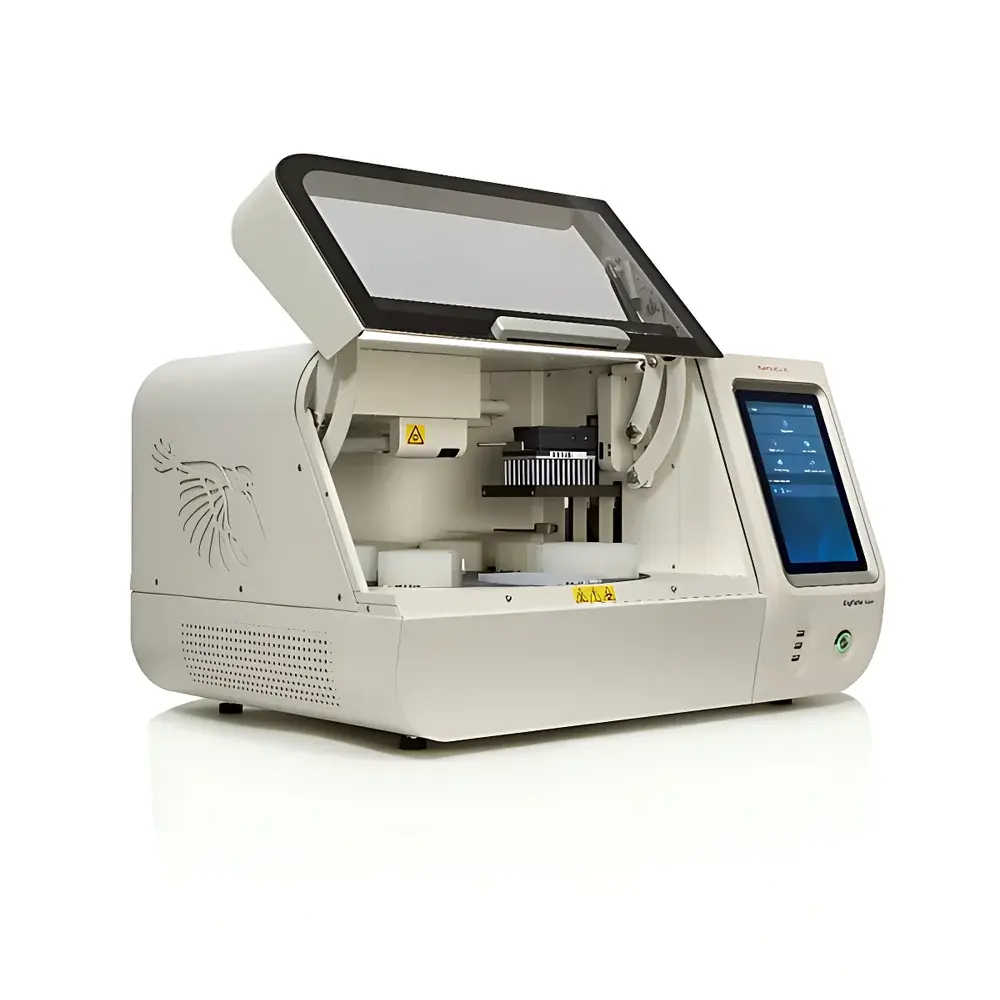
Thermo Scientific KingFisher Apex Automated Magnetic Particle Processor
| Brand | Thermo Scientific |
|---|---|
| Origin | Singapore |
| Model | KingFisher Apex |
| Instrument Type | Magnetic Bead-Based Purification System |
| Automation Level | Dedicated Fully Automatic |
| Throughput | 24 or 96 samples per run |
| Sample Volume Range | 10–5000 µL per well |
| Processing Time per Run | 15–65 minutes |
Overview
The Thermo Scientific KingFisher Apex is a fully automated, high-precision magnetic particle processor engineered for reproducible isolation of nucleic acids (DNA/RNA), proteins, and cells using magnetic bead-based chemistry. Unlike liquid-handling platforms that rely on pipetting, the KingFisher Apex employs a proprietary magnetic rod transfer technology—where magnetized rods directly capture, transport, and release functionalized magnetic beads within sample wells. This solid-phase approach eliminates centrifugation, vacuum aspiration, and inter-well liquid transfer, thereby minimizing aerosol generation, cross-contamination risk, and operator variability. Built upon the proven architecture of the KingFisher Flex platform, the Apex introduces enhanced thermal control (down to 4 °C), dual-magnet head automation, barcode-tracked consumables, and cloud-integrated workflow management—making it suitable for regulated environments requiring audit-ready documentation and traceability.
Key Features
- Patented Magnetic Rod Transfer Technology: Uses monolithic, end-magnetized permanent magnets with zero seam construction to concentrate beads exclusively at the rod tip—ensuring precise, non-dripping bead movement and eliminating carryover between wells.
- Dual Smart Magnet Head System: Automatically selects and installs either the 96-well deep-well, 96-well combi, 96-well PCR, or 24-well combi magnet head based on protocol requirements; supports hot-swappable backup heads for uninterrupted operation.
- Ultra-Low Elution Volume Capability: Optimized magnet head geometry enables elution volumes as low as 10 µL directly into barcoded storage tubes—maximizing analyte concentration and enabling seamless integration with downstream applications such as qPCR or NGS library prep.
- 4 °C Temperature-Controlled Incubation: Integrated Peltier-based cooling across all eight plate positions allows temperature-sensitive protocols—including immunoprecipitation and cell lysis—to be performed under chilled conditions, preserving integrity of labile biomolecules.
- Comprehensive UV Decontamination: Dual short-wave UV-C lamps provide full-chamber irradiation (254 nm) with programmable exposure up to 23 h 59 min, validated to reduce surface bioburden and safeguard operator safety.
- Barcode-Enabled Consumables Management: Built-in scanner reads 2D barcodes on Thermo Scientific-certified plates and tubes, enforcing correct plate loading, supporting lot-level traceability, and feeding data into electronic lab notebook (ELN) or LIMS systems.
Sample Compatibility & Compliance
The KingFisher Apex operates as an open-platform system compatible with a broad spectrum of commercially available magnetic beads—including Thermo Scientific Dynabeads, MagMax, Pierce, and SMART Digest reagents—as well as third-party and domestic bead formulations. It accommodates standard microplate formats (96-deep well, 96-shallow well, 96-PCR, 24-deep well), cryovials, and custom tube racks. The instrument meets mechanical and electrical safety standards per IEC 61010-1 and is designed to support compliance with Good Laboratory Practice (GLP) and Good Manufacturing Practice (GMP) frameworks. Its software architecture supports 21 CFR Part 11-compliant audit trails when connected to validated network environments, and its hardware design minimizes aerosol dispersion—aligning with ISO 22174:2017 (nucleic acid extraction validation) and CLSI EP25-A guidelines for contamination control in molecular diagnostics.
Software & Data Management
The KingFisher Apex features a 10-inch capacitive touchscreen interface running embedded Linux OS with intuitive drag-and-drop protocol builder. Users can create, edit, duplicate, and archive methods locally or via secure Wi-Fi/LAN connection to Thermo Fisher’s CloudLink platform. All method parameters—including magnetic field timing, agitation speed, incubation temperature, UV cycle duration, and barcode validation rules—are stored with timestamps and user IDs. Data export options include CSV, PDF, and XML formats compliant with LIMS ingestion schemas. USB ports enable direct transfer to external drives; RS-232 serial interface supports handshake communication with robotic arms and peripheral devices for fully integrated walk-away workflows.
Applications
- High-throughput genomic DNA and total RNA isolation from blood, saliva, tissue homogenates, and FFPE samples
- Plasmid purification and CRISPR guide RNA cleanup
- Protein A/G-based immunoprecipitation and affinity purification under cold conditions
- Cell isolation (e.g., CTC enrichment, PBMC separation) using antibody-conjugated beads
- Viral RNA extraction for diagnostic RT-qPCR and sequencing workflows
- Microbiome sample preparation with bead-beating compatibility (when used with appropriate lysis kits)
- Automated library normalization and size selection in NGS library prep pipelines
FAQ
Does the KingFisher Apex require dedicated Thermo Scientific reagents?
No—the system is an open platform and supports magnetic beads from multiple vendors, provided they meet standard size (0.5–5 µm) and surface chemistry specifications.
Can the instrument be integrated into a robotic workstation?
Yes—it includes RS-232 and Ethernet interfaces for bidirectional communication with Hamilton, Tecan, or other liquid handlers, and is compatible with track-based automation systems via mechanical arm docking protocols.
Is remote monitoring and troubleshooting supported?
Yes—via CloudLink connectivity, users can monitor real-time run status, receive email alerts upon completion or error, and share protocols securely across global sites.
What is the maximum allowable viscosity for sample lysates?
The system is validated for lysates with viscosities up to 100 cP when using recommended lysis buffers; higher-viscosity samples may require dilution or pre-filtration to ensure consistent bead capture efficiency.
How does the 4 °C incubation function impact protein stability during IP workflows?
Independent validation studies demonstrate ≥35% higher target recovery and reduced proteolytic degradation compared to ambient-temperature processing—particularly critical for phosphoprotein and transcription factor isolation.
Related Products




