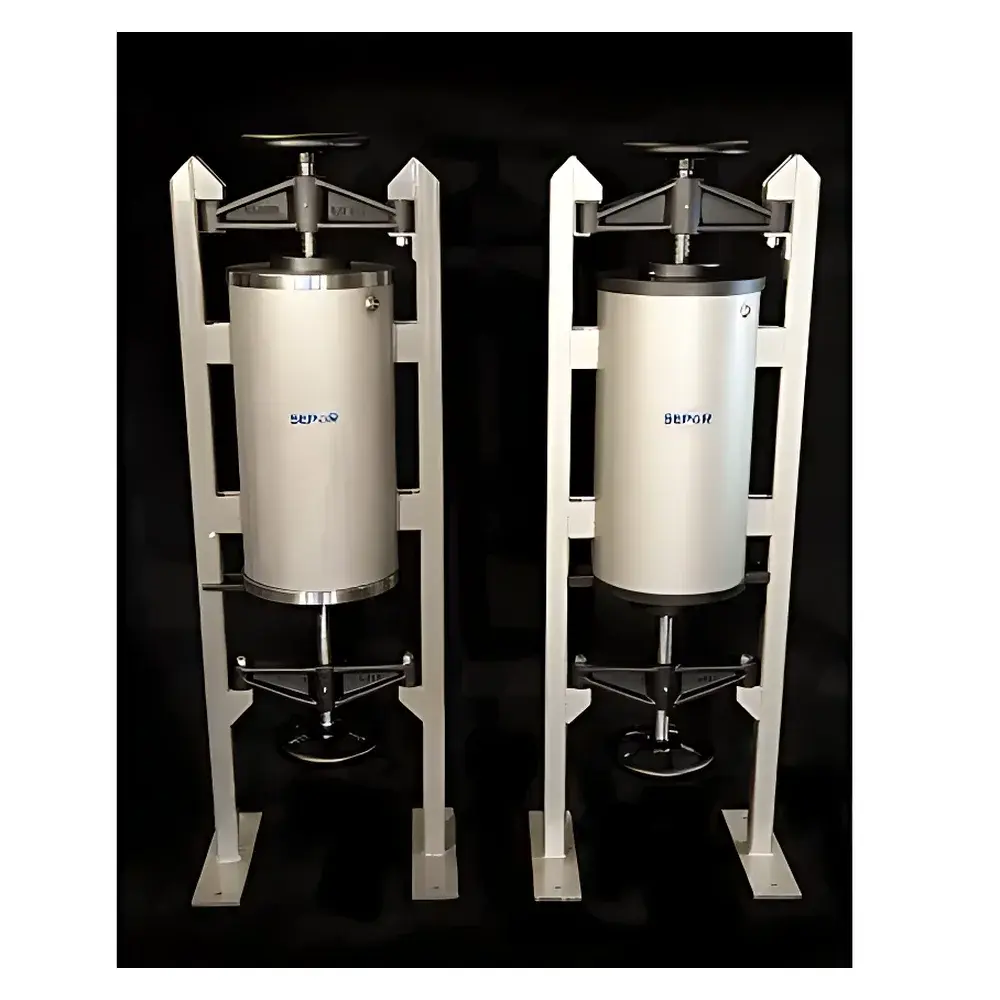
Sepor 11.5 Gallon Floor-Mounted Batch Pressure Filter
| Origin | USA |
|---|---|
| Manufacturer Type | Authorized Distributor |
| Origin Category | Imported |
| Model | 11.5 Gallon Floor Mounted Batch Pressure Filter |
| Pricing | Available Upon Request |
Overview
The Sepor 11.5 Gallon Floor-Mounted Batch Pressure Filter is an engineered solution for laboratory- and pilot-scale solid–liquid separation under controlled pressure conditions. Designed for batch-mode operation, this filtration system operates on the principle of positive-pressure-driven flow through a fixed filter medium—typically filter cloth or high-wet-strength filter paper—mounted on a perforated baseplate. It functions within a maximum working pressure of 75 PSI (5.2 bar), enabling rapid dewatering of slurries with varying solids content, particle size distribution, and rheological behavior. Unlike continuous vacuum or centrifugal systems, this unit delivers reproducible cake formation and consistent filtrate clarity across discrete batches, making it suitable for process development, material characterization, and quality control in mineral processing, chemical synthesis, pharmaceutical intermediate isolation, and environmental sample preparation.
Key Features
- Robust floor-mounted structural design with dual-material options: carbon steel (ASTM A36) or 304 stainless steel—selected based on chemical compatibility and corrosion resistance requirements.
- Spiral-jack actuated lid mechanism enables precise, tool-free opening and closing; integrated swing-arm pivot allows full 180° lid rotation for unobstructed access during slurry loading, cake inspection, or media replacement.
- Identical spiral-jack actuation applied to the perforated baseplate, which also features a swing-out configuration for efficient cake discharge without manual scraping or disassembly.
- Integrated pressure management system includes a calibrated analog pressure gauge (0–100 PSI), spring-loaded safety relief valve (set at 75 PSI), air vent valve, and bottom-mounted drain valve—all connected via internal stainless steel tubing.
- Supplied standard accessories include one reusable filter cloth, one pack of 100 high-wet-strength filter papers (nominal pore size: 25 µm), and all necessary sealing gaskets and O-rings rated for compressed air service up to 75 PSI.
- Minimal utility requirement: only compressed air source ≥1 CFM at 60 PSI is needed—no electricity, pumps, or vacuum generators required.
Sample Compatibility & Compliance
This pressure filter accommodates slurries with suspended solids ranging from coarse sand (>100 µm) to fine precipitates (<5 µm), provided viscosity remains within practical pneumatic conveyance limits (typically <500 cP). The 25 µm nominal-rated filter papers are compliant with ASTM E128 for retention testing of particulate filters and meet USP criteria for particulate matter in non-injectable preparations when used in validated protocols. All wetted components in the stainless steel variant conform to FDA 21 CFR 178.3570 (indirect food additives—adhesives and components of coatings) and are compatible with Good Manufacturing Practice (GMP) and Good Laboratory Practice (GLP) environments. Documentation packages—including material certifications (MTRs), pressure vessel compliance statements, and calibration records for gauges—are available upon request for audit readiness.
Software & Data Management
As a manually operated mechanical system, this pressure filter does not incorporate embedded electronics, programmable logic controllers (PLCs), or digital interfaces. However, its operational repeatability supports integration into regulated workflows: pressure decay curves can be logged externally using calibrated pressure transducers and data acquisition systems (e.g., LabVIEW or MATLAB-based DAQ); filtration time, inlet pressure, and cake mass are routinely recorded in electronic lab notebooks (ELNs) compliant with 21 CFR Part 11 when paired with appropriate audit-trail-enabled software. Optional digital pressure logging kits and timed-cycle templates are available for SOP alignment and batch record generation.
Applications
- Mineral processing: bench-scale dewatering trials for flotation concentrates, leach residues, or tailings characterization.
- Chemical R&D: isolation of crystalline intermediates, catalyst recovery, and spent reagent filtration.
- Pharmaceutical development: small-batch filtration of API suspensions prior to lyophilization or granulation studies.
- Environmental labs: solid-phase extraction of sediments, wastewater sludges, or contaminated soil leachates.
- Academic research: teaching core principles of filtration kinetics, cake resistance modeling (based on Carman–Kozeny equation), and compressibility index determination.
FAQ
What compressed air specifications are required for reliable operation?
A minimum airflow of 1 CFM at 60 PSI is recommended; higher flow rates reduce cycle time but do not increase maximum operating pressure beyond the 75 PSI safety limit.
Can the unit be used with corrosive or organic solvents?
Yes—with the 304 stainless steel construction option and chemically resistant filter media (e.g., PTFE-coated cloth or solvent-grade cellulose papers); compatibility must be verified per specific solvent using NIST Chemical Resistance Database guidelines.
Is validation support documentation available for GMP use?
Yes—IQ/OQ protocol templates, material traceability reports, and pressure gauge calibration certificates are provided upon order confirmation for regulated applications.
How often should the filter cloth be replaced?
Reusability depends on abrasion, fouling, and cleaning method; typical service life ranges from 20–50 cycles under moderate load; visual inspection for fiber damage or pore occlusion is the primary maintenance indicator.
Are spare parts and consumables stocked globally?
Standard spares—including replacement cloths (P/N 070B-005), 25 µm filter paper packs (P/N 070B-007), and O-ring kits—are maintained in regional distribution centers across North America, Europe, and APAC.
Related Products