
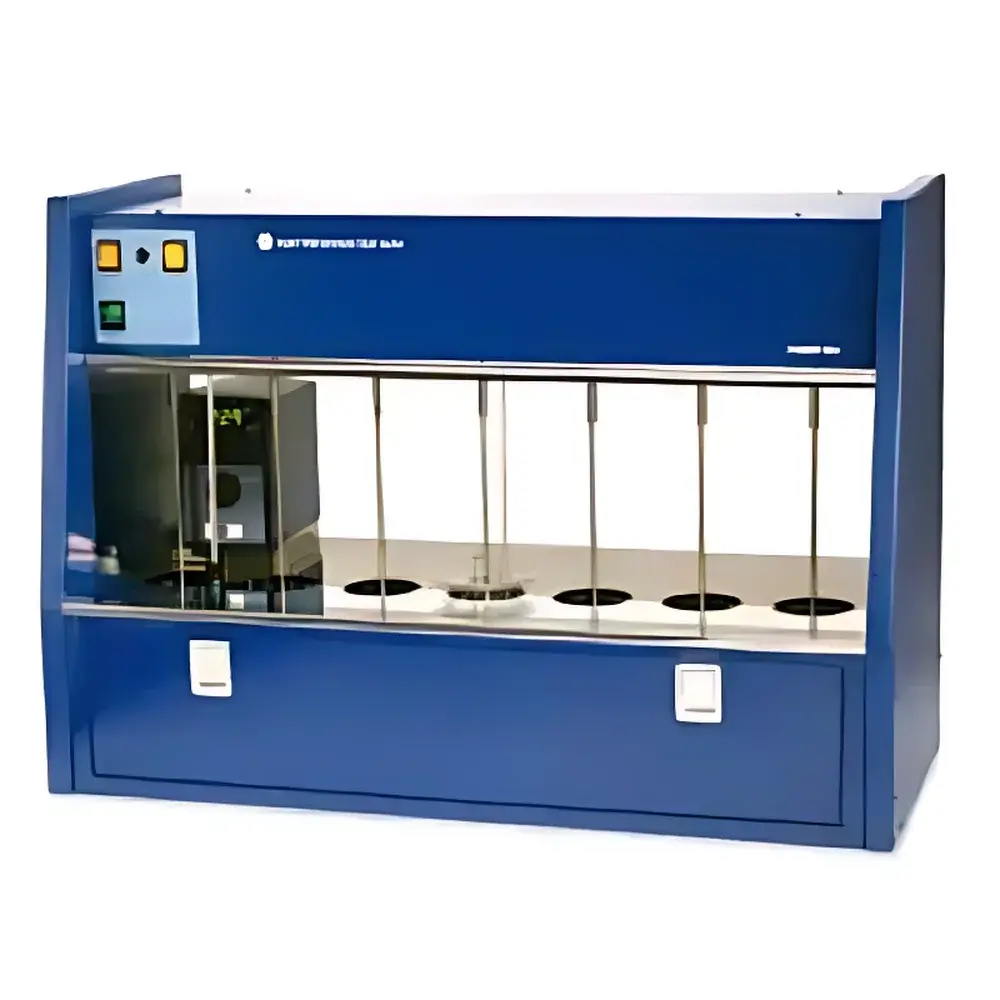
SETA Model 11200-8 Liquid Phase Rust Corrosion Tester
| Brand | SETA |
|---|---|
| Origin | United Kingdom |
| Model | 11200-8 |
| Bath Volume | 31 L |
| Temperature Range | Ambient to 120 °C |
| Temperature Stability | ±0.1 °C |
| Stirring Speed | 1000 ±50 rpm |
| Test Positions | 7 |
| Voltage | 110–120 V / 220–240 V, 50/60 Hz |
| Power Consumption | 1.5 kW |
| Dimensions (W×D×H) | 63 × 85 × 38 cm |
| Weight | 52 kg |
Overview
The SETA Model 11200-8 Liquid Phase Rust Corrosion Tester is a precision-engineered benchtop instrument designed to evaluate the rust-inhibiting performance of petroleum-based lubricants and hydraulic fluids under standardized immersion conditions. It operates on the principle of controlled immersion corrosion testing, wherein steel test specimens are fully submerged in a heated, aerated oil–water emulsion while subjected to continuous mechanical agitation. This simulates real-world service environments where water contamination and thermal stress synergistically accelerate ferrous metal oxidation. The system complies with a comprehensive suite of international test methods—including ASTM D665 (Method A and B), ISO 7120, IP 135, BS 2000-135, JIS K2510, NF T60-151, and NACE TM0172-2001—ensuring data traceability for regulatory submissions, quality control audits, and formulation benchmarking in refinery, additive development, and OEM lubricant qualification laboratories.
Key Features
- Seven independent test positions enable parallel evaluation of multiple samples or replicate runs per batch, improving throughput without compromising inter-test consistency.
- Digital PID temperature controller with auxiliary heating and dual-stage overtemperature protection ensures stable thermal regulation within ±0.1 °C across the full operating range (ambient to 120 °C), critical for method compliance and reproducible corrosion kinetics.
- High-torque, brushless DC motor drives seven synchronized stirring rods at 1000 ±50 rpm, generating uniform shear and interfacial turbulence between oil and synthetic seawater or distilled water phases—essential for consistent rust initiation and propagation profiles.
- Quick-release magnetic coupling mechanism allows tool-free removal and reinstallation of individual stirrers, minimizing downtime during specimen loading/unloading and facilitating routine cleaning or calibration verification.
- Robust stainless-steel bath construction (31 L capacity) resists chemical degradation from aggressive test media, including chloride-containing synthetic seawater formulations used in ASTM D665 Method B and NACE TM0172.
- Universal power input (110–120 V / 220–240 V, 50/60 Hz) enables global deployment without hardware modification; integrated 1.5 kW heating system achieves rapid thermal equilibration and maintains setpoint stability under variable ambient loads.
Sample Compatibility & Compliance
The SETA 11200-8 accommodates standard ASTM D665-compliant polished steel test strips (typically 76 mm × 12.7 mm × 1.5 mm), as well as alternative geometries specified in ISO 7120 and JIS K2510. It supports both fresh-water and synthetic seawater (3.5 wt% NaCl) emulsions, with optional humidity-controlled air sparging available via external gas manifolds. All operational parameters—including temperature ramp rate, dwell time, agitation onset delay, and total test duration—are configurable to align with method-specific requirements. The instrument’s design meets mechanical and electrical safety standards per IEC 61010-1 and carries CE marking for conformity with EU Machinery Directive 2006/42/EC. Data generated are suitable for inclusion in GLP-compliant study reports and satisfy documentation requirements for ISO/IEC 17025-accredited testing laboratories.
Software & Data Management
While the base configuration features standalone analog/digital controls, optional RS-232 or USB interface modules support integration with laboratory information management systems (LIMS) and electronic lab notebooks (ELN). Real-time temperature and stirrer status logs can be exported in CSV format for post-test statistical analysis (e.g., ANOVA of rust rating distributions across replicates). When paired with validated software packages compliant with FDA 21 CFR Part 11, the system supports audit-trail generation, user access controls, and electronic signature workflows—enabling full data integrity alignment with pharmaceutical-grade lubricant validation protocols and API RP 500/505 hazardous area documentation frameworks.
Applications
- Quality assurance of turbine oils, hydraulic fluids, and gear oils for rust inhibition efficacy prior to field deployment.
- Accelerated screening of corrosion inhibitor additives during lubricant formulation R&D.
- Comparative assessment of base oil oxidative stability under aqueous contamination scenarios.
- Supporting failure analysis investigations where rust-related bearing or servo-valve degradation is suspected.
- Contract testing services requiring auditable adherence to ASTM, ISO, or NACE corrosion methodology specifications.
FAQ
What test standards does the SETA 11200-8 directly support?
It is factory-configured and verified for ASTM D665 (Methods A and B), ISO 7120, IP 135, BS 2000-135, JIS K2510, NF T60-151, and NACE TM0172-2001.
Can the instrument operate continuously for extended durations (e.g., 24 h)?
Yes—the thermal management system and sealed motor assembly are rated for uninterrupted operation up to 96 hours, provided ambient cooling and ventilation meet manufacturer-specified clearance requirements.
Is calibration traceable to national standards?
Temperature sensors are supplied with UKAS-accredited calibration certificates (NPL-traceable); stirrer speed verification fixtures and reference thermometers are available as optional accessories.
How is rust evaluation performed post-test?
Rust assessment follows visual rating scales defined in each applicable standard (e.g., ASTM D665 uses a 0–5 scale based on rust spot density and coverage); digital imaging tools and automated rust quantification software may be integrated externally.
Does the unit include test specimens and emulsion preparation guidelines?
Standard delivery includes mounting hardware and operator manual with step-by-step procedures for preparing synthetic seawater, conditioning steel strips, and verifying bath cleanliness—but test specimens and reagents are supplied separately per laboratory SOPs.




