
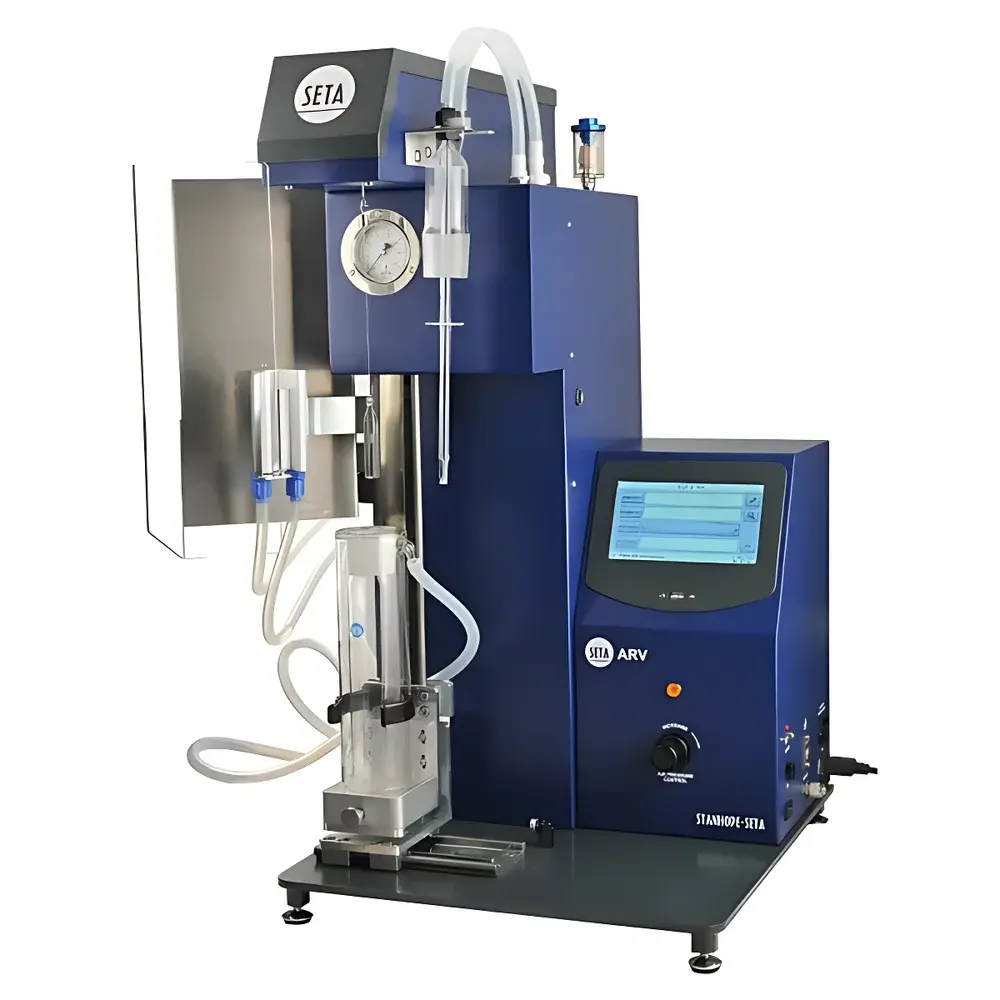
SETA Model 15840-0 Automatic Air Release Value Tester
| Brand | SETA |
|---|---|
| Origin | United Kingdom |
| Model | 15840-0 |
| Standards Compliance | ASTM D3427, IP 313, BS 2000-313, ISO 9120, DIN 51381, NFT 60-149, SH/T 0308 |
| Temperature Range | Ambient to 75 °C |
| Temperature Stability | ±0.2 °C |
| Touchscreen Interface | 7-inch LCD with Embedded Control Software |
| LIMS Connectivity | Yes |
Overview
The SETA Model 15840-0 Automatic Air Release Value Tester is an engineered solution for quantifying the time required for entrained air to separate from petroleum-based lubricants and industrial oils under controlled thermal and atmospheric conditions. It operates on the principle of real-time density monitoring via a precision buoyancy-based measurement system—where a calibrated density hammer immersed in the test fluid undergoes measurable buoyant force changes as air bubbles evolve and escape. This method directly correlates density drift with volumetric air content reduction, enabling objective, operator-independent endpoint detection per internationally recognized test standards including ASTM D3427, ISO 9120, and IP 313. Designed for routine quality control laboratories in refining, additive manufacturing, and OEM lubricant formulation facilities, the instrument eliminates manual observation bias and timing inconsistencies inherent in traditional stopwatch-based protocols.
Key Features
- Integrated electro-mechanical architecture: Combines thermostatically controlled heating, pressure-regulated sample chamber, microprocessor-based control logic, and high-resolution density sensing into a single compact footprint.
- Slide-rail sample tube positioning system: Enables rapid, repeatable alignment of multiple test tubes without mechanical recalibration—reducing setup variability and improving inter-test reproducibility.
- Embedded 7-inch capacitive touchscreen interface: Hosts proprietary firmware for method configuration, real-time density trend visualization, automatic endpoint recognition, and result export—no external PC or driver installation required.
- Onboard density hammer thermostatic chamber: Maintains the density hammer at precise equilibrium temperature prior to immersion, eliminating pre-conditioning delays associated with oven-based stabilization.
- Dual-stage vapor management: Includes a high-efficiency activated carbon filter integrated into the exhaust path to capture volatile hydrocarbon vapors generated during elevated-temperature testing, ensuring laboratory air quality compliance and operator safety.
- LIMS-ready digital output: Supports ASTM E1384-compliant data formatting and bidirectional communication via Ethernet or RS-232, facilitating audit-trail generation and electronic record retention aligned with FDA 21 CFR Part 11 requirements.
Sample Compatibility & Compliance
The instrument accommodates standard 100 mL glass test tubes (ASTM D3427-compliant dimensions) and is validated for use with mineral oils, synthetic esters, polyalphaolefins (PAOs), and formulated hydraulic and turbine oils. All operational parameters—including ramp rate, soak duration, pressure setpoint (ambient or regulated), and density threshold criteria—are programmable within defined limits specified by each referenced standard. The system’s thermal uniformity profile across the bath volume meets ISO/IEC 17025 calibration traceability requirements when verified using NIST-traceable PRT probes. Full documentation packages—including IQ/OQ protocols, certificate of conformance, and factory calibration records—are supplied with each unit to support GLP and GMP laboratory validation processes.
Software & Data Management
Firmware version 3.2+ provides role-based user access control (administrator, analyst, reviewer), configurable audit trails capturing all parameter modifications and result approvals, and timestamped raw density vs. time datasets stored in CSV and XML formats. Data integrity safeguards include write-protected storage partitions, automatic backup to USB media, and optional encrypted network transmission. Exported reports include full metadata: operator ID, environmental ambient conditions (if connected to optional external sensors), method revision level, instrument serial number, and deviation flags for out-of-specification runs. The software architecture supports periodic firmware updates via secure HTTPS channel, maintaining long-term regulatory alignment without hardware modification.
Applications
- Quality assurance of turbine oils in power generation facilities, where delayed air release correlates with foam stability issues and potential cavitation damage in bearing housings.
- Formulation screening of anti-foam additives (e.g., silicone polymers, acrylate copolymers) during R&D development cycles.
- Batch release testing for aviation lubricants subject to DEF STAN 91-94 and SAE AS5780 specifications.
- Root-cause analysis of field-reported oil aeration in hydraulic systems operating under high-shear conditions.
- Third-party certification testing for ISO 8573-1 Class 0 compressed air system lubricants.
FAQ
What standards does the SETA 15840-0 fully support out-of-the-box?
ASTM D3427, IP 313, BS 2000-313, ISO 9120, DIN 51381, NFT 60-149, and SH/T 0308 — all implemented with preloaded method templates and pass/fail logic.
Is external calibration equipment required for daily operation?
No. The integrated density hammer and thermal bath are factory-calibrated against NIST-traceable references; only periodic verification using certified reference oils (e.g., ISO VG 32 and VG 100 standards) is recommended per ISO/IEC 17025 internal quality procedures.
Can test methods be modified to accommodate non-standard protocols?
Yes. Advanced users may define custom temperature ramps, density thresholds, and hold times via the administrator-level firmware interface while retaining full audit trail logging.
How is data integrity ensured during power interruption?
The system employs non-volatile memory for active run data and automatically resumes measurement from last valid timestamp upon reboot, with no loss of intermediate density samples.
Does the unit meet electromagnetic compatibility requirements for installation in analytical labs?
Yes. Certified to IEC 61326-1:2013 for emission and immunity, including resistance to RF fields up to 10 V/m and electrostatic discharge per IEC 61000-4-2 Level 3.





