
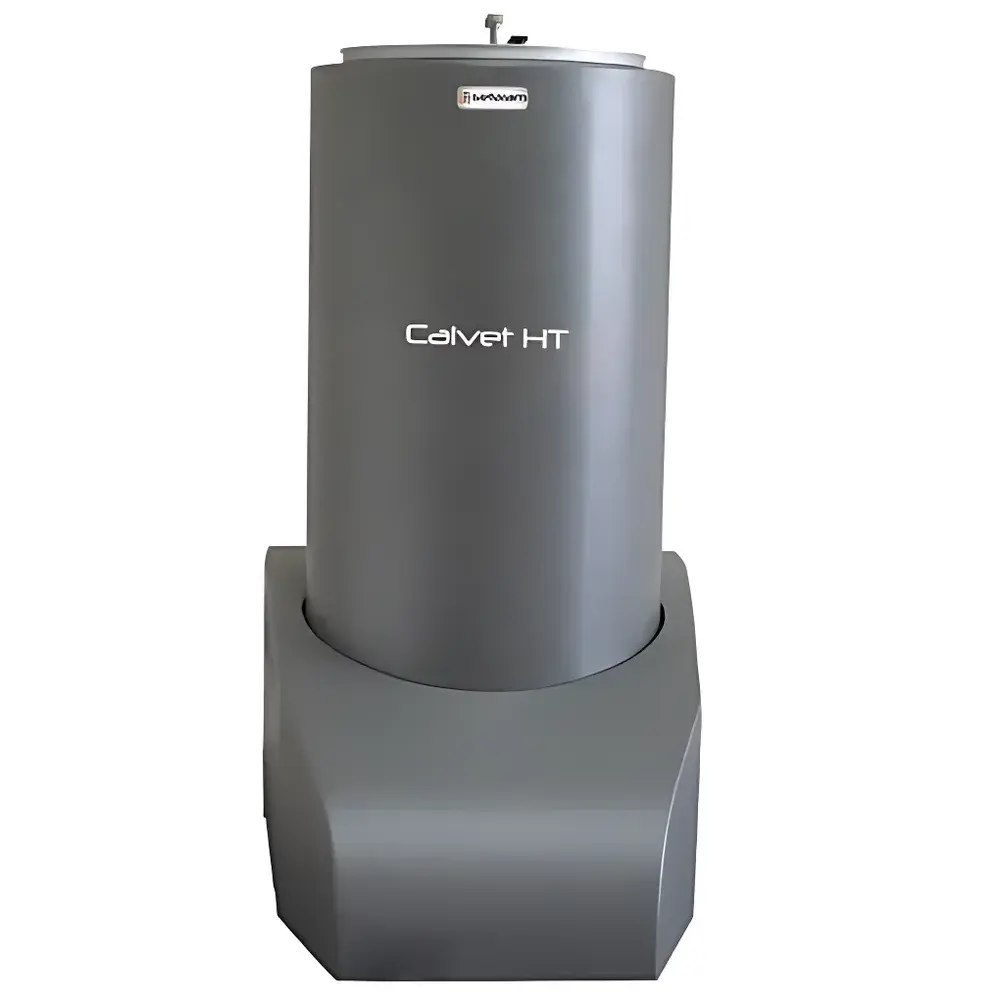
SETARAM Calvet HT/600°C High-Performance Calorimeter
| Brand | SETARAM |
|---|---|
| Origin | France |
| Model | Calvet HT (formerly C600) |
| Instrument Type | Reaction Calorimeter |
| Measurement Mode | 3D Calvet Calorimetry |
| Temperature Range | Ambient to 600 °C |
| Temperature Resolution | 0.5 μW (heat flow resolution) |
| Pressure Capability | Up to 400 bar |
| Sample Configuration | Dual-zone 3D thermopile sensor array |
| Compliance | Designed for GLP/GMP environments, compatible with ASTM E698, ISO 11357-4, and USP <1031> thermal stability protocols |
Overview
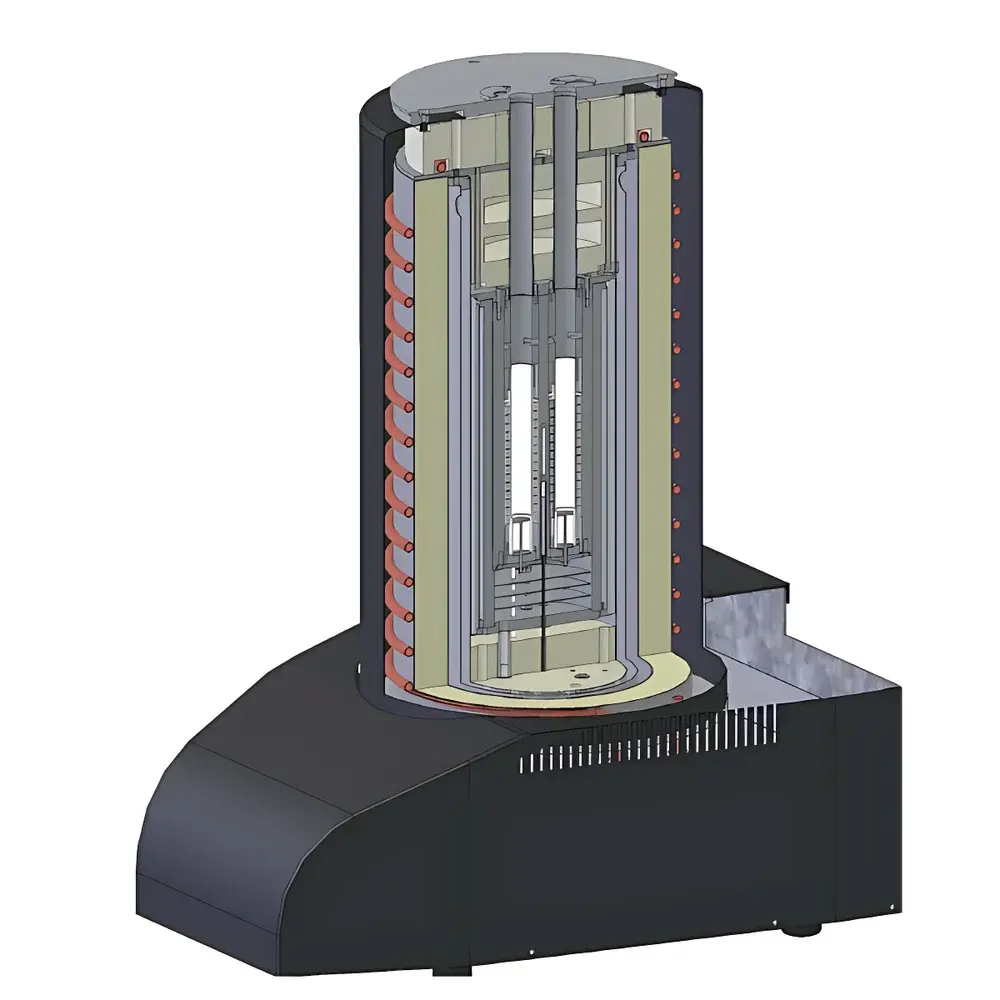
The SETARAM Calvet HT is a high-temperature reaction calorimeter engineered for quantitative, absolute heat flow measurement under demanding thermochemical conditions — from ambient to 600 °C. Unlike conventional differential scanning calorimeters (DSC), the Calvet HT employs true 3D Calvet calorimetry: two concentric cylindrical thermopile stacks — each comprising 144 precision-calibrated thermocouples — fully surround both sample and reference zones. This symmetrical, omnidirectional sensor architecture captures radial, axial, and tangential heat fluxes simultaneously, minimizing parasitic losses and enabling near-zero baseline drift. The system operates on the principle of heat conduction rather than temperature difference, delivering intrinsic accuracy in absolute enthalpy determination without reliance on calibration standards for every run. Its robust mechanical design supports extended operation at elevated temperatures and pressures, making it uniquely suited for kinetic modeling of exothermic decomposition, catalytic reaction screening, and safety-critical thermal hazard assessment in energetic materials, battery electrolytes, and process-scale chemical synthesis.
Key Features
- True 3D Calvet sensor geometry with dual 144-junction thermopile arrays for isotropic heat flux detection
- Continuous operating temperature range from ambient to 600 °C with active furnace control and external water-cooled jacketing
- Integrated pressure module supporting isobaric experiments up to 400 bar, with real-time pressure monitoring and feedback-controlled regulation
- Modular sample cell platform: standard hermetic cylindrical cells, stirred/reactive cells, gas-permeable membranes, and vacuum-compatible configurations
- Simultaneous isothermal and dynamic (scanning) operation modes — enabling direct simulation of industrial process profiles including hold-ramp-hold sequences
- Corrosion-resistant construction using Inconel 600, Hastelloy C-276, and fluoropolymer seals for aggressive media (e.g., HF, Cl₂, SO₂, molten salts)
Sample Compatibility & Compliance
The Calvet HT accommodates diverse sample forms — solids, powders, slurries, viscous liquids, and pressurized gases — within user-replaceable, application-specific cells. Standard cells support masses up to 10 g; custom high-mass configurations enable gram-scale process-representative testing. All cells are validated for leak integrity per ISO 15848-2 and certified for use in ATEX Zone 1 environments when equipped with optional explosion-proof enclosures. Data acquisition and instrument control comply with FDA 21 CFR Part 11 requirements via audit-trail-enabled software, supporting full traceability for GLP and GMP-regulated studies. Thermal data interpretation aligns with ASTM E698 (kinetic analysis of decomposition), ISO 11357-4 (reaction enthalpy), and ICH Q1A(R2) stability testing guidelines.
Software & Data Management
Thermal Explorer™ software provides integrated control of temperature, pressure, stirring rate, and gas flow (when coupled to mass flow controllers). It delivers real-time heat flow, cumulative enthalpy, and derived kinetic parameters (Eₐ, ln A) using model-free (e.g., Ozawa-Flynn-Wall) and model-fitting algorithms. Raw data files (.tdf) are stored in vendor-neutral HDF5 format with embedded metadata (user ID, timestamp, calibration history, environmental logs). Export options include CSV, Excel, and ASCII for third-party modeling tools (e.g., MATLAB, ChemCAD, Aspen Plus). Electronic signatures, role-based access control, and automated backup to network drives ensure regulatory readiness.
Applications
- Safety evaluation of energetic compounds (propellants, explosives, pyrotechnics) per UN Test Series 3 and EU CLP Annex I
- Thermal stability and decomposition kinetics of Li-ion battery cathode/anode materials and electrolyte formulations
- Catalyst deactivation studies under realistic reactor conditions (T, P, gas atmosphere)
- Hydration/dehydration thermodynamics of pharmaceutical hydrates and excipients
- Heat of reaction quantification for scale-up of nitration, hydrogenation, and polymerization processes
- Calibration transfer between lab-scale calorimetry and RC1-type reaction calorimeters
FAQ
What distinguishes Calvet HT from conventional DSC instruments?
Calvet HT measures absolute heat flow via 3D conduction calorimetry, not relative temperature differentials. It requires no baseline subtraction or reference standard recalibration for enthalpy quantification.
Can the Calvet HT perform simultaneous TGA-like mass loss monitoring?
No — it is a pure calorimeter. For coupled thermal–mass analysis, SETARAM recommends integration with a TGA (e.g., Setsys Evolution) via synchronized triggering and shared atmosphere control.
Is remote operation supported for unattended overnight runs?
Yes — Thermal Explorer™ supports secure SSH and VPN-based remote desktop access with full instrument control and real-time data streaming.
How is temperature uniformity maintained across the 600 °C measurement zone?
A three-zone resistive furnace with independent PID loops, combined with active water-jacket cooling of the outer calorimeter body, ensures ±0.5 °C axial homogeneity over a 50 mm sample height.
Are custom cell designs available for proprietary reaction systems?
Yes — SETARAM’s Application Engineering team collaborates on bespoke cell development, including multi-inlet gas manifolds, optical windows for in situ spectroscopy, and electromagnetic stirring mechanisms.



