
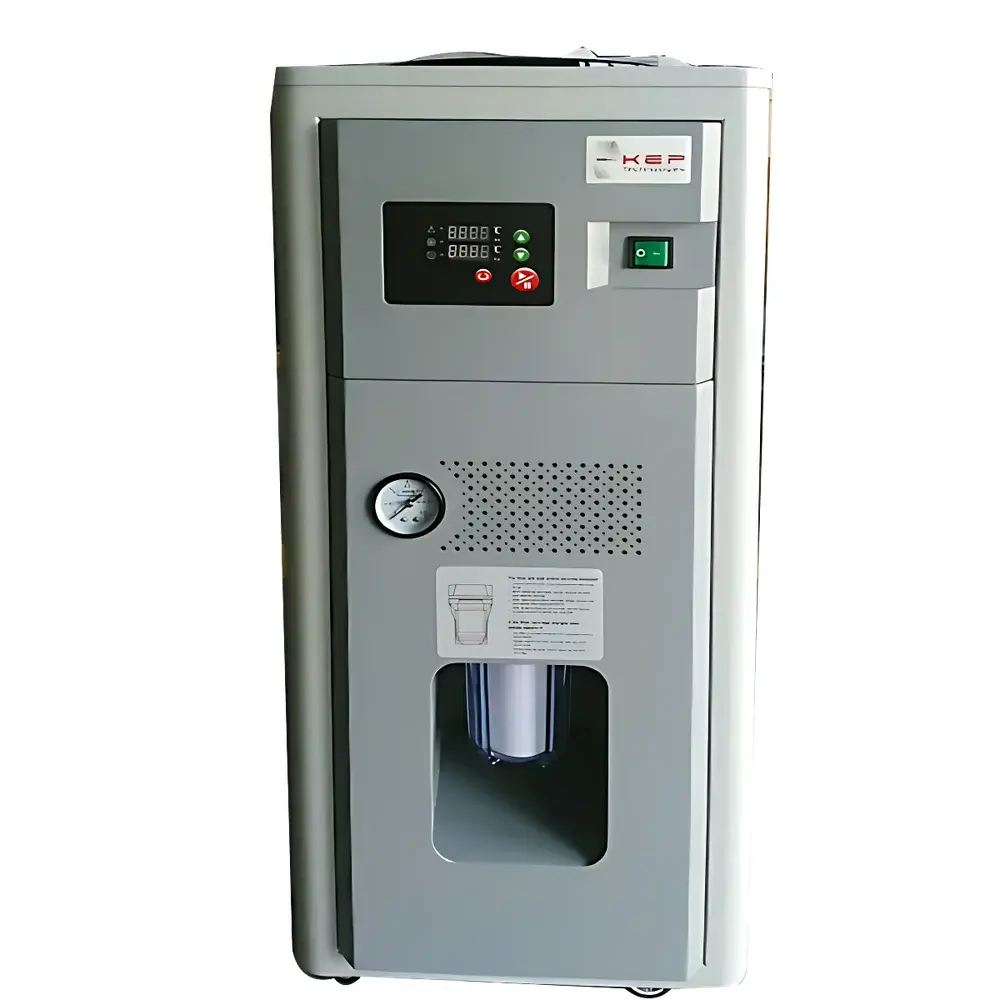
SETARAM H2 Cryogenic Circulating Water Bath
| Brand | SETARAM |
|---|---|
| Origin | France |
| Model | H2 Circulating Water Bath |
| Nominal Cooling Capacity | 1600 W |
| Temperature Control Range | 5–35 °C |
| Temperature Stability | ±0.1 °C |
| Pump Head (Max/Rated) | 28/21 m |
| Flow Rate (Max/Rated) | 60/33 L/min |
| Stainless Steel Reservoir Volume | 16 L |
| Power Supply | 220 V / 50 Hz |
| Dimensions (W×D×H) | 360 × 550 × 860 mm |
| Interface Options | RS232/RS485 Serial Communication, WP7/WP12 Parallel I/O for On/Off & Alarm Relay Outputs |
| Construction | Full Stainless Steel Reservoir & Pump, Centrifugal Low-Noise Pump, Hermetic Refrigeration Compressor, Thermal Bypass PID Control Architecture |
Overview
The SETARAM H2 Cryogenic Circulating Water Bath is an engineered thermal management system designed for precision temperature stabilization of sensitive analytical and optical instruments in regulated laboratory environments. Operating on a closed-loop refrigeration cycle with thermal gas bypass PID control, the H2 delivers high-fidelity heat exchange across its 5–35 °C operating range, maintaining ±0.1 °C stability under dynamic load conditions. Its architecture integrates a hermetic scroll compressor, low-noise centrifugal circulation pump, and full stainless steel wetted path—including reservoir, piping, and impeller—to ensure long-term corrosion resistance and microbiological inertness. Unlike open-bath or immersion-style units, the H2 employs forced convection through a dedicated external loop, enabling consistent thermal coupling to peripheral devices such as spectrometers, NMR consoles, laser cavities, and vacuum pumps—without direct fluid contact with the instrument’s internal cooling jackets.
Key Features
- Thermal gas bypass PID control algorithm ensures rapid response to thermal load transients while minimizing overshoot and drift.
- Full stainless steel reservoir (16 L capacity) with integrated 5-inch polypropylene melt-blown filter for continuous particulate removal and extended fluid service life.
- Low-noise centrifugal pump delivering up to 60 L/min at 28 m head, optimized for pressure-sensitive applications including capillary electrophoresis and microfluidic platforms.
- RS232 and RS485 serial interfaces compliant with Modbus RTU protocol, supporting remote monitoring, setpoint adjustment, and alarm status polling via LabVIEW, Python, or SCADA systems.
- WP7/WP12 parallel I/O module provides dry-contact relay outputs for equipment interlock, enabling fail-safe shutdown of connected instruments upon flow loss, overtemperature, or low-level detection.
- Ergonomic front-panel interface with backlit LCD and tactile keypad supports intuitive local operation, real-time parameter display, and multi-level password protection for GLP-compliant access control.
Sample Compatibility & Compliance
The H2 is validated for continuous operation with deionized water, 30% ethylene glycol/water mixtures, and other non-corrosive heat transfer fluids compatible with stainless steel and fluoropolymer seals. Its design meets mechanical safety requirements per IEC 61010-1 and electromagnetic compatibility standards per EN 61326-1. While not certified for medical device use, the unit supports GxP-aligned workflows through configurable audit trail logging (when integrated with compatible supervisory software), electronic signature capability, and 21 CFR Part 11–compliant data export formats (CSV, XML). It is routinely deployed in laboratories adhering to ISO/IEC 17025, ASTM E2915, and USP guidelines for analytical instrument qualification.
Software & Data Management
The H2 does not include embedded graphical software but provides full command-line instruction sets for both serial and parallel communication protocols. Standard ASCII-based commands enable bi-directional interrogation of operational parameters—including actual temperature, setpoint, pump speed, compressor status, and alarm history—and support programmable event-triggered actions (e.g., relay activation upon deviation >±0.3 °C for 10 s). When interfaced with third-party lab automation platforms (e.g., Thermo Fisher SampleManager, LabVantage), the H2 contributes timestamped telemetry to centralized asset monitoring dashboards. All communication logs are exportable in UTF-8 encoded text files for traceability and QA review.
Applications
- Analytical instrumentation: Cooled sample introduction systems for ICP-OES and ICP-MS; condenser jacketing for Kjeldahl digestors and distillation assemblies; temperature stabilization of AAS flame atomizers and FTIR interferometer optics.
- High-resolution microscopy: Active cooling of SEM stage controllers and cryo-transfer systems to suppress thermal drift during long-duration imaging sessions.
- Laser systems: Thermal management of CO₂ laser power supplies and RF-excited slab lasers where ambient fluctuations >±0.5 °C induce beam pointing instability.
- Vacuum infrastructure: Heat rejection from turbomolecular pump controllers and diffusion pump foreline chillers to maintain optimal backing pressure and rotor bearing longevity.
- Process validation rigs: Integration into PAT (Process Analytical Technology) frameworks for real-time thermal profiling of small-scale rotary evaporators (<2 L) and jacketed reaction vessels.
FAQ
What is the maximum allowable working pressure of the H2’s circulation loop?
The system is rated for continuous operation at ≤3 bar (gauge) static pressure; higher pressures require external pressure regulation and are not supported by factory calibration.
Can the H2 operate continuously at 5 °C ambient temperature?
Yes—the refrigeration circuit maintains specified performance down to 5 °C ambient; however, sustained operation below 15 °C ambient may reduce compressor efficiency and requires confirmation of dew point management in unconditioned spaces.
Is the stainless steel reservoir passivated per ASTM A967?
Yes—reservoirs undergo nitric acid passivation and water-break-free testing prior to shipment, with certificate of conformance available upon request.
Does the H2 support dual-temperature zone control?
No—the unit regulates a single thermal loop; independent dual-zone operation requires integration of two H2 units or use of a custom manifold with flow-splitting valves and secondary PID controllers.
What maintenance intervals are recommended for the PP cotton filter?
Filter replacement is advised every 6 months under continuous operation with DI water; frequency increases proportionally with total dissolved solids (TDS) >5 ppm or glycol-based fluid usage.



