
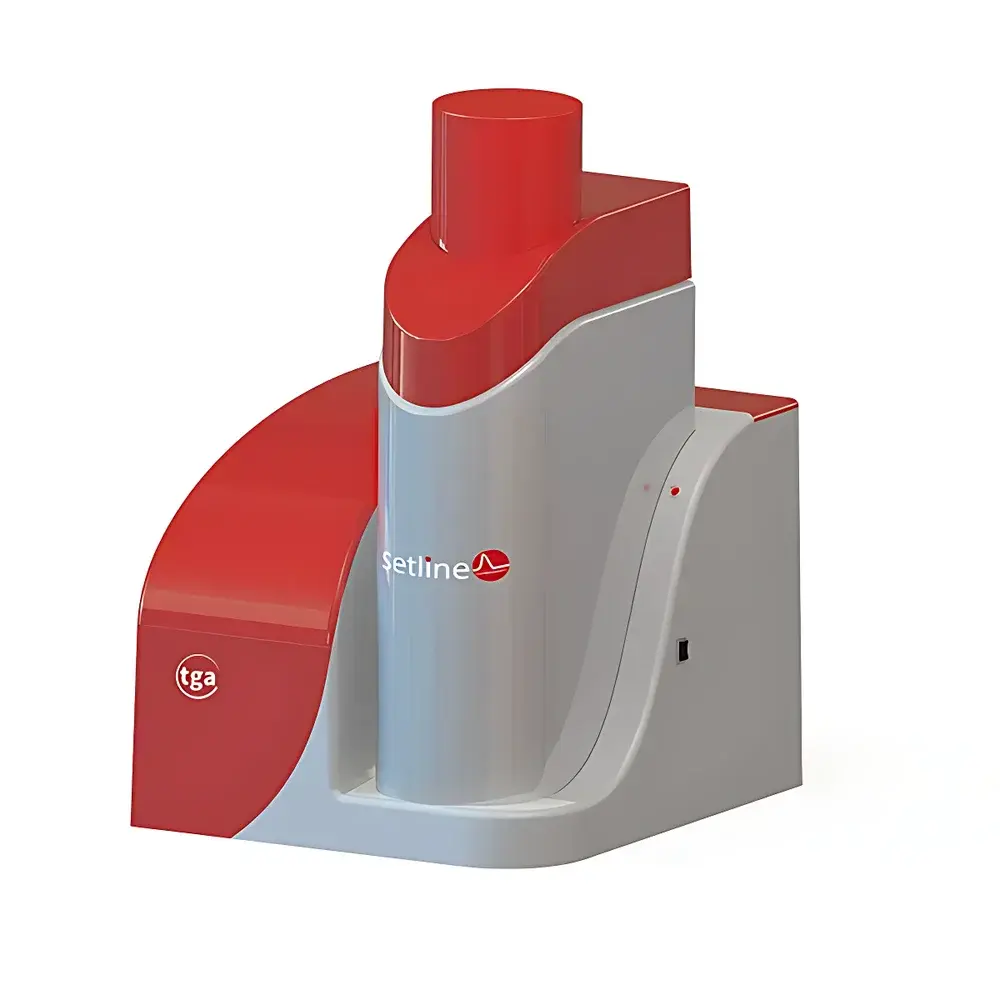
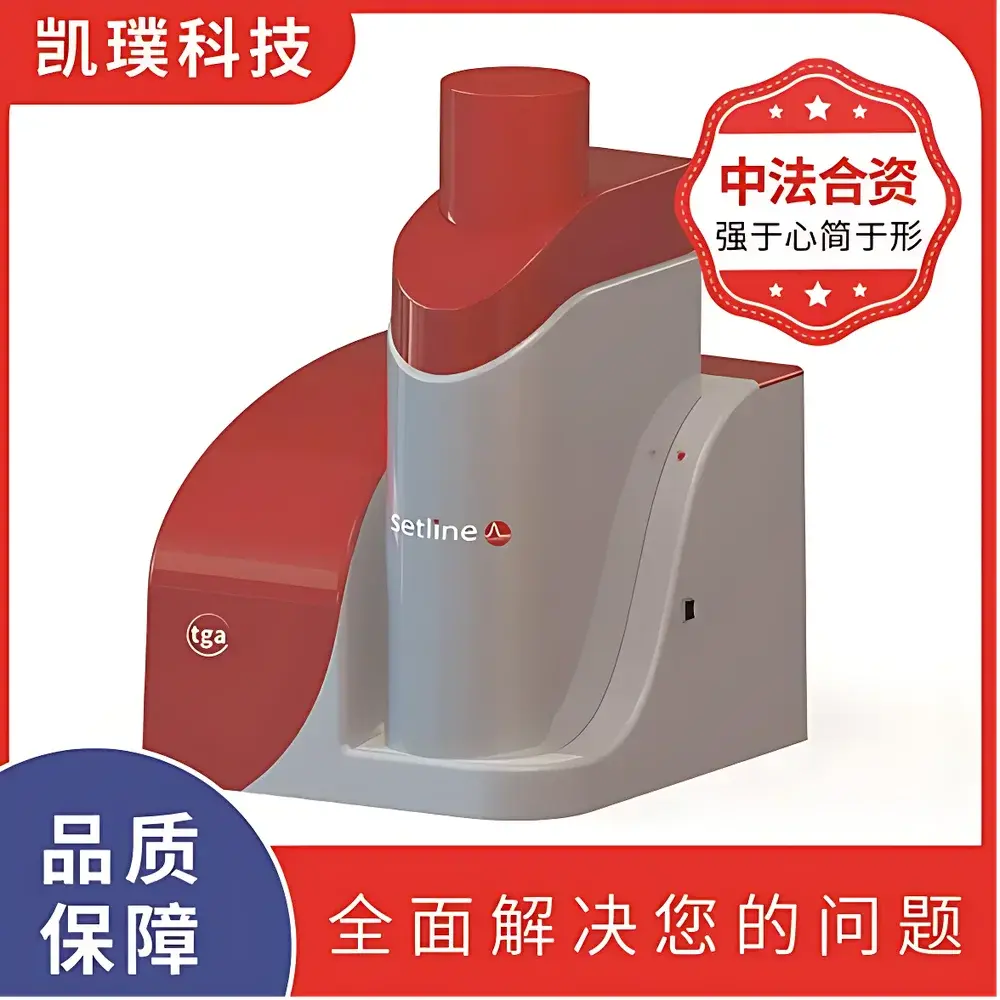
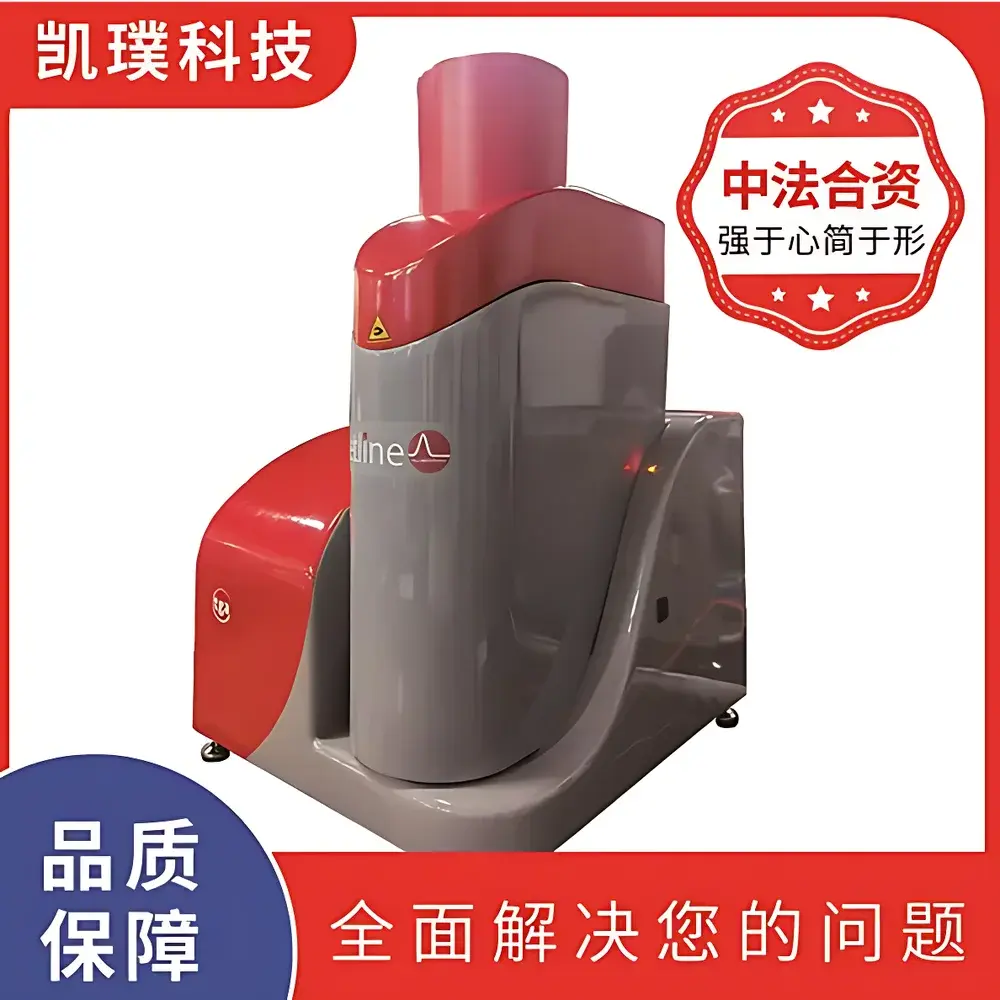
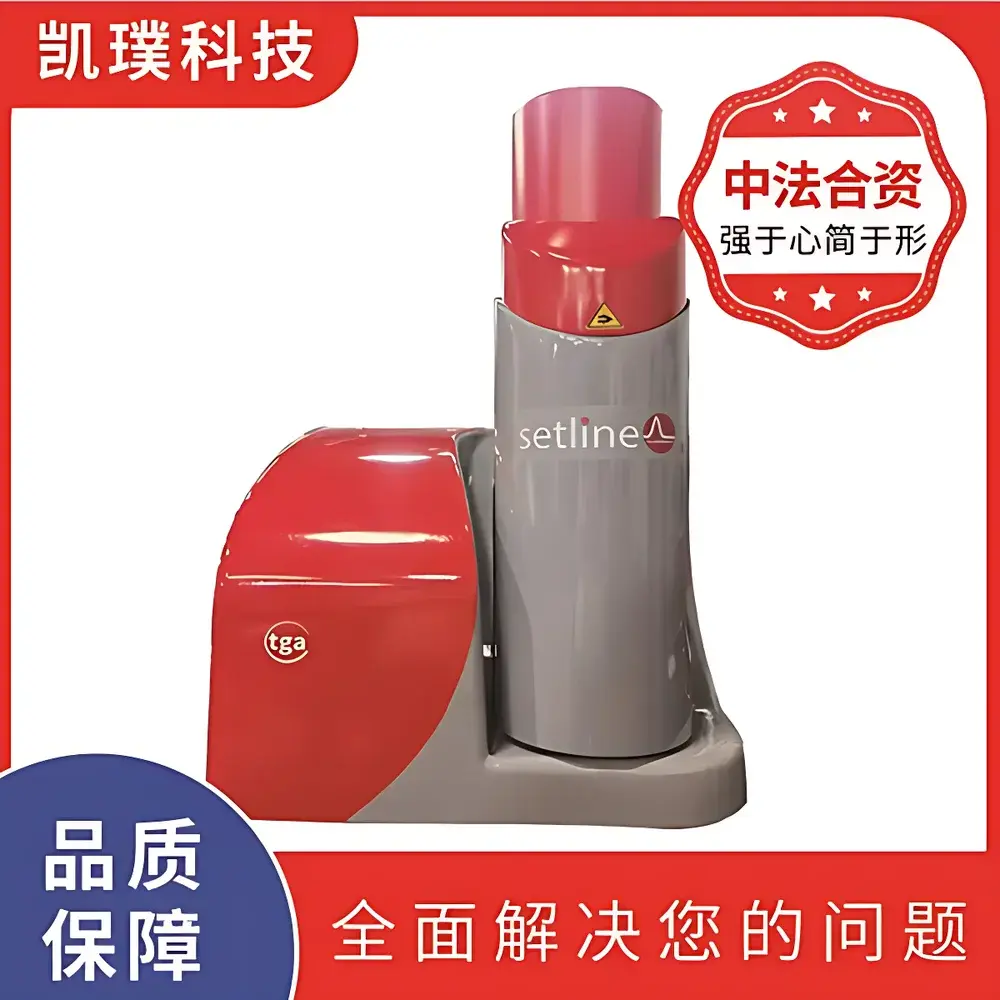
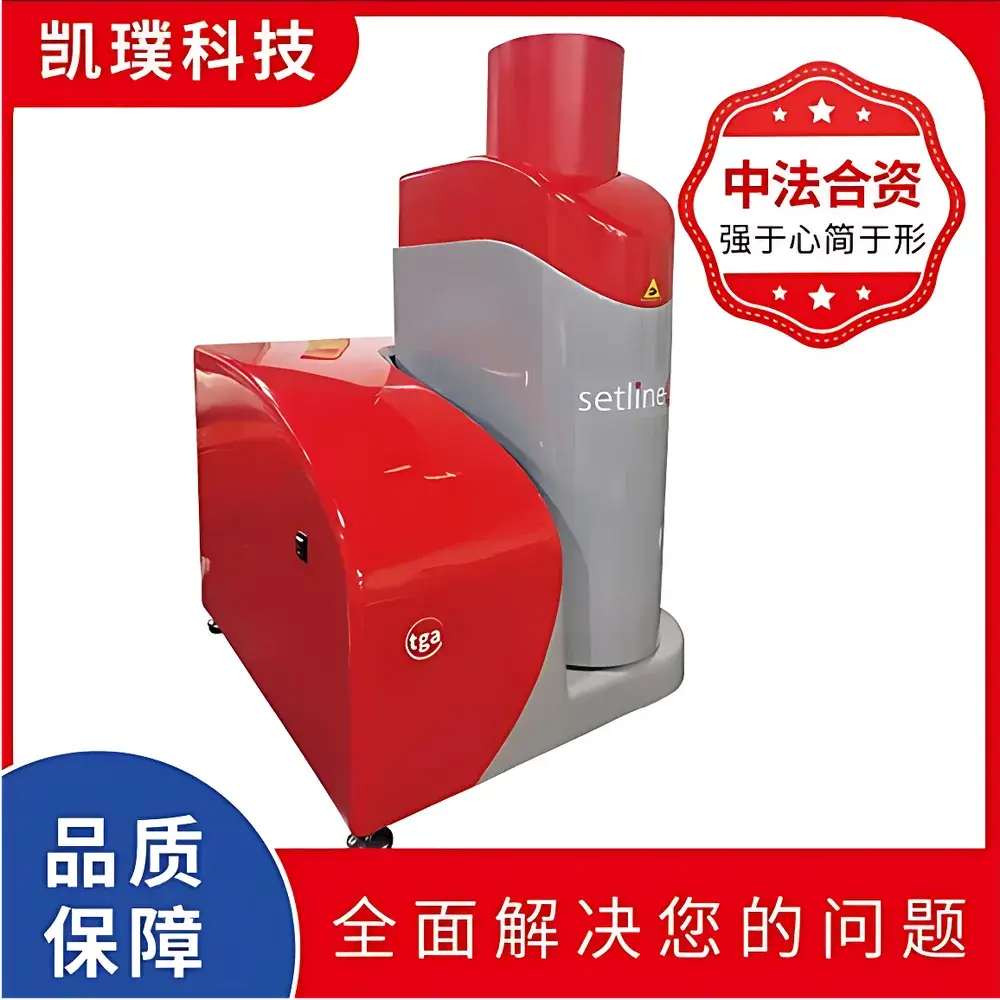
SETARAM Setline TGA Thermogravimetric Analyzer
| Brand | SETARAM |
|---|---|
| Origin | Beijing, China (Manufactured under France-China joint development) |
| Model | Setline TGA |
| Temperature Range | Ambient to 1100 °C |
| Temperature Accuracy | ±0.3 K |
| Temperature Precision | ±0.1 °C |
| Heating/Cooling Rate | 0.01–50 K/min |
| Dynamic Mass Range | ±20 mg / ±200 mg |
| Balance Sensitivity | 0.0023 µg |
| Mass Accuracy | 0.01% |
| Mass Precision | 0.005% |
| Maximum Sample Mass | 0.3 g |
| Baseline Drift | 25 µg |
| Baseline Repeatability | ±5 µg |
| Atmosphere Options | Inert (N₂, Ar, He) or Oxidizing (air, O₂) |
| Gas Flow Rate | 10–100 mL/min |
| Crucible Materials | Al, Al₂O₃, Pt, Quartz (130–250 µL volume) |
| Cooling | Integrated water-cooled furnace |
| Software | CALISTO 2.0 Thermal Analysis Suite |
| Power Supply | 230 V, 50/60 Hz |
| Dimensions (H×W×D) | 650(850)×400×500 mm |
Overview
The SETARAM Setline TGA is a high-precision thermogravimetric analyzer engineered for rigorous academic research, industrial R&D, and quality control laboratories. It operates on the fundamental principle of thermogravimetry—measuring mass change as a function of temperature or time under controlled atmospheric conditions. Designed through collaborative R&D between French engineering expertise (SETARAM, part of KEP Technologies Group) and localized manufacturing in Beijing, the Setline TGA integrates an optimized top-hanging microbalance architecture with a robust, water-cooled furnace system. This configuration minimizes buoyancy-induced signal drift across wide thermal ranges—critical for quantitative analysis of decomposition kinetics, compositional quantification, and thermal stability assessment. Its ambient-to-1100 °C operational envelope, sub-microgram mass resolution, and programmable heating/cooling rates (0.01–50 K/min) support reproducible measurements compliant with ASTM E1131, ISO 11358, and USP <41> guidelines for thermal analysis. The instrument is fully compatible with evolved gas analysis (EGA) coupling—enabling seamless integration with FTIR, MS, or GC/MS systems for real-time identification of volatiles.
Key Features
- Top-hanging microbalance design with 0.0023 µg sensitivity, engineered to suppress thermal buoyancy artifacts and ensure baseline stability (drift ≤25 µg, repeatability ±5 µg)
- Water-cooled, programmable furnace delivering precise temperature control (±0.1 °C accuracy, ±0.3 K absolute accuracy) and rapid cooling without external cryogens
- Modular crucible system supporting standardized Al₂O₃, Pt, quartz, and Al crucibles (130–250 µL), validated for inert and oxidative atmospheres (N₂, Ar, air, O₂)
- Gas flow regulation (10–100 mL/min) with integrated mass flow controller for consistent purge conditions during dynamic or isothermal experiments
- Compact footprint (650×400×500 mm) and modular electronics architecture—designed for space-constrained labs while maintaining service accessibility
- Fully independent temperature calibration system using certified reference materials (e.g., Ni, Cu, Al), traceable to NIST standards
Sample Compatibility & Compliance
The Setline TGA accommodates solid, powder, and granular samples up to 0.3 g, with typical loadings ranging from 5–40 mg depending on application requirements. It is routinely deployed for polymer degradation profiling (e.g., NBR, EPDM, PTFE), pharmaceutical moisture/volatiles quantification (per USP <731>), mineralogical composition analysis (carbonate decomposition, hydroxide dehydration), and catalyst stability screening. All hardware and software modules comply with GLP/GMP documentation requirements. CALISTO 2.0 supports full 21 CFR Part 11 compliance—including electronic signatures, audit trails, user access levels, and data integrity safeguards—making it suitable for regulated environments in pharma, food safety, and advanced materials certification.
Software & Data Management
CALISTO 2.0 is a dedicated thermal analysis platform offering intuitive experiment setup, real-time data visualization, and advanced post-processing tools. Users define multi-step temperature programs (ramp, hold, modulated), configure gas switching sequences, and apply automatic baseline correction algorithms. Quantitative analysis includes derivative thermogravimetry (DTG), kinetic modeling (e.g., Ozawa-Flynn-Wall, Kissinger), stoichiometric mass loss conversion, and component quantification via chemical factor calculation. Raw data (mass vs. temperature/time) are stored in vendor-neutral ASCII format with embedded metadata (instrument ID, operator, calibration logs, atmosphere settings). The software supports direct export to Excel, Origin, and MATLAB, and integrates with LIMS via OPC UA protocols.
Applications
- Materials Science: Thermal stability ranking of elastomers, decomposition onset temperatures of fluoropolymers, filler content determination (e.g., carbon black in rubber)
- Pharmaceuticals: Residual solvent quantification, hydrate/dehydrate transition analysis, excipient compatibility screening
- Geosciences & Minerals: Stepwise decomposition of carbonates (dolomite, magnesite), clay dehydroxylation (e.g., talc), and oxide phase transformations
- Energy & Catalysis: Coke burn-off kinetics in spent catalysts, thermal oxidation behavior of battery electrode materials
- Food & Agriculture: Moisture, ash, and volatile organic content determination per AOAC 985.24 and ISO 5984
FAQ
What is the maximum recommended sample mass for optimal resolution?
For highest mass resolution and minimal thermal lag, we recommend 10–30 mg for most polymers and minerals. Up to 0.3 g may be loaded for coarse-grained or low-sensitivity applications, though resolution degrades above 100 mg.
Can the Setline TGA operate under vacuum?
No—the standard configuration supports only positive-pressure inert or oxidative gas flows (10–100 mL/min). Vacuum operation requires optional pressure-controlled manifold upgrade.
Is CALISTO 2.0 validated for regulated QC environments?
Yes. Full 21 CFR Part 11 functionality—including role-based access control, electronic signatures, and immutable audit trails—is enabled by default and documented in the IQ/OQ/PQ validation package.
How often does the microbalance require recalibration?
Factory calibration is performed pre-shipment. Routine user verification uses certified reference standards (e.g., Ni, Cu) before critical experiments. Annual recalibration by authorized SETARAM service engineers is recommended for GLP-compliant workflows.
What maintenance is required for the water-cooled furnace?
Closed-loop deionized water circulation requires biannual inspection of coolant level and conductivity. No consumables or periodic replacement parts are needed beyond standard crucible usage.



