
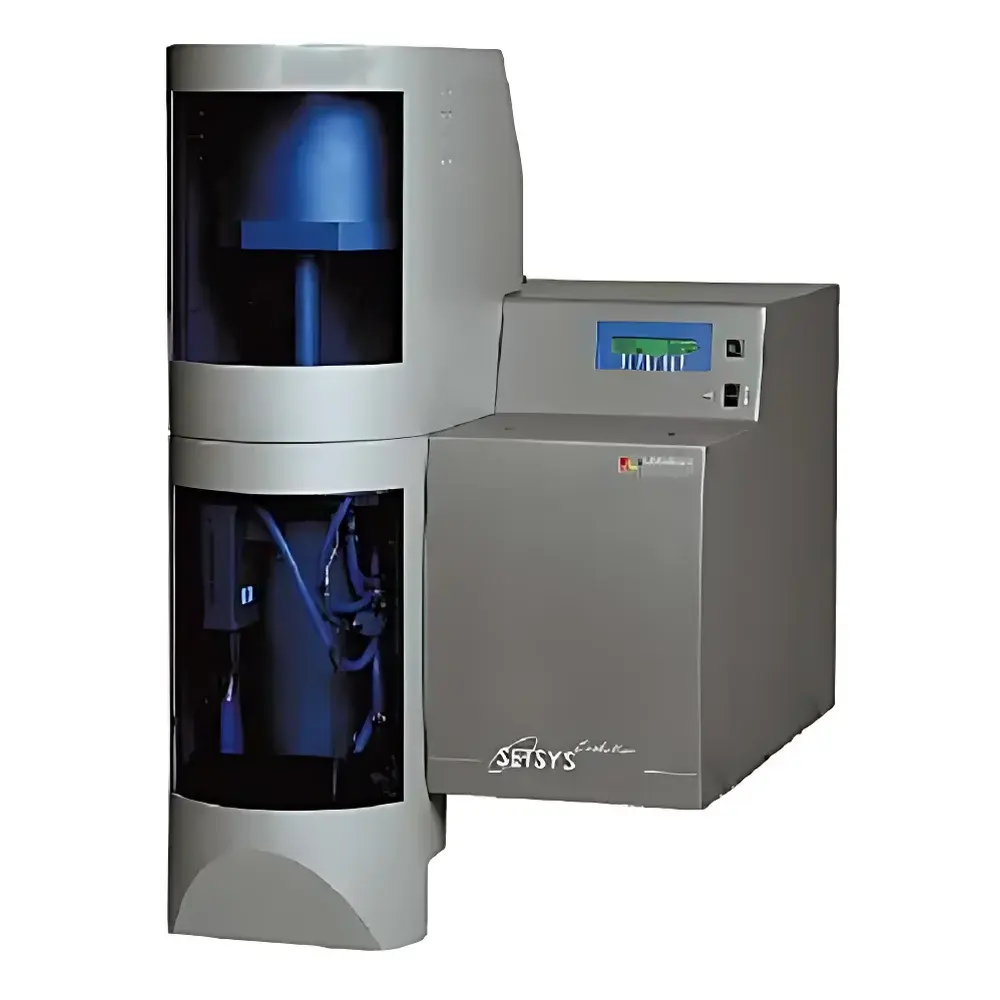
SETARAM Setsys Evo Thermomechanical Analyzer
| Brand | SETARAM |
|---|---|
| Origin | France |
| Model | Setsys Evo TMA |
| Temperature Range | −150 °C to 2400 °C |
| Heating/Cooling Rate | 0–100 °C/min |
| Displacement Resolution | 0.2 nm |
| Displacement Noise | 5 nm |
| Force Range | 0–3.5 N (controllable) |
| Sample Length | 0–20 mm |
| Sample Diameter | ≤10 mm |
| Maximum Displacement Range | ±2 mm |
| Load Capacity | −150 g to +350 g |
| Measurement Modes | Compression, Penetration, 3-Point Bending, Tensile, Dilatometric, Volumetric Expansion |
Overview
The SETARAM Setsys Evo Thermomechanical Analyzer (TMA) is a high-temperature, modular thermal analysis platform engineered for precise dimensional change measurement under controlled thermal and mechanical stimuli. Based on the robust Setsys Evolution architecture, this instrument applies the fundamental principle of thermomechanical analysis—quantifying dimensional response (expansion, contraction, creep, softening, or deformation) of solid or semi-solid materials as a function of temperature, time, and applied force. With an extended operational range up to 2400 °C, it enables characterization of refractory ceramics, nuclear fuels, high-entropy alloys, and advanced composites where conventional TMA systems fail. Its dual-capability design allows seamless transition between standalone TMA operation and simultaneous thermogravimetric analysis (STA), supporting correlated mass-loss and dimensional-change data acquisition under identical thermal history—a critical requirement for kinetic modeling and phase transformation studies.
Key Features
- Ultra-high-temperature capability: Programmable heating/cooling from −150 °C to 2400 °C with ramp rates adjustable from 0 to 100 °C/min, ensuring compatibility with rapid sintering, glass transition, and high-temperature creep protocols.
- Nanometer-scale displacement resolution: Optical encoder-based sensor system delivers 0.2 nm resolution and ≤5 nm baseline noise, enabling detection of sub-micron dimensional shifts during early-stage structural relaxation or surface densification.
- Programmable force control: Linear motor-driven load application with fully controllable force range from −150 g (tension) to +350 g (compression), supporting both static and dynamic mechanical loading profiles.
- Modular probe library: Interchangeable sensor heads—including compression, penetration, 3-point bending, tensile, dilatometric, and volumetric expansion probes—allow method-specific configuration without hardware revalidation.
- Integrated STA compatibility: Optional coupling with TG/DSC modules enables concurrent acquisition of mass change, heat flow, and dimensional response, aligned temporally and thermally for unambiguous interpretation of multi-parameter events (e.g., decomposition-induced swelling or oxidation-driven expansion).
Sample Compatibility & Compliance
The Setsys Evo TMA accommodates cylindrical or rectangular specimens up to 20 mm in length and 10 mm in diameter, including powders (in crucible-mounted configurations), fibers, thin films, and bulk ceramics. It supports inert, oxidizing, reducing, and controlled-atmosphere environments (via integrated gas purging or vacuum sealing), essential for studying redox-sensitive materials such as UO₂, SiC, or Ni-based superalloys. The system complies with ASTM E831 (linear thermal expansion), ASTM D696 (coefficient of linear expansion of plastics), ISO 11359-2 (TMA of polymers), and USP (thermal analysis in pharmaceutical excipient qualification). Data acquisition and reporting meet GLP/GMP requirements, with full audit trail support and optional 21 CFR Part 11-compliant software modules available for regulated laboratories.
Software & Data Management
Control and analysis are executed via SETARAM’s Calisto software suite, a Windows-based platform offering real-time parameter monitoring, multi-step temperature/force profiling, and automated baseline correction. Raw displacement, force, and temperature signals are recorded at ≥10 Hz sampling rate, preserving transient mechanical responses. Post-acquisition tools include derivative analysis (dL/dT), coefficient-of-thermal-expansion (CTE) calculation across user-defined intervals, glass transition onset identification (per ASTM E1352), and creep compliance modeling. Export formats include ASCII, CSV, and universal .tdms for integration with MATLAB, Python (NumPy/Pandas), or LIMS platforms. All method files, raw data, and processed results are timestamped and digitally signed to ensure traceability and data integrity.
Applications
- Aerospace & nuclear engineering: Quantification of thermal strain in ceramic matrix composites (CMCs) and fuel pellet behavior under simulated reactor conditions.
- Ceramic processing: Monitoring shrinkage kinetics, pore closure, and densification onset during sintering of Al₂O₃, ZrO₂, and Si₃N₄.
- Metallurgy: Determination of solidus/liquidus temperatures, thermal expansion mismatch in brazed joints, and high-temperature creep resistance of turbine blade alloys.
- Pharmaceutical development: Characterization of polymorphic transitions, amorphous content stability, and tablet excipient thermal expansion during lyophilization cycle design.
- Energy materials: Analysis of thermal expansion hysteresis in battery electrode materials (e.g., NMC, LFP) and dimensional stability of hydrogen storage hydrides under cycling conditions.
FAQ
What is the maximum sample temperature supported by the Setsys Evo TMA?
The instrument supports continuous operation up to 2400 °C using a graphite furnace with water-cooled flange and radiation shielding; optional tungsten furnace configurations extend stability for ultra-refractory testing.
Can the system perform dynamic mechanical measurements (e.g., frequency sweeps)?
While primarily designed for quasi-static and slow-scan TMA, the Setsys Evo supports oscillatory force application up to 1 Hz for limited viscoelastic screening; dedicated DMA functionality requires complementary instrumentation.
Is calibration traceable to national standards?
Yes—displacement calibration is performed using NIST-traceable interferometric standards; temperature calibration follows ITS-90 via certified reference materials (e.g., In, Sn, Zn, Al, Ag, Au fixed points).
How is atmosphere control implemented during high-temperature runs?
A dual-gas manifold with mass flow controllers enables precise blending of Ar, He, H₂, N₂, CO, CO₂, or synthetic air; vacuum operation down to 10⁻⁵ mbar is supported via turbomolecular pumping.
Does the system support automated sample changers?
The standard configuration is single-sample; however, the modular frame design permits integration with third-party robotic autosamplers compatible with high-temperature sample holders upon custom engineering review.



