
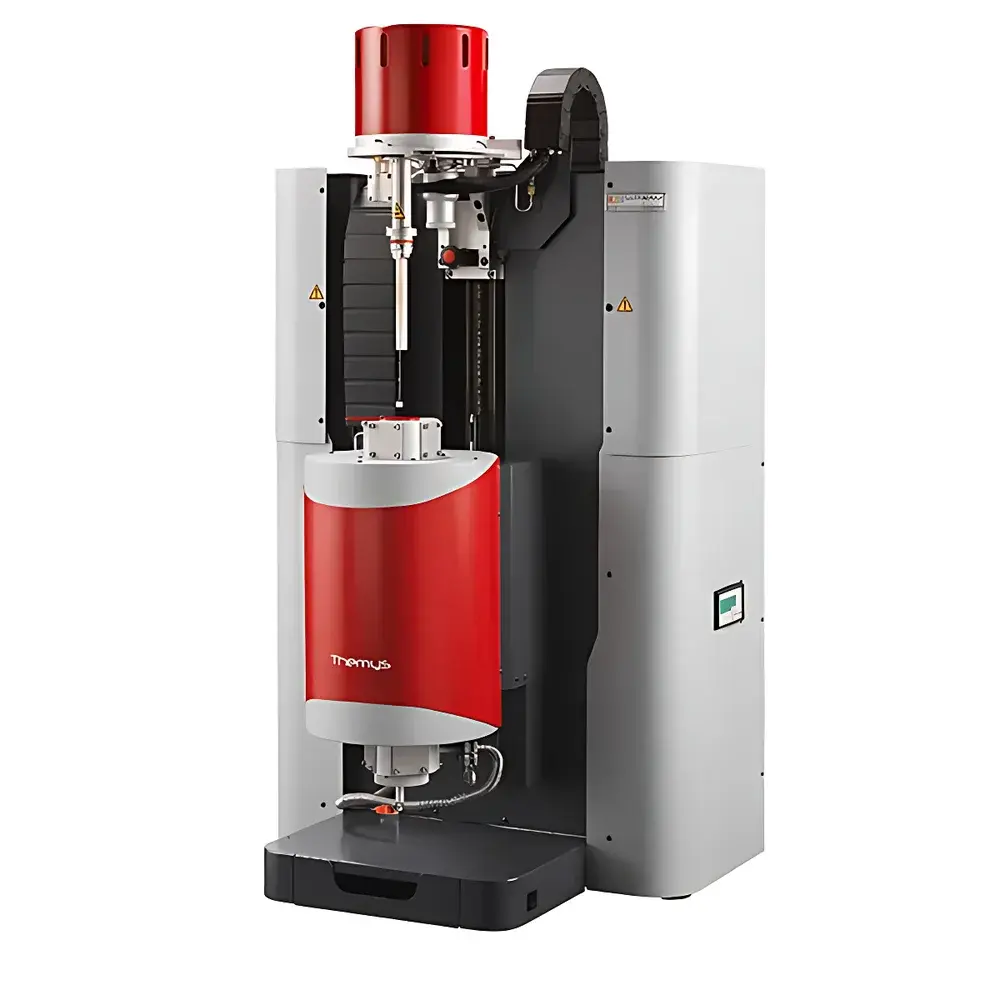
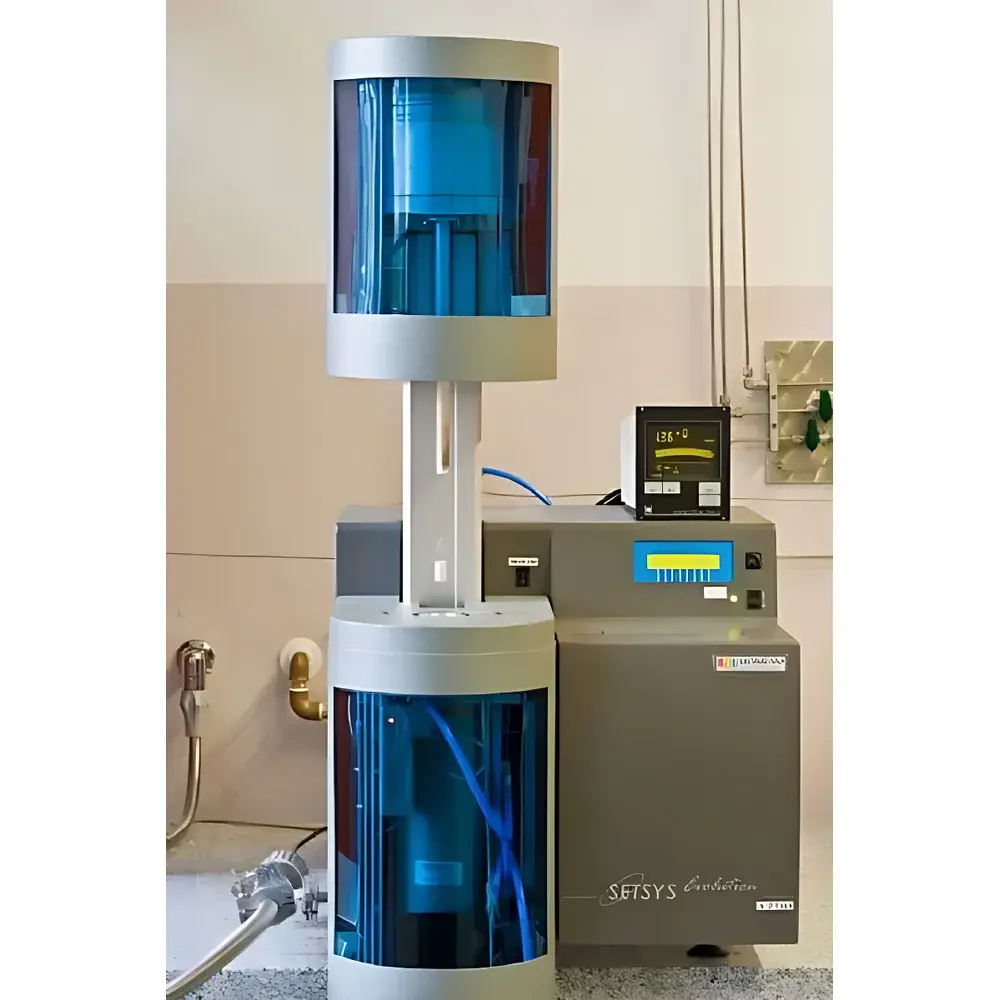
SETARAM THEMYS TMA Thermomechanical Analyzer
| Brand | SETARAM |
|---|---|
| Origin | France |
| Model | THEMYS TMA |
| Instrument Type | Thermomechanical Analyzer (TMA) |
| Temperature Range | –150 to 2400 °C (configurable up to 2400 °C with high-temp furnace option) |
| Heating/Cooling Rate | 0–100 °C/min |
| Displacement Resolution | 0.2 nm |
| Displacement Noise | 5 nm |
| Force Range | 0–3.5 N (bidirectional, programmable) |
| Sample Length | 0–20 mm |
| Sample Diameter | ≤10 mm |
| Maximum Displacement Range | ±2 mm |
| Load Capacity | –150 to +350 g (equivalent force range) |
| Probe Options | Compression, Penetration, 3-Point Bending, Tensile, Dilatometric, and Volumetric probes |
Overview
The SETARAM THEMYS TMA is a high-precision thermomechanical analyzer engineered for quantitative measurement of dimensional changes in solid and semi-solid materials under controlled temperature, time, and mechanical stress conditions. Based on the proven THEMYS platform, this instrument operates on the fundamental principle of contact-based linear displacement sensing—using ultra-sensitive capacitive or optical sensors to detect minute dimensional responses (expansion, contraction, softening, creep, or phase-induced strain) as a function of thermal history. Its extended high-temperature capability—up to 2400 °C with optional graphite or molybdenum furnace configurations—enables characterization of refractory ceramics, nuclear fuels, advanced alloys, and ultra-high-temperature composites inaccessible to conventional TMA systems. The modular architecture supports seamless integration with simultaneous thermal analysis (STA), allowing synchronized TMA-DSC or TMA-TGA measurements within a single sample chamber—critical for decoupling enthalpic, mass-loss, and dimensional effects during complex thermal transitions.
Key Features
- Ultra-high-resolution displacement detection: 0.2 nm resolution with sub-5 nm baseline noise, enabling detection of early-stage structural relaxation and micro-scale sintering kinetics.
- Programmable bidirectional force control (0–3.5 N), supporting both compressive and tensile loading modes with active feedback regulation.
- Multi-probe modularity: Interchangeable probe assemblies—including compression, penetration, 3-point bending, tensile, dilatometric, and volumetric configurations—allow method-specific sample coupling without hardware recalibration.
- Configurable temperature range: Standard operation from –150 °C to 1000 °C; extended variants certified to 1600 °C, 1750 °C, and 2400 °C per ISO 11359-2 and ASTM E831 compliance protocols.
- Full PC-based automation via SETARAM’s Calisto software: Supports multi-step temperature ramps, isothermal holds, dynamic load cycling, and real-time derivative analysis (dL/dT, d²L/dT²).
- Robust mechanical design with low-drift ceramic or Inconel sample holders, inert atmosphere compatibility (Ar, He, N₂, H₂, vacuum), and integrated purge gas flow control.
Sample Compatibility & Compliance
The THEMYS TMA accommodates cylindrical, disc, filament, and irregular geometries up to 20 mm in length and 10 mm in diameter. It is routinely deployed for ISO 11359-1/2 (plastics), ASTM E831 (linear thermal expansion), ASTM D696 (coefficient of linear expansion), ASTM C372 (ceramic thermal expansion), and USP (container closure integrity under thermal stress) testing. Data acquisition and reporting comply with GLP/GMP requirements, including full audit trail logging, electronic signatures, and 21 CFR Part 11–ready configuration options. All high-temperature furnace variants are CE-marked and meet IEC 61000-6-3 EMC standards.
Software & Data Management
Calisto v5.x provides intuitive workflow-driven experiment setup, real-time visualization of L(t), L(T), and dL/dT curves, and automated calculation of coefficients (CTE, αL), inflection points (Tg, softening onset), and kinetic parameters (activation energy via isoconversional methods). Raw data export is supported in ASCII, CSV, and universal .itx formats. Batch processing, comparative overlay tools, and customizable report templates facilitate regulatory submissions and cross-laboratory data harmonization. Optional Calisto Connect enables remote monitoring, centralized database synchronization, and role-based access control for multi-user environments.
Applications
- Aerospace & nuclear engineering: Sintering shrinkage profiling of SiC/Si₃N₄ composites; thermal expansion mismatch analysis in turbine blade coatings; creep behavior of Zr-alloys under simulated LOCA conditions.
- Ceramics & metallurgy: Quantification of densification onset, pore closure temperature, and glass transition in oxide and non-oxide systems; liquid-phase sintering kinetics in WC-Co hardmetals.
- Energy materials: Thermal stability assessment of molten salt containment alloys; decomposition-induced swelling in battery electrode materials; hydrate dissociation strain in methane clathrates.
- Pharmaceuticals & biomaterials: Glass transition mapping of amorphous solid dispersions; tablet coating integrity under accelerated storage conditions; thermal expansion anisotropy in lyophilized protein matrices.
- Process safety: Time-to-ignition prediction under thermal runaway scenarios; deformation onset temperature for pressure vessel liner materials.
FAQ
What temperature calibration standards are supported for high-temperature TMA operation above 1500 °C?
Certified reference materials including high-purity tungsten (Tm = 3422 °C), molybdenum (Tm = 2623 °C), and nickel (Tm = 1455 °C) are used for furnace calibration traceable to NIST SRMs.
Can the THEMYS TMA perform dynamic mechanical measurements (e.g., frequency sweeps)?
While primarily optimized for static and quasi-static thermomechanical profiling, optional oscillatory modules enable limited dynamic testing (0.01–1 Hz) under isothermal conditions; full DMA functionality requires integration with a dedicated DMA system.
Is vacuum-compatible operation available across the full temperature range?
Yes—standard vacuum capability is rated to 10⁻³ mbar; high-vacuum (<10⁻⁶ mbar) configurations with differential pumping are available for ultra-high-temperature applications involving reactive samples.
How is probe alignment and zero-force initialization performed?
Automated probe approach routines with force-threshold detection ensure repeatable contact establishment; zero-force calibration is executed via closed-loop load cell nulling prior to each test sequence.
Does the system support custom probe fabrication for non-standard sample geometries?
SETARAM offers OEM probe design services—including bespoke quartz, alumina, or graphite tips—with metrological validation and thermal expansion compensation algorithms embedded in Calisto.
Related Products



