
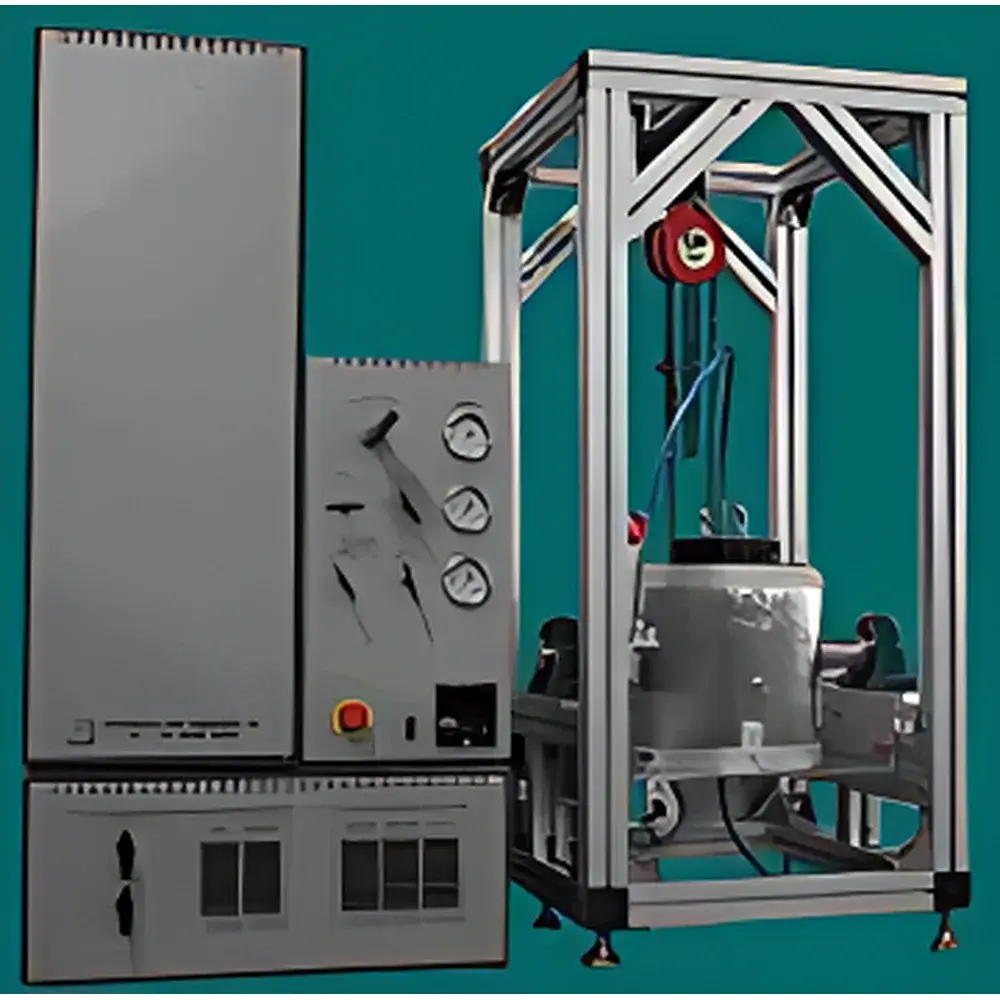
SFT SFT-1000 Supercritical Fluid Extraction and Reaction System
| Brand | SFT |
|---|---|
| Origin | USA |
| Model | SFT-1000 |
| Max Temperature | 200 °C |
| Max Pressure | 10,000 psi |
| Extraction Vessel Capacity | Up to 4 L (benchtop) or 20 L (cabinet configuration) |
| CO₂ Flow Rate | 1–250 g/min (2–500 mL/min at STP) |
| Temperature Control Accuracy | ±1 °C (in supercritical phase) |
| Throttle Valve Heating | Up to 250 °C |
| Power Requirement | 4000 W heating capacity |
| Dimensions | 92 cm × 61 cm × 76 cm |
| Weight | 100 kg |
Overview
The SFT SFT-1000 Supercritical Fluid Extraction and Reaction System is a fully automated, benchtop-to-pilot-scale platform engineered for precision supercritical fluid processing using carbon dioxide (CO₂) as the primary solvent. Operating on the principles of supercritical fluid thermodynamics, the system leverages CO₂’s tunable solvation power—modulated via independent control of pressure (up to 10,000 psi) and temperature (up to 200 °C)—to achieve selective extraction, fractionation, or in-situ reaction of thermolabile and nonpolar compounds. Its dual-channel architecture enables parallel or sequential processing, supporting method development, scalability assessment, and process validation under reproducible, instrument-controlled conditions. Designed for integration into regulated laboratory environments, the SFT-1000 conforms to core engineering standards for pressure containment (ASME BPVC Section VIII), thermal safety, and electrical compliance (UL/CSA Class I, Div 2).
Key Features
- Fully programmable PLC-based automation with embedded microprocessor controlling pressure, temperature, flow, timing, valve sequencing, and solvent delivery modes.
- Dual independent extraction/reactor channels—each configurable with interchangeable vessels (standard 4 L benchtop; optional 20 L cabinet-mounted configuration).
- High-fidelity thermal management: 4000 W band-heater system with ±1 °C stability in supercritical phase; heated throttle valve (up to 250 °C) prevents solute precipitation and nozzle clogging.
- Integrated overpressure protection: rupture disc assembly coupled with real-time PLC interlock logic ensures automatic shutdown upon deviation from preset safety thresholds.
- Real-time parameter monitoring via backlit LCD display with scrollable interface—showing live pressure, temperature, mass flow, elapsed time, and active method step.
- Expandable architecture: RS232C communication ports enable bidirectional command exchange with external PCs; battery-backed memory retains up to 20 non-sequential methods with full audit trail capability.
Sample Compatibility & Compliance
The SFT-1000 is validated for extraction and reaction applications involving botanical matrices (e.g., cannabinoids, terpenes, flavonoids), pharmaceutical actives (including APIs and excipients), nutraceuticals, and polymer-modification precursors. Its inert stainless-steel wetted path (316 SS) and absence of organic solvent residues support compliance with USP , , and FDA 21 CFR Part 11 requirements when paired with validated software protocols. The system supports co-solvent introduction—either manually or via automated online injection—enabling polarity tuning per ASTM D7925-15 (Standard Guide for Supercritical Fluid Extraction of Natural Products). All pressure vessels are ASME-stamped and certified for operation at 10,000 psi; documentation includes material traceability, hydrostatic test reports, and third-party inspection certificates.
Software & Data Management
Control and data acquisition are managed through SFT’s proprietary PC-based software suite, compatible with Windows 10/11 and supporting IEEE 1394 and USB-RS232 adapters. The software provides full method creation, editing, and archival functionality—including gradient pressure/temperature ramps, multi-step hold sequences, and dynamic flow profiling. Raw sensor data (pressure, temperature, flow, time) are logged at user-defined intervals (100 ms to 5 s resolution) and exported in CSV or XML format for LIMS integration. Audit trails record operator ID, timestamp, parameter changes, and system events—meeting GLP/GMP documentation requirements. Optional 21 CFR Part 11 compliance package includes electronic signatures, role-based access control, and immutable data archiving.
Applications
- Decaffeination and essential oil isolation from coffee, tea, and citrus biomass.
- Extraction of high-value phytochemicals (e.g., curcumin, resveratrol, paclitaxel) under oxygen-free, low-thermal-stress conditions.
- Supercritical impregnation of polymers and medical devices with antimicrobial agents.
- In-situ enzymatic or catalytic reactions (e.g., transesterification, hydrogenation) within the extraction vessel.
- Residual solvent removal from pharmaceutical intermediates per ICH Q5C guidelines.
- Method transfer from analytical SFE (e.g., SFT-150) to pilot scale for DOE-driven optimization and regulatory filing support.
FAQ
What CO₂ supply specifications are required for continuous operation?
Liquid CO₂ must be supplied from a standard 50-L Dewar or high-pressure cylinder equipped with a dip-tube siphon. Minimum inlet pressure: 600 psi; recommended feed line: 1/4″ SS tubing with Swagelok fittings.
Is the system compatible with alternative supercritical fluids beyond CO₂?
While optimized for CO₂, the SFT-1000 can accommodate N₂O and ethane with appropriate modifications to pressure transducers, seals, and safety interlocks—subject to prior engineering review and validation.
How is method reproducibility ensured across multiple operators and shifts?
All critical parameters are locked within stored methods; manual overrides require supervisor-level credentials. Temperature and pressure sensors are calibrated traceably to NIST standards annually, with calibration certificates included in the system dossier.
Can the system be integrated into an existing plant SCADA network?
Yes—via optional Modbus TCP or OPC UA gateway module (sold separately), enabling real-time telemetry and remote start/stop commands under ISO/IEC 62443-3-3 security framework.



