
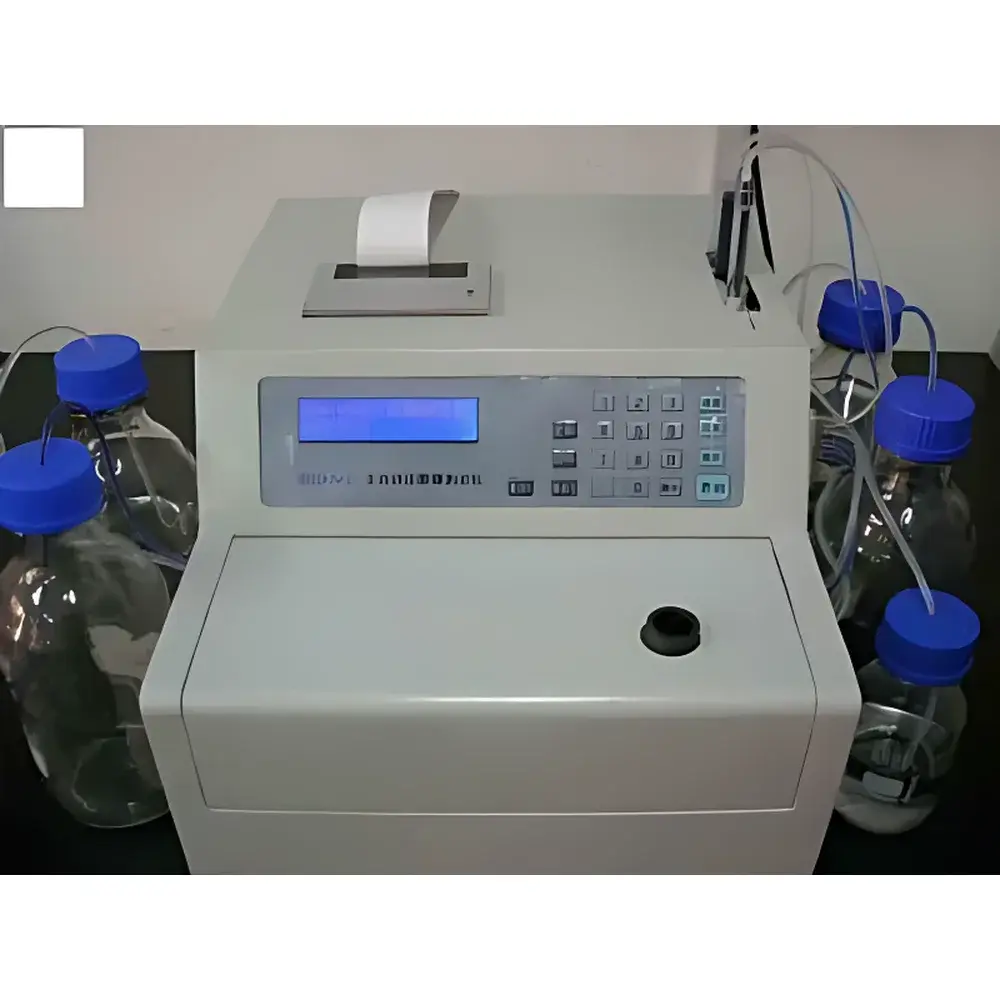
SGD-IV-D Saccharimeter by Shandong Manufacturer
| Origin | Shandong, China |
|---|---|
| Manufacturer Type | Authorized Distributor |
| Origin Category | Domestic (China) |
| Model | SGD-IV-D |
| Pricing | Available Upon Request |
| Power Supply | 220 V AC, 50 Hz |
| Dimensions (L×W×H) | 421 × 342 × 230 mm |
| Weight | 12 kg |
| Display | LCD Screen |
| Sensitivity | 0.01 % (w/v, expressed as glucose) |
| Linear Range | 0.01–1.00 % (w/v, expressed as glucose) |
| Measurement Cycle Time | ≤ 2.5 minutes |
Overview
The SGD-IV-D Saccharimeter is a precision optical instrument engineered for rapid, reliable quantification of soluble solids—primarily sucrose and reducing sugars—in aqueous solutions via polarimetric measurement. Based on the fundamental principle of optical rotation, the device measures the angular deviation of plane-polarized light as it passes through a chiral solution containing optically active compounds such as D-glucose, D-fructose, and sucrose. This rotation angle (α), expressed in degrees, is directly proportional to the concentration, path length, and specific rotation ([α]) of the analyte under defined temperature and wavelength conditions (typically sodium D-line, 589.3 nm). Designed for routine quality control and process monitoring, the SGD-IV-D delivers high reproducibility in environments ranging from fermentation broth analysis to finished-product verification in food, pharmaceutical, and biotechnology manufacturing.
Key Features
- High-sensitivity polarimetric detection with resolution down to 0.01 % (w/v, as glucose), enabling accurate low-concentration measurements critical in early-stage fermentation or dilute syrup formulations.
- Stable, thermally compensated optical path ensures minimal drift during sequential analyses; no external water-jacketed cell required for standard operation.
- Integrated LCD display provides real-time readout of optical rotation (°) and direct sugar concentration (% w/v), with automatic temperature compensation referenced to 20 °C (per ISO 2150:2019).
- Compact benchtop form factor (421 × 342 × 230 mm) and lightweight construction (12 kg) facilitate deployment in QC labs, pilot-scale bioreactor suites, and field-deployable mobile testing stations.
- Measurement cycle time ≤ 2.5 minutes—including sample loading, auto-zeroing, and result output—supports high-throughput screening without compromising accuracy.
- Robust mechanical design with precision-ground quartz polarizer and analyzer elements ensures long-term calibration stability and resistance to ambient vibration.
Sample Compatibility & Compliance
The SGD-IV-D accommodates standard 100 mm and 200 mm path-length polarimetric cells (supplied separately), compatible with clarified liquid samples across diverse matrices: microbial fermentation broths (e.g., glutamic acid, citric acid, ethanol), antibiotic fermentation supernatants (penicillin, cephalosporins), starch hydrolysates (glucose, maltose, isomaltose), fruit juices, honey, syrups (HFCS, maltodextrin), and plant extracts. Sample turbidity must be minimized (< 0.5 NTU) via centrifugation or filtration to avoid scattering-induced error. The instrument meets core metrological requirements outlined in ISO 2150:2019 (sugar determination in cane and beet sugar products), AOAC Official Method 932.12 (polarimetric sugar assay), and supports traceability per ISO/IEC 17025 when operated with certified reference standards (e.g., NIST SRM 84g sucrose solution). It is suitable for GLP-compliant environments where documented calibration, operator ID, and audit-ready measurement logs are maintained manually or via external data capture.
Software & Data Management
The SGD-IV-D operates as a standalone analytical endpoint with embedded firmware; no proprietary PC software is bundled. However, its RS-232 serial interface enables integration with laboratory information management systems (LIMS) or custom SCADA platforms for automated data logging. Users may export timestamped results—including measured rotation, calculated % (w/v), ambient temperature, and operator code—to CSV via terminal emulation. For regulated environments (e.g., FDA-regulated biomanufacturing), the device supports 21 CFR Part 11 compliance when paired with validated third-party data acquisition software featuring electronic signatures, audit trails, and role-based access control. Calibration records (zero check, standard verification) are retained internally for ≥ 500 cycles and can be reviewed on-screen or printed via optional thermal printer interface.
Applications
- Microbial Fermentation Monitoring: Real-time tracking of sugar depletion in Corynebacterium glutamicum, Aspergillus niger, and Saccharomyces cerevisiae cultivations to optimize feeding strategies and endpoint determination.
- Pharmaceutical Bioprocessing: Quantification of residual glucose in penicillin G or cephalexin fermentations to ensure metabolic shift into secondary metabolite production phase.
- Starch Conversion Validation: Verification of enzymatic hydrolysis efficiency in glucose syrup, high-maltose syrup, and fructo-oligosaccharide production lines.
- Food & Beverage Quality Assurance: Batch release testing of honey purity (adulteration screening), fruit juice Brix consistency, confectionery syrup density, and beet/cane sugar refinery intermediates.
- Academic & Method Development: Teaching polarimetry fundamentals in undergraduate physical chemistry labs; supporting validation of HPLC or enzymatic assays via orthogonal measurement.
FAQ
What is the recommended calibration frequency for the SGD-IV-D?
Calibration verification using a certified sucrose standard (e.g., 1.00 % w/v at 20 °C) is advised before each analytical session or every 8 hours of continuous use.
Can the SGD-IV-D measure invert sugar directly?
No—it reports total optical rotation, which is additive for D-glucose (+52.5°) and D-fructose (−92.0°). Quantification of invert sugar requires complementary analysis (e.g., HPLC) or application of correction factors based on hydrolysis kinetics.
Is temperature control built into the instrument?
The SGD-IV-D includes internal temperature sensing and digital compensation but does not feature active thermostating; users must pre-equilibrate samples to 20 °C ± 0.5 °C for ISO-compliant reporting.
Does the device comply with USP or Ph. Eur. 2.2.7?
While not pre-certified to pharmacopoeial monographs, its performance parameters (sensitivity, linearity, repeatability) satisfy the instrumental requirements specified in USP “Polarimetry” and Ph. Eur. 2.2.7 “Optical Rotation” when operated under controlled conditions.
Are spare parts and service support available internationally?
Yes—authorized distributors provide global technical documentation, certified replacement cells, quartz optics, and firmware update services under multi-year support agreements.



