
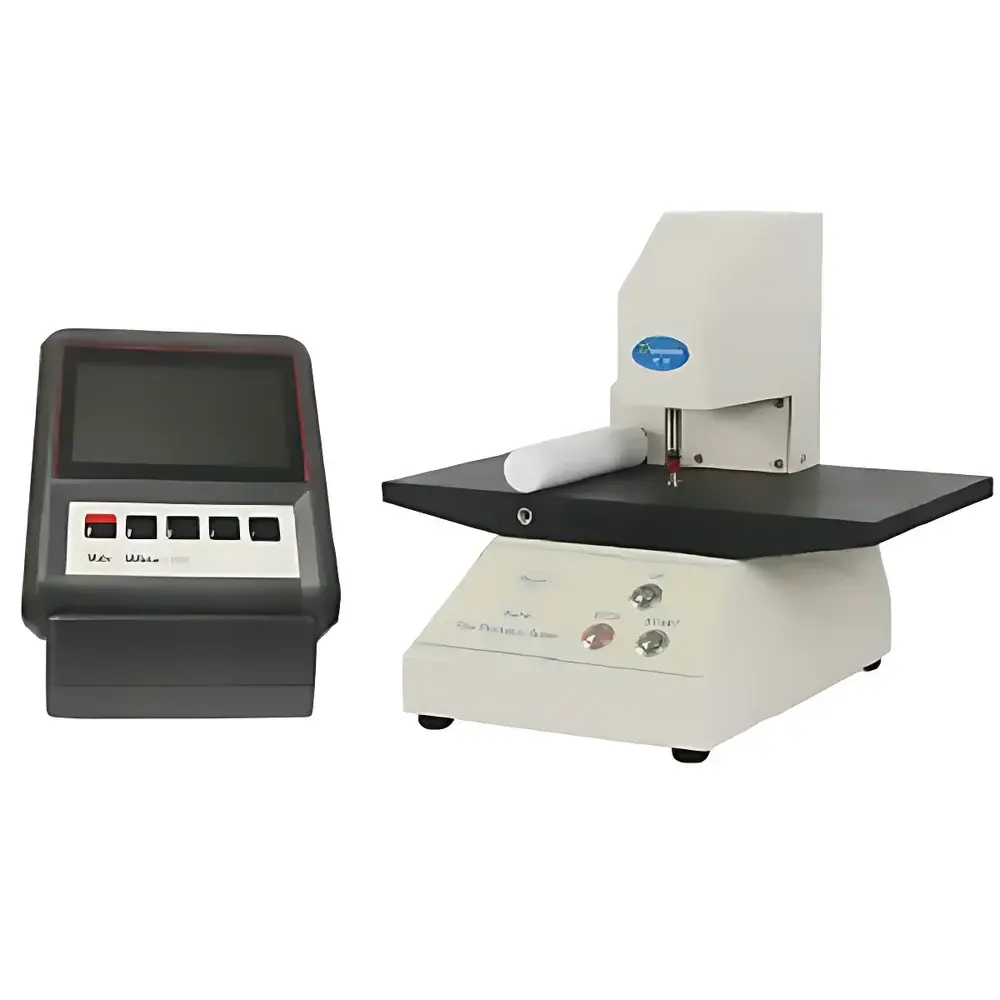
SHANG ZHUN DM49-86 Film Thickness Gauge
| Brand | SHANG ZHUN |
|---|---|
| Origin | Guangdong, China |
| Manufacturer Type | Authorized Distributor |
| Country of Origin | China |
| Model | DM49-86 |
| Price | Upon Request |
| Measurement Range | 0–200 µm |
| Resolution | 0.01 µm |
| Accuracy Limit | ±0.3% |
| Operating Temperature | 10–40 °C |
| Power Supply | 115–230 V AC, 50–60 Hz |
| Air Pressure Requirement | 0.2–1.0 MPa |
| Power Consumption | 48 W |
| Standard Probe Force | 0.75 N (optional: 0.25 N, 0.5 N, 0.75 N) |
| Measurement Speed | Up to 20 measurements/min (automated mode) |
| Display Unit Dimensions | 170 × 130 × 150 mm |
| Stage Dimensions | 250 × 300 × 250 mm (customizable) |
| Probe Types | Flat probe, large-radius arc probe (interchangeable) |
| Net Weight | Display unit 0.7 kg |
| Base Material | Grade-0 granite surface plate |
Overview
The SHANG ZHUN DM49-86 Film Thickness Gauge is a high-precision mechanical contact gauge engineered for non-destructive, single-point thickness measurement of thin films, coatings, foils, and laminates on rigid or semi-rigid substrates. It operates on the principle of controlled-force mechanical displacement sensing: a calibrated probe applies a defined normal load to the sample surface, and the resulting vertical displacement—measured via a high-resolution linear encoder—is converted into thickness value based on pre-calibrated zero-reference and material-specific compression compensation. Designed for metrology-grade repeatability in QC laboratories and production environments, the instrument integrates a Grade-0 granite base plate to minimize thermal drift and mechanical deformation, ensuring long-term dimensional stability under ambient industrial conditions (10–40 °C). Its ±0.3% accuracy limit—traceable to national standards—and 0.01 µm resolution meet routine requirements for ISO/IEC 17025-accredited testing procedures involving thin polymer films, metallic coatings, optical filters, and semiconductor wafers.
Key Features
- Grade-0 granite stage (250 × 300 × 250 mm) providing exceptional flatness (<0.5 µm/m), rigidity, and corrosion resistance—critical for baseline stability and long-term calibration integrity.
- Motorized auto-leveling mechanism with adjustable probe parallelism compensation, eliminating iterative coefficient recalibration between sample batches or operator shifts.
- Automated measurement cycle (up to 20 readings/min) with programmable dwell time and force ramping—reducing operator-induced variability and enabling unattended operation during extended QA runs.
- Dual-probe compatibility: interchangeable flat and large-radius arc probes support both planar surfaces and gently curved substrates (e.g., cylindrical lenses, molded plastic parts) without edge artifact interference.
- Real-time force feedback control ensures consistent 0.75 N nominal contact load (with optional 0.25 N / 0.5 N variants), minimizing substrate deformation in soft films (e.g., PET, PI, acrylics) while maintaining signal-to-noise ratio.
- Integrated environmental monitoring: internal temperature sensor logs ambient conditions alongside each measurement, supporting ASTM E122-compliant uncertainty budgeting.
Sample Compatibility & Compliance
The DM49-86 accommodates a broad range of non-porous, solid-phase materials including anodized aluminum, electroplated copper/nickel, PVD-coated glass, polyimide flex circuits, and lacquer-coated metal sheets. Sample thickness must remain within 0–200 µm; substrates must exhibit sufficient rigidity to resist indentation under applied probe force (minimum Shore D hardness ≥ 60 recommended). The system complies with ISO 2178 (non-magnetic coatings on magnetic base metals), ISO 2360 (non-conductive coatings on non-magnetic conductive base metals), and supports method validation per ASTM D7091 for field-deployable coating gauges. All firmware and data handling routines adhere to ALCOA+ principles (Attributable, Legible, Contemporaneous, Original, Accurate, Complete, Consistent, Enduring, Available) for regulated environments requiring audit readiness.
Software & Data Management
- Real-time statistical engine computes mean, standard deviation, max/min, Cp/Cpk, and trend analysis across user-defined batches or shift cycles.
- Dynamic visualization suite generates thickness profile curves, deviation heatmaps, polar radar plots for radial uniformity assessment, and X-bar/R control charts—exportable as SVG/PNG for inclusion in CAPA reports.
- Role-based access control (administrator, operator, reviewer) enforces separation of duties; all user actions—including parameter edits, calibration events, and data deletions—are timestamped and logged with operator ID for FDA 21 CFR Part 11 compliance.
- SQL-based local database stores raw measurements with full metadata: sample ID, operator name, equipment ID, calibration certificate number, environmental conditions, and probe configuration—retained for ≥15 years without manual archiving.
- One-click export to Excel (.xlsx) with customizable templates aligned to internal SOPs or customer-facing quality documentation (e.g., PPAP Level 3).
Applications
This gauge serves critical functions across multiple sectors: in automotive supply chains, verifying paint film build on body panels per OEM specifications (e.g., GMW14872, Ford WSS-M2P175-B); in electronics manufacturing, validating solder mask thickness on PCBs to IPC-4552A tolerances; in packaging R&D, measuring barrier layer uniformity on metallized PET films for food-grade lamination; and in optics fabrication, quantifying anti-reflective coating thickness on precision lenses prior to hard-coating. Its rapid 15-ms response time enables integration into inline sampling stations where throughput exceeds 300 units/hour, while its modular probe design facilitates adaptation to custom fixtures for irregular geometries.
FAQ
Is the DM49-86 suitable for measuring soft elastomeric films?
Yes—when configured with the optional 0.25 N probe and appropriate dwell time, it minimizes viscoelastic recovery artifacts in silicone or TPU films up to 150 µm thick. Calibration against certified step-height standards is recommended for such applications.
Can measurement data be exported directly to LIMS or MES platforms?
Yes—the software supports configurable ODBC connections and CSV/XML API endpoints for automated transfer to LabVantage, Thermo Fisher SampleManager, or Siemens Opcenter Execution.
What calibration standards are required for ISO 17025 accreditation?
A traceable set of certified thickness standards (e.g., NIST SRM 2143, PTB 1121) covering 10–180 µm range, verified annually by an ILAC-MRA accredited lab, plus documented intermediate checks using reference blocks before each shift.
Does the granite stage require periodic re-lapping or surface maintenance?
No—Grade-0 granite exhibits negligible wear under normal use. Annual flatness verification using an electronic level or autocollimator is sufficient per ISO 10360-2.
How is probe wear monitored and compensated?
Each probe carries a unique serial ID linked to its wear history in the database. Software alerts trigger at 50,000 cycles or when repeatability degrades beyond ±0.1 µm over 10 consecutive reference measurements.




