
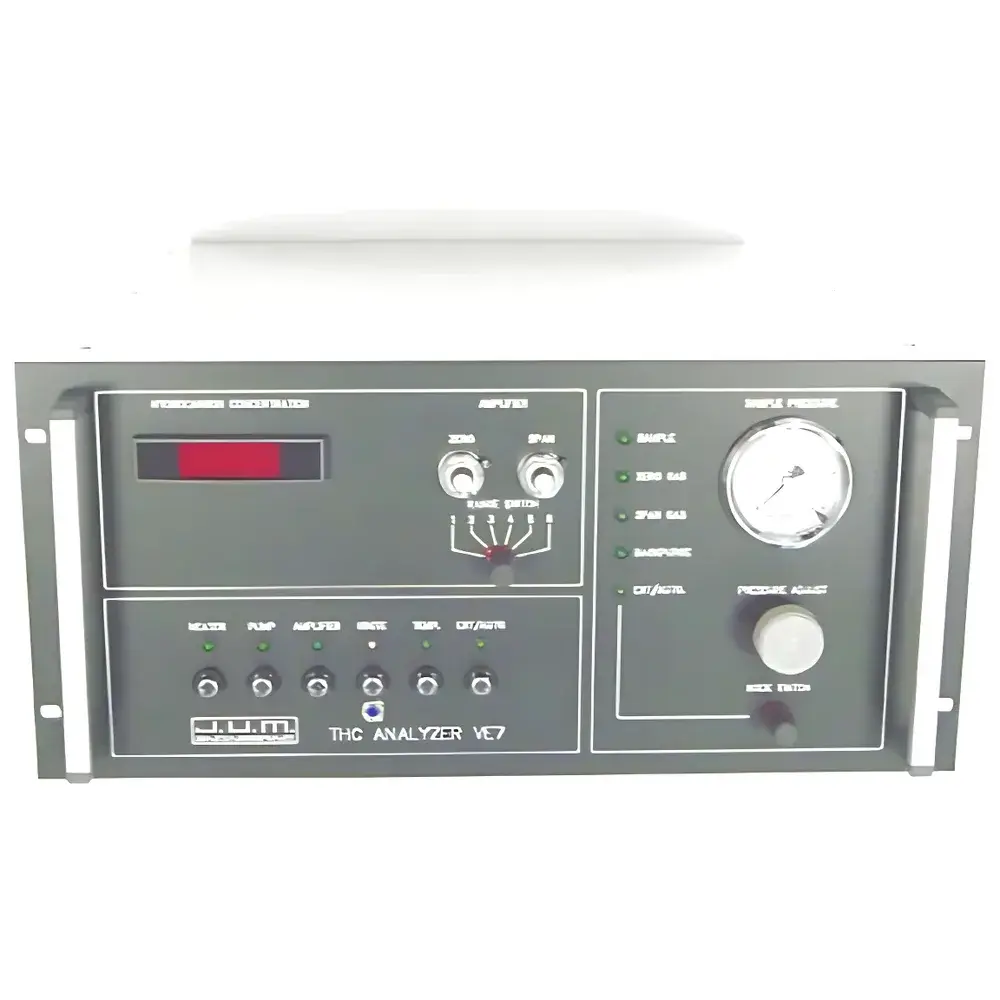
J.U.M. VE7-2 High-Temperature Total Hydrocarbon Analyzer (VOCs)
| Brand | J.U.M. |
|---|---|
| Origin | Germany |
| Manufacturer Type | Authorized Distributor |
| Origin Category | Imported |
| Model | VE7-2 |
| Detection Principle | Flame Ionization Detection (FID) |
| Instrument Type | Online Continuous Analyzer |
| Typical Configuration | Total VOC Analyzer |
| Measurement Range | 0–1000 ppm (expandable to 0–100,000 ppm) |
| Resolution | 0.1 ppm |
| Accuracy | ±5% of reading |
| Response Time (T90) | <60 s |
| Detector Sensitivity | ≤1 ppm CH₄ full-scale |
| Oven Temperature | 190 °C |
| Carrier/Burner Air Supply | Integrated zero-air generator |
Overview
The J.U.M. VE7-2 High-Temperature Total Hydrocarbon Analyzer is an online continuous emission monitoring system engineered for precise, stable quantification of total volatile organic compounds (VOCs) and non-methane hydrocarbons (NMHC) in hot, humid, or condensable gas streams. Built upon flame ionization detection (FID) — the reference method for hydrocarbon quantification per EPA Method 25A, EN 12619, and ISO 13845 — the VE7-2 employs a fully heated sample path from probe inlet to detector, maintaining all components at 190 °C to prevent condensation, adsorption, or catalytic loss of reactive or high-boiling-point VOCs (e.g., C₆–C₁₂ aliphatics, aromatics, oxygenates). Unlike ambient-temperature FID analyzers, this architecture eliminates cold spots and ensures quantitative recovery of thermally labile species, making it suitable for stack gas, reactor effluent, catalytic converter exhaust, and semiconductor process purge streams where traditional analyzers exhibit drift or under-reporting.
Key Features
- Fully integrated high-temperature sample conditioning: heated probe, filter, line, and detector oven maintained at 190 °C (374 °F) to preserve sample integrity and avoid fractionation
- Self-cleaning heated filter with programmable reverse-pulse backflush to minimize maintenance intervals and extend filter life in particulate-laden streams
- Onboard zero-air generator supplying combustion-grade air to the FID burner — eliminating external compressed air cylinders or oil-free compressors
- Modular design with front-access service panels and tool-free component replacement, enabling field maintenance without disassembly of the heated zone
- Multi-range measurement capability: factory-configurable full-scale ranges from 0–10 ppm up to 0–100,000 ppm (CH₄-equivalent), selectable via software or hardware jumpers
- Real-time digital signal processing with linearized output (4–20 mA, RS-485/Modbus RTU, optional Ethernet/IP) compliant with CE EMS and EMC directives
Sample Compatibility & Compliance
The VE7-2 is validated for use with flue gases, biogas, syngas, engine exhaust, semiconductor process gases (N₂, Ar, He), and solvent-laden air streams containing up to 30% H₂O vapor and trace particulates (<5 mg/m³). It meets regulatory requirements for continuous emission monitoring systems (CEMS) under German BImSchV Ordinances 2, 13, and 17; European standards EN 12619 (FID-based NMHC analyzers) and EN 13526 (performance testing of CEMS); U.S. EPA Methods 25A (total gaseous organic concentration) and 503 (calibration and validation of FID systems); and ISO 13845 (performance criteria for hydrocarbon analyzers). Its design supports GLP/GMP audit trails when integrated with compliant data acquisition systems and satisfies key elements of FDA 21 CFR Part 11 for electronic records and signatures when deployed with validated software.
Software & Data Management
The VE7-2 operates with J.U.M.’s proprietary VEMO® firmware, supporting remote configuration, calibration logging, fault diagnostics, and event-driven data export via ASCII or CSV. Calibration history (zero/span dates, gas concentrations, operator ID, deviation reports) is stored onboard with timestamped entries and checksum verification. Optional integration with J.U.M. CEMS Manager™ enables centralized fleet monitoring, automated QA/QC scheduling, alarm escalation (email/SMS), and report generation aligned with TA Luft and EU Directive 2010/75/EU (IED) reporting templates. All calibration and maintenance actions are logged with immutable timestamps, supporting regulatory audit readiness.
Applications
- Continuous monitoring of NMHC/VOC emissions from industrial combustion sources (boilers, kilns, incinerators)
- Real-time optimization of thermal/catalytic oxidizers and regenerative thermal oxidizers (RTOs)
- Exhaust characterization during engine dynamometer testing and aftertreatment development
- In-line purity assurance of bulk inert gases (N₂, Ar) used in semiconductor fabrication and pharmaceutical manufacturing
- LEL (lower explosive limit) surveillance in solvent recovery and vapor recovery units
- Carbon adsorption bed breakthrough detection and regeneration cycle control
- Trace hydrocarbon contamination monitoring in cleanroom supply air and ultra-high-purity carrier gases
FAQ
Does the VE7-2 require external zero air or compressed air?
No — it includes an integrated zero-air generator producing hydrocarbon-free combustion air meeting ASTM D6216 specifications.
Can the instrument measure methane separately from total hydrocarbons?
Not natively; the VE7-2 reports total ionizable carbon (as CH₄-equivalent). For speciated analysis, pairing with a GC-FID or GC-MS is recommended.
What is the minimum detectable level (MDL) under standard operating conditions?
The system achieves a method detection limit (MDL) of ≤0.5 ppm (CH₄) at 190 °C with 60-second averaging, per EPA 40 CFR Part 60, Appendix A-1.
Is the heated filter compatible with sticky or polymerizing VOCs like styrene or acrylates?
Yes — the 190 °C operating temperature and periodic reverse-pulse cleaning mitigate fouling; optional quartz fiber filters are available for highly reactive matrices.
How often is calibration required for compliance with EN 12619?
EN 12619 mandates daily zero/span checks and quarterly full performance audits; the VE7-2’s automated calibration sequence supports both requirements with full traceability.







