
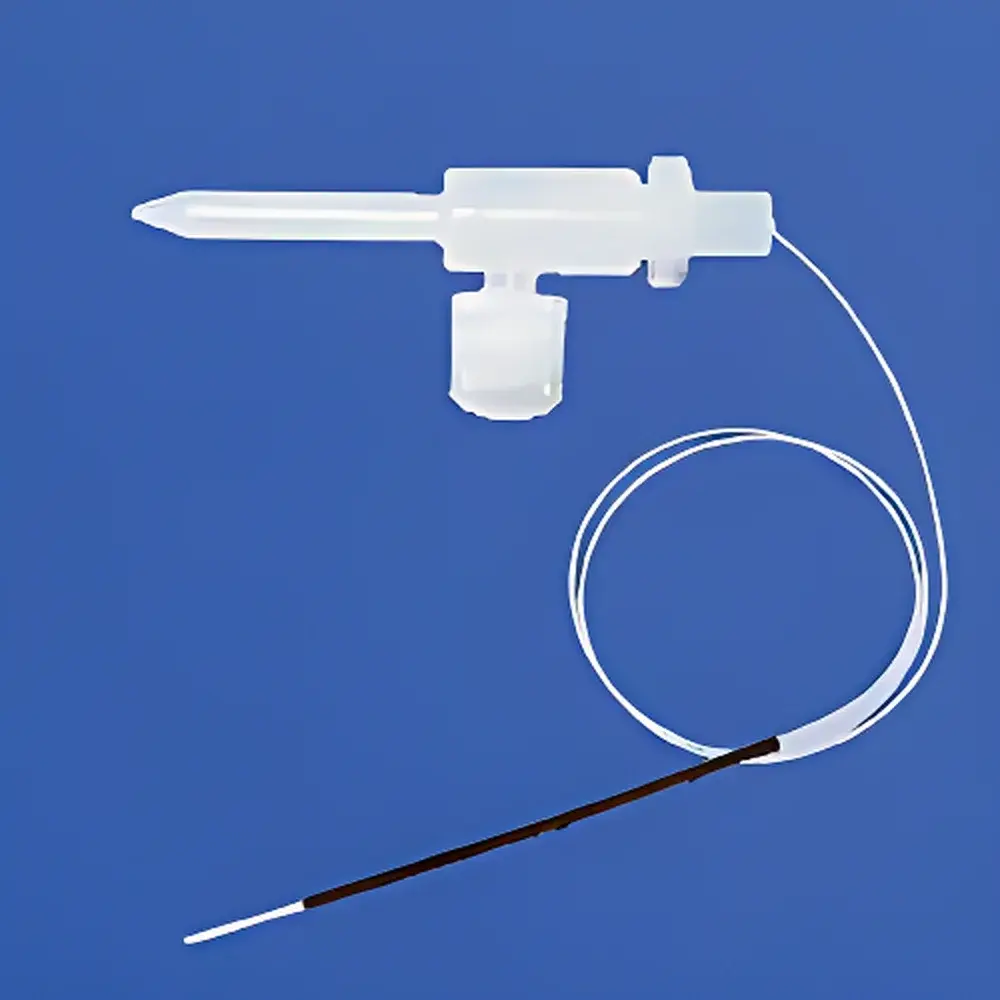
Savillex PFA Concentric Nebulizer for Agilent 7500 ICP-MS
| Brand | Savillex |
|---|---|
| Origin | USA |
| Model | Compatible with Agilent 7500 Series |
| Nebulizer Type | PFA Concentric (C-Flow) & Cross-Flow (X-Flow) |
| Nominal Uptake Rate | 200 µL/min (C-Flow), 50 µL/min (C-Flow Low-Flow Option) |
| Material | 100% Perfluoroalkoxy (PFA), O-Ring-Free Construction |
| Torch Interface | Push-Fit Connector for Agilent ICP-MS Torch |
| Compliance | Fully Compatible with ASTM D5673, ISO/IEC 17025 Trace Metal Analysis Protocols, USP <232>/<233> Elemental Impurities Testing |
Overview
The Savillex PFA Concentric Nebulizer is a high-purity, chemically inert sample introduction component engineered specifically for ultra-trace elemental analysis by Inductively Coupled Plasma Mass Spectrometry (ICP-MS). Designed to meet the stringent demands of modern regulatory-compliant laboratories—particularly those performing environmental monitoring, clinical toxicology, semiconductor-grade reagent certification, and pharmaceutical elemental impurities testing—the nebulizer operates on the principle of pneumatic concentric aerosol generation. Its all-PFA construction eliminates metallic leaching, carbon contamination, and surface adsorption artifacts that compromise detection limits and long-term reproducibility. Unlike conventional quartz or sapphire-based nebulizers, the C-Flow design delivers consistent sub-10 µm droplet size distribution even at low uptake rates (50–200 µL/min), enabling optimal ionization efficiency in the plasma while minimizing polyatomic interferences and cone clogging. The X-Flow variant extends this inertness to high-TDS matrices (up to 25% w/v dissolved solids), making it suitable for geological digests, brine analysis, and industrial process streams without performance degradation.
Key Features
- 100% perfluoroalkoxy (PFA) monolithic construction—no metal, no carbon, no elastomeric seals—ensuring zero background contribution from the nebulizer itself
- O-ring-free end cap design prevents seal degradation, swelling, or outgassing under aggressive acid conditions (HF, HNO₃, HCl, aqua regia)
- Precision-machined concentric capillary geometry ensures ±2.5% inter-unit flow rate reproducibility across manufacturing lots
- Push-fit torch connector enables rapid, repeatable alignment with Agilent 7500-series ICP-MS torches—reducing setup variability and improving plasma stability
- Optimized internal geometry suppresses liquid droplet carryover into the transfer tubing, minimizing memory effects and rinse time between samples
- Two standard configurations: C-Flow (200 µL/min nominal uptake) for general-purpose ultra-trace analysis; C-Flow-LF (50 µL/min) for micro-flow desolvation or low-volume sample conservation
- X-Flow lateral-flow variant provides enhanced tolerance to suspended particulates and high-salinity matrices without compromising aerosol stability
Sample Compatibility & Compliance
The Savillex PFA nebulizer is validated for use with aqueous, organic, and mixed-phase samples containing up to 25% total dissolved solids (TDS). It maintains stable aerosol generation in 10 M HNO₃, 48% HF, and concentrated HCl solutions—conditions routinely encountered in EPA Method 6020B, ISO 17294-2, and USP sample preparation workflows. Its inert surface minimizes analyte adsorption for volatile elements (e.g., Hg, As, Se) and refractory species (e.g., Zr, Nb, Ta), supporting method validation per ICH Q2(R2) guidelines. When integrated into a full PFA sample introduction kit—including PFA spray chamber, drain line, transfer tubing, and torch—it satisfies GLP/GMP audit requirements for trace metal analysis in regulated environments. The absence of carbon-based components eliminates risk of carbon-based polyatomic interferences (e.g., 12C14N+, 13C16O+) critical for isotopic ratio measurements.
Software & Data Management
While the nebulizer itself is a passive hardware component, its performance directly impacts data integrity in ICP-MS acquisition software platforms such as Agilent MassHunter. Stable aerosol generation translates into improved signal-to-noise ratios, reduced dwell-time variability, and lower relative standard deviation (RSD) for replicate analyses (<1.8% RSD for Be at 10 ng/L over 10 injections). The consistent flow profile supports automated calibration routines requiring precise mass flow control, including internal standard correction (e.g., Sc, Rh, Ir, Bi) and bracketed standard additions. For laboratories operating under FDA 21 CFR Part 11 compliance, the reproducibility and traceability of nebulizer performance—documented via lot-specific QC certificates and material certifications—form part of the instrument qualification (IQ/OQ/PQ) package.
Applications
- Ultra-trace quantification of Be, Li, Mg, and other low-mass elements in ultrapure water (ASTM D5127)
- Elemental impurities testing in pharmaceutical excipients and active ingredients (USP /, ICH Q3D)
- Isotopic ratio analysis of Sr, Nd, Pb in geological reference materials (NIST SRM 610, BCRC-1)
- High-TDS wastewater analysis (EPA 6020B) using X-Flow configuration with Scott-type spray chamber
- Single-cell ICP-MS sample introduction when paired with low-flow micro-concentric systems
- Reference material certification and inter-laboratory comparison studies requiring certified uncertainty budgets
FAQ
Is this nebulizer compatible with instruments other than Agilent 7500-series ICP-MS?
Yes—mechanical compatibility with other ICP-MS platforms (e.g., Thermo Fisher iCAP RQ, PerkinElmer NexION) can be achieved using Savillex’s optional adapter kits; however, optimal sensitivity and stability are validated only on Agilent 7500 systems.
What is the expected lifetime under routine operation with 2% HNO₃ matrix?
Typical service life exceeds 12 months with daily use and proper rinsing protocols; longevity increases significantly when used with desolvation systems or low-acid mobile phases.
Does the PFA construction affect nebulizer efficiency compared to quartz?
No—C-Flow achieves equivalent or superior aerosol output efficiency (measured as % transport efficiency via Na standard) due to optimized capillary geometry and reduced surface tension hysteresis.
Can the nebulizer be cleaned in an ultrasonic bath?
Yes—full immersion in dilute nitric acid (2% v/v) followed by DI water sonication is recommended; avoid organic solvents that may stress PFA mechanical integrity.
Is there lot-to-lot performance documentation available?
Each production lot includes a Certificate of Conformance listing batch-specific flow rate verification data, material traceability (ASTM D4894), and extractables testing results per USP .






