
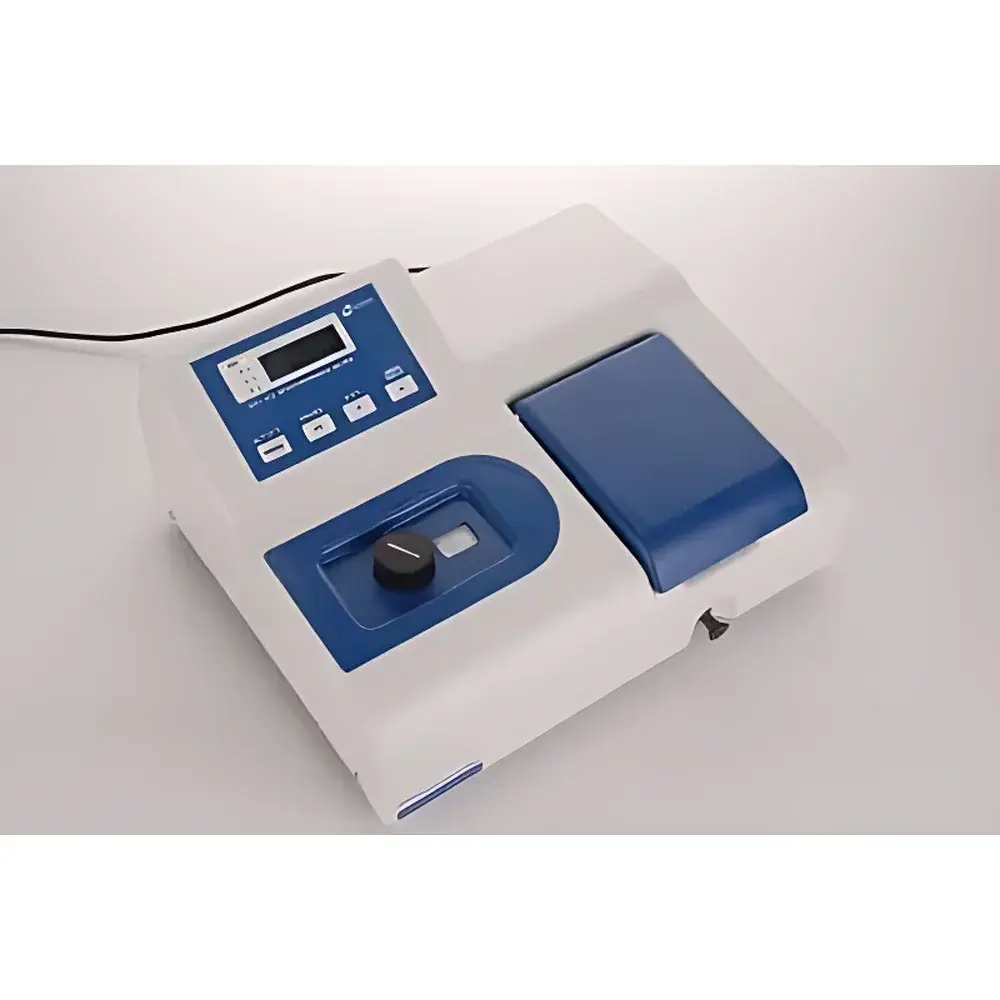
Shanghai INESA UV752 Ultraviolet-Visible Spectrophotometer
| Origin | Shanghai, China |
|---|---|
| Manufacturer Type | Authorized Distributor |
| Origin Category | Domestic (PRC) |
| Model | UV752 |
| Price | USD 1,280 (FOB Shanghai) |
| Optical System | Achromatic Czerny-Turner with 1200 lines/mm grating |
| Wavelength Range | 195–1020 nm |
| Wavelength Accuracy | ±2 nm |
| Spectral Bandwidth | 5 nm |
| Wavelength Repeatability | 1 nm |
| Stray Light | ≤0.3%T at 360 nm |
| Photometric Accuracy | ±0.5%T |
| Photometric Repeatability | ±0.2%T |
| Photometric Range | 0–200%T, –0.301–2.000 A |
| Baseline Drift | ≤0.2%T/h |
| Baseline Linearity | ±0.004 A/h @ 500 nm |
| Noise | ≤0.3%T at 100%T |
| Stability | ±0.004 A/h @ 500 nm |
| Operating Modes | Transmittance (T), Absorbance (A), Concentration (C) |
| Display | 4-digit LED LCD |
| Zero Adjustment | Automatic |
| Wavelength Drive | Manual |
| Lamp Source | Imported tungsten lamp and deuterium lamp |
| Lamp Switching | Manual |
| Printer Interface | Parallel port (thermal printer, optional) |
| Net Weight | 12 kg |
Overview
The Shanghai INESA UV752 Ultraviolet-Visible Spectrophotometer is a benchtop single-beam optical instrument engineered for routine quantitative and qualitative analysis in the 195–1020 nm spectral range. It operates on the principle of Beer–Lambert law-based absorption spectroscopy, utilizing a fixed-grating Czerny-Turner monochromator with a 1200 lines/mm holographic grating to resolve incident polychromatic light into discrete wavelengths. The system integrates dual-lamp architecture—comprising an imported deuterium lamp for UV region (195–350 nm) and an imported tungsten-halogen lamp for visible/NIR region (350–1020 nm)—with manual lamp switching to ensure spectral continuity and photometric consistency across the full operating range. Designed for robustness in high-throughput laboratory environments, the UV752 features an automated optical shutter that minimizes exposure of the silicon photodiode detector to ambient light during idle periods, thereby extending sensor lifetime and improving long-term measurement reproducibility. Its mechanical and optical architecture complies with fundamental design conventions defined in ISO 13703:2001 (spectrophotometers — performance specifications) and supports method validation protocols aligned with USP , EP 2.2.25, and ASTM E275–22.
Key Features
- Spacious sample compartment accommodating standard cuvettes from 5 mm to 100 mm pathlength—enabling flexibility in dilution strategy and compatibility with microvolume adapters (when used with optional holders)
- Integrated automatic zeroing circuitry eliminating manual dark-current adjustment and reducing operator-induced variability between measurements
- Critical optical and electronic components—including grating, photodetector, and lamp assemblies—sourced from internationally certified suppliers to meet stringent metrological traceability requirements
- High-stability dual-lamp housing with thermal management design minimizing wavelength drift during extended operation
- Dedicated parallel-port interface supporting industry-standard thermal printers for GLP-compliant hardcopy output of spectra, calibration reports, and sample logs (printer sold separately)
- Compact footprint (450 × 360 × 220 mm) and 12 kg net weight facilitating integration into regulated QC labs with limited bench space
Sample Compatibility & Compliance
The UV752 accepts standard rectangular quartz, glass, or plastic cuvettes (10 mm nominal pathlength) as well as specialized cells for turbid, viscous, or low-volume samples. Its open optical path allows direct insertion of flow cells, fiber-optic probes, or integrating spheres (with third-party adapters). While the instrument itself does not include built-in audit trail or electronic signature functionality, its analog/digital signal chain and deterministic manual operation support paper-based GMP/GLP workflows per FDA 21 CFR Part 11 Annex A guidelines. All photometric calibrations can be verified using NIST-traceable neutral density filters (e.g., Schott NG series) and holmium oxide solution reference standards. The device meets electromagnetic compatibility (EMC) requirements per IEC 61326-1:2020 and safety standards per IEC 61010-1:2010.
Software & Data Management
The UV752 operates as a standalone hardware platform with embedded firmware controlling wavelength selection, signal amplification, analog-to-digital conversion (12-bit resolution), and display rendering. No proprietary PC software is required for basic operation; however, optional RS-232 or USB-to-serial adapters enable connection to external PCs running custom LabVIEW, Python (PySerial), or MATLAB scripts for automated data capture, batch processing, and report generation. Raw absorbance/time or %T/wavelength datasets are exportable in ASCII-delimited format compatible with Excel, OriginLab, and JMP. For regulated environments, users may implement CSV logging with timestamped file naming and folder-level access controls to satisfy ALCOA+ data integrity principles.
Applications
This spectrophotometer serves as a foundational tool in diverse analytical contexts: quantification of nucleic acid concentration (A260) and purity (A260/A280 ratio) in molecular biology labs; determination of enzyme kinetics (e.g., LDH, ALT) via NADH/NADPH monitoring at 340 nm; verification of cleaning agent residuals in pharmaceutical equipment (per USP ); heavy metal analysis (e.g., Cr(VI) via diphenylcarbazide complex at 540 nm) in environmental water testing; assay of active pharmaceutical ingredients (APIs) in tablet dissolution studies; and quality control of dyes, pigments, and polymer additives in petrochemical R&D. Its 5 nm spectral bandwidth provides adequate resolution for most fixed-wavelength assays while maintaining sufficient radiant throughput for low-light applications.
FAQ
Is the UV752 compliant with ISO/IEC 17025 requirements for accredited testing laboratories?
The instrument’s metrological performance—particularly wavelength accuracy (±2 nm), photometric repeatability (±0.2%T), and stray light (<0.3%T)—meets minimum criteria outlined in ISO/IEC 17025:2017 Clause 6.4 for equipment suitability. Full compliance requires documented calibration against traceable standards, uncertainty budgeting, and periodic verification per internal SOPs.
Can the UV752 be used for kinetic measurements?
No—the UV752 lacks time-scan or multi-wavelength kinetic acquisition capability. It supports only single-point or multi-point fixed-wavelength readings. For kinetic studies, consider the UV752N variant or higher-tier models with scanning and time-course modules.
What maintenance is recommended for long-term reliability?
Biannual inspection of lamp intensity output, cleaning of cuvette holder optics with lens-grade tissue and isopropanol, and verification of zero stability after warm-up (≥30 min) are advised. Lamp replacement intervals average 1,000 hours for deuterium and 2,000 hours for tungsten sources.
Does the instrument support USB or Bluetooth connectivity?
No—only parallel port (for printer) and optional RS-232 serial interface are provided. USB connectivity requires external serial-to-USB converter with appropriate driver installation.
Is NIST-traceable calibration documentation available?
Yes—calibration certificates issued by INESA’s authorized metrology partner (CNAS-accredited lab) are available upon request at additional cost, including uncertainty statements per GUM (JCGM 100:2008).




