
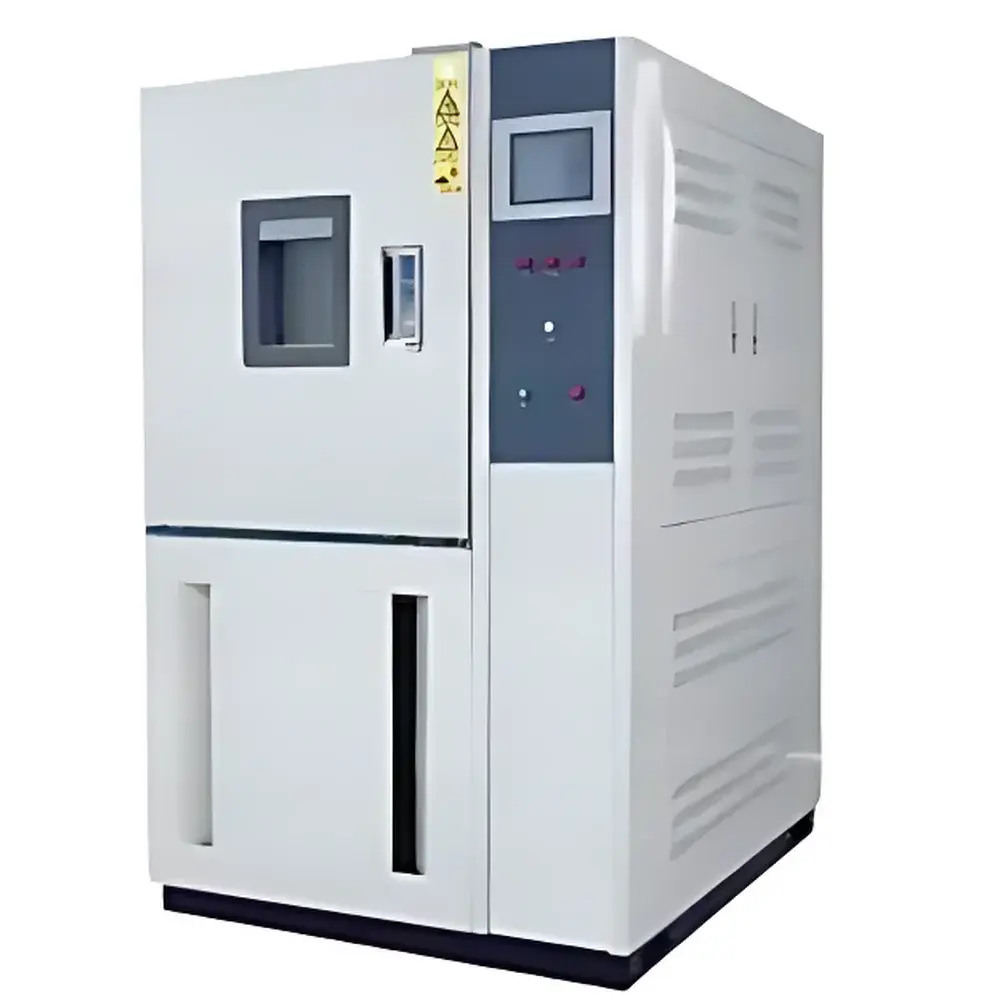
Shanghai Jinhoo LRT Series Large-Scale Environmental Stress Screening Chamber (Temperature & Humidity)
| Key | Brand: Jinhoo |
|---|---|
| Origin | Shanghai, China |
| Model | LRT |
| Temperature Range | -60 °C to +80 °C |
| Humidity Range | 30–95 %RH |
| Control Accuracy (Programmable Type) | ±0.5 °C / ±3 %RH |
| Control Accuracy (Standard Type) | ±1 °C / ±5 %RH |
| Display Resolution (Programmable) | 0.01 °C / 0.1 %RH |
| Display Resolution (Standard) | 0.1 °C / 1 %RH |
| Heating Rate | ~60 min (from -60 °C to +80 °C) |
| Cooling Rate | 90–210 min (dependent on low-temp configuration A–D) |
| Power Supply | AC 3-phase 380 V, 50 Hz |
| Safety Protections | Overcurrent, overload, compressor overheat, emergency power cutoff |
Overview
The Jinhoo LRT Series Large-Scale Environmental Stress Screening (ESS) Chamber is an industrial-grade, walk-in environmental test system engineered for thermal and humidity conditioning of large-volume or high-mass test articles. Designed in accordance with fundamental principles of convective heat transfer and psychrometric control, the chamber delivers stable, repeatable temperature-humidity profiles across volumetric test spaces—supporting accelerated life testing, burn-in validation, and reliability qualification protocols. Its architecture integrates dual-stage refrigeration circuits, precision PID-controlled heating/humidification subsystems, and a horizontally distributed air circulation system based on multi-blade centrifugal fans. The LRT series accommodates full-scale assemblies—including avionics racks, automotive ECUs, defense electronics enclosures, and pharmaceutical manufacturing equipment—within customizable internal dimensions, making it suitable for laboratories and production facilities requiring compliance-aligned environmental simulation at scale.
Key Features
- Modular stainless steel and pre-painted galvanized steel panel construction ensures structural integrity, moisture resistance, and long-term dimensional stability under cyclic thermal stress.
- Horizontal airflow design with vertical heat exchange minimizes thermal stratification and achieves uniform temperature distribution (±1.5 °C) and humidity homogeneity (±5 %RH) throughout the working volume, verified per IEC 60068-3-5.
- Dual-circuit refrigeration system utilizes imported compressors (e.g., Bitzer or Copeland) and eco-friendly refrigerants (R404A/R23 cascade or R507), enabling reliable operation down to –60 °C without performance degradation.
- Two control platform options: programmable touchscreen interface (LRT-P) with 0.01 °C/0.1 %RH resolution and ±0.5 °C/±3 %RH control accuracy; or microprocessor-based digital controller (LRT-S) offering robust operation at ±1 °C/±5 %RH accuracy.
- Integrated safety architecture includes compressor overload protection, phase failure detection, overtemperature cut-off, ground-fault circuit interruption, and emergency power disconnect—fully compliant with IEC 61000-6-2 and UL 61010-1 requirements.
- RS-232/485 communication interface supports remote monitoring, script-based test sequencing, data logging, and integration into centralized laboratory information management systems (LIMS) or MES platforms.
- Timed output relay contacts enable synchronized external device triggering (e.g., power cycling, sensor activation) during dynamic test phases—critical for HALT/HASS and MIL-STD-810G Method 502.6 execution.
Sample Compatibility & Compliance
The LRT chamber accommodates large-format test specimens up to custom-defined internal volumes (standard configurations range from 5 to 50 m³). It supports static and dynamic thermal-humidity exposure of finished goods, subassemblies, and raw materials used in aerospace (AS9100), automotive (IATF 16949), medical device (ISO 13485), and pharmaceutical (ICH Q1A–Q5E) supply chains. Test profiles conform to ASTM D4332, ISO 6270-2, JEDEC JESD22-A104, and MIL-STD-810G environmental test methods. Optional calibration certificates traceable to NIM (China National Institute of Metrology) or UKAS-accredited labs are available upon request. The system’s operational envelope and control fidelity meet prerequisite conditions for GLP-compliant stability studies and GMP-aligned equipment qualification (IQ/OQ/PQ).
Software & Data Management
The LRT-P variant includes embedded Windows CE-based controller firmware supporting user-defined multi-step temperature-humidity ramps, dwells, and cycles—with up to 100 programmable segments per profile. Real-time data acquisition records temperature, relative humidity, setpoint deviation, alarm status, and runtime diagnostics at configurable intervals (1–60 sec). Export formats include CSV and Excel-compatible .xls files. Optional PC software enables remote supervision via Ethernet or USB, audit trail generation with user authentication (aligned with FDA 21 CFR Part 11 requirements), and automated report generation including pass/fail evaluation against predefined acceptance criteria. All logged data retain time stamps with millisecond precision and are stored redundantly on both internal flash memory and external USB drives.
Applications
- Thermal burn-in screening of power electronics, battery modules, and motor controllers prior to field deployment.
- Environmental stress screening (ESS) of military-grade communication systems per MIL-STD-883 Method 1010.8.
- Accelerated aging of polymer components, adhesives, and composite laminates under combined thermal-humidity load.
- Stability chamber validation for pharmaceutical packaging and active ingredient storage protocols (ICH Q1A–Q5E).
- Climate simulation for automotive infotainment units, ADAS sensors, and EV charging infrastructure under extreme ambient conditions.
- Pre-shipping environmental conditioning of large-scale industrial automation panels and control cabinets.
FAQ
What is the difference between LRT-P and LRT-S models?
The LRT-P features a programmable touchscreen HMI with higher control accuracy (±0.5 °C / ±3 %RH), finer display resolution (0.01 °C / 0.1 %RH), and advanced data logging capabilities. The LRT-S uses a microprocessor-based digital controller optimized for basic steady-state and step-change testing with ±1 °C / ±5 %RH accuracy.
Can the chamber be customized for non-standard internal dimensions?
Yes—modular panel design allows scalable internal volume configuration. Customers may specify height, width, depth, door orientation, and internal shelving layout during order placement.
Is the system compliant with FDA 21 CFR Part 11 for electronic records?
The optional PC software package includes role-based access control, electronic signatures, and immutable audit trails—enabling compliance when deployed within validated laboratory environments.
What refrigerant is used, and is it ozone-safe?
The system employs R404A/R23 cascade or R507 refrigerant blends—zero ozone depletion potential (ODP = 0) and globally accepted under current F-Gas Regulation and EPA SNAP program guidelines.
How is temperature uniformity verified inside the chamber?
Uniformity is assessed using a minimum of nine calibrated PT100 sensors placed on a 3×3 grid per IEC 60068-3-5, with results documented in factory acceptance test (FAT) reports provided with each unit.



