
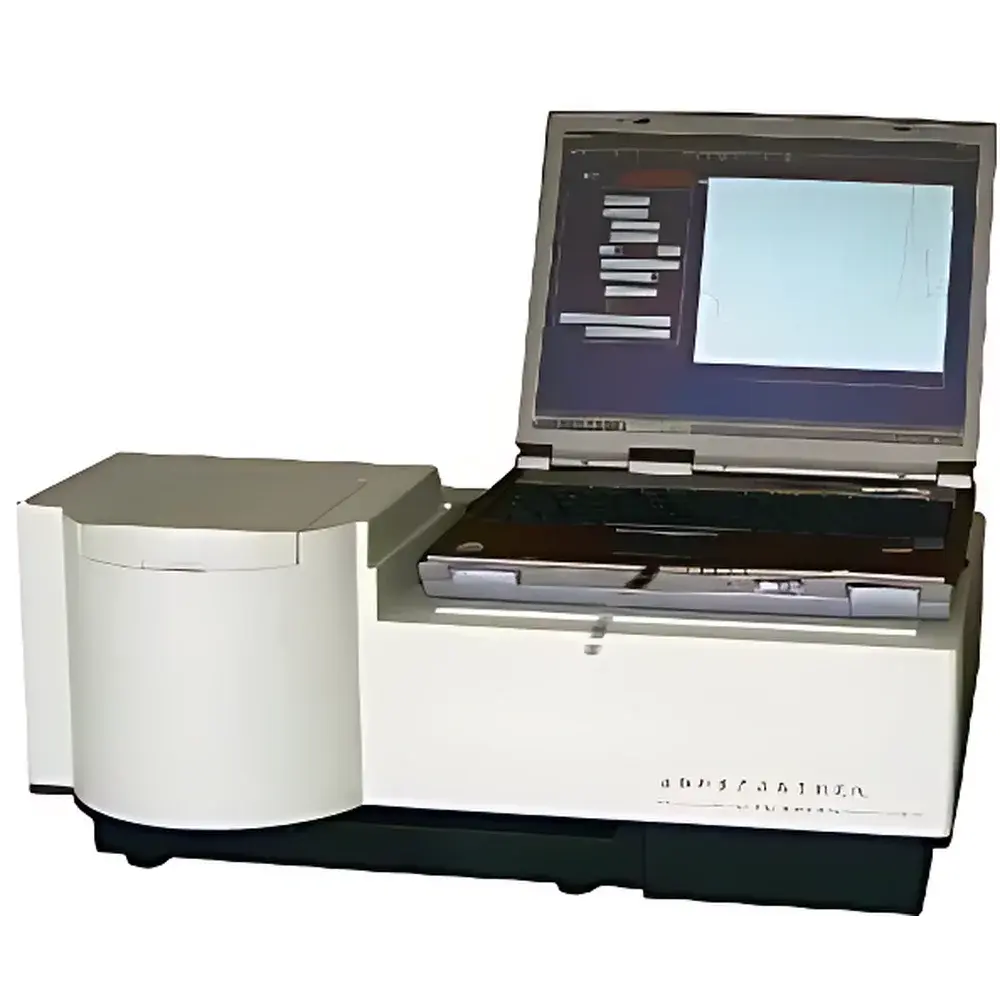
Shanghai Lumex S400 Grating-Based Diffuse Reflectance Near-Infrared Spectrometer
| Brand | Lumex |
|---|---|
| Origin | Shanghai, China |
| Manufacturer Type | Authorized Distributor |
| Product Origin | Domestic (China) |
| Model | S400 Near-Infrared Spectrometer |
| Pricing | Available Upon Request |
| Wavelength Range | 1300–2500 nm |
| Wavelength Repeatability | ≤1 nm |
| Scan Interval Options | 4 cm⁻¹, 8 cm⁻¹, 16 cm⁻¹ |
| Absorbance Repeatability | ≤0.002 A |
| Signal-to-Noise Ratio | ≥10³ (at 2100 nm, 32 scans) |
| Display | 800 × 600 true-color LCD touchscreen |
| Communication Interface | RS-232 serial port |
| Printer Compatibility | Standard inkjet printers |
| Detector | Cooled PbS photodetector (Japan-sourced) |
| Integrating Sphere Reflectance | ≥95% |
| Sample Rotation Stage | Motorized 360° continuous rotation |
| Integrated Sample Holders | Dual-configurable cup and flat-surface cells |
| Scan Time | <120 seconds per spectrum |
Overview
The Shanghai Lumex S400 is a compact, grating-based diffuse reflectance near-infrared (NIR) spectrometer engineered for rapid, non-destructive qualitative and quantitative analysis of heterogeneous solid, powdered, granular, and coated materials. Operating in the 1300–2500 nm spectral region—spanning the first and second overtones of C–H, N–H, and O–H stretching vibrations—the S400 leverages robust optical design and thermoelectrically cooled PbS detection to deliver high photometric accuracy and long-term baseline stability. Its core measurement principle relies on diffuse reflectance spectroscopy (DRS), where incident NIR radiation interacts with sample volume scattering and absorption mechanisms; the resulting remitted intensity is mathematically correlated to chemical composition and physical properties via multivariate calibration models (e.g., PLS, PCR). Designed for field-deployable and laboratory benchtop use, the S400 integrates a motorized rotating sample stage and dual-purpose sample holders to mitigate heterogeneity bias—a critical requirement for agricultural, pharmaceutical, and feed quality control workflows.
Key Features
- Thermoelectrically cooled PbS detector (Japan-sourced) ensures low dark current drift and enhanced signal fidelity across the full 1300–2500 nm range.
- High-efficiency integrating sphere (≥95% reflectance) enables reproducible diffuse reflectance measurements independent of surface texture or particle size distribution.
- Motorized 360° sample rotation stage allows automated multi-angle acquisition per sample, reducing sampling error from compositional segregation or anisotropic scattering.
- Dual integrated sample cells: one optimized for loose powders/granules (depth-adjustable cup), another for flat-surface or coated substrates (contact-mode holder).
- Onboard Windows-compatible control and analysis software supports full instrument self-diagnosis, wavelength calibration, spectral acquisition, real-time model validation, and GLP-compliant report generation.
- Embedded 800 × 600 true-color LCD interface enables standalone operation without external PC; RS-232 serial interface supports integration into LIMS or MES environments.
Sample Compatibility & Compliance
The S400 accommodates diverse physical forms—including whole grains, milled cereals, soybean meal, dairy powders, tablet coatings, textile fibers, polymer pellets, and bulk pharmaceutical excipients—without solvent extraction or derivatization. Its non-contact or minimal-contact measurement mode aligns with ISO 12099:2017 (Animal feeding stuffs — General guidelines for near-infrared spectroscopic analysis) and ASTM E1655-22 (Standard Practices for Infrared Multivariate Quantitative Analysis). While not certified for GMP production release, the system supports audit-ready data handling when used in R&D, incoming inspection, or process monitoring under GLP frameworks. All spectral acquisitions include timestamped metadata, operator ID fields, and configurable audit trails compliant with FDA 21 CFR Part 11 requirements when deployed with validated software configurations.
Software & Data Management
The bundled NIR Analysis Suite runs natively on Windows OS and provides complete lifecycle support for chemometric modeling: spectral preprocessing (SNV, MSC, derivatives), outlier detection, PLS regression, cross-validation, and model transfer between instruments. Raw spectra are stored in vendor-neutral .jdx and .csv formats; calibration models (.mdl) include embedded uncertainty estimates and residual diagnostics. The software enforces role-based access control (administrator/user modes), electronic signature capture for critical operations (e.g., model deployment), and automated backup to network drives or USB storage. All reports—generated in PDF or printer-ready formats—include spectral overlays, prediction confidence intervals, and compliance metadata required for internal QA documentation.
Applications
- Agriculture & Feed: Moisture, protein, oil, starch, and fiber quantification in corn, wheat, soybeans, and compound animal feed.
- Food Industry: Real-time monitoring of fat content in cheese, lactose in milk powder, and adulteration screening in edible oils.
- Pharmaceuticals: Identification of active pharmaceutical ingredients (APIs), blend uniformity assessment, and coating thickness estimation on tablets.
- Chemicals & Polymers: Qualitative verification of polymer grade, plasticizer content, and moisture in hygroscopic resins.
- Textiles: Cotton/viscose/polyester blend ratio determination and finish concentration analysis on woven fabrics.
FAQ
What spectral resolution options does the S400 support?
The S400 offers selectable scan intervals of 4 cm⁻¹, 8 cm⁻¹, and 16 cm⁻¹—corresponding to effective spectral resolutions suitable for routine QC (8 cm⁻¹) and research-grade discrimination (4 cm⁻¹).
Is the instrument capable of transmission measurements?
No—the S400 is configured exclusively for diffuse reflectance geometry. Transmission or transflectance measurements require optional external accessories not included in the base configuration.
Can calibration models built on other NIR instruments be transferred to the S400?
Yes, via the model transfer module using piecewise direct standardization (PDS) or slope/bias correction algorithms, provided spectral alignment and detector response harmonization are performed.
Does the system meet regulatory requirements for pharmaceutical use?
The hardware and software architecture support 21 CFR Part 11 compliance when implemented with validated procedures, electronic signatures, and audit-trail-enabled configurations—but formal GMP validation remains the responsibility of the end-user’s QA department.
What maintenance is required for long-term photometric stability?
Annual wavelength verification using NIST-traceable polystyrene or rare-earth oxide standards is recommended; detector cooling performance should be verified biannually via dark current measurement at ambient and operational temperatures.





