
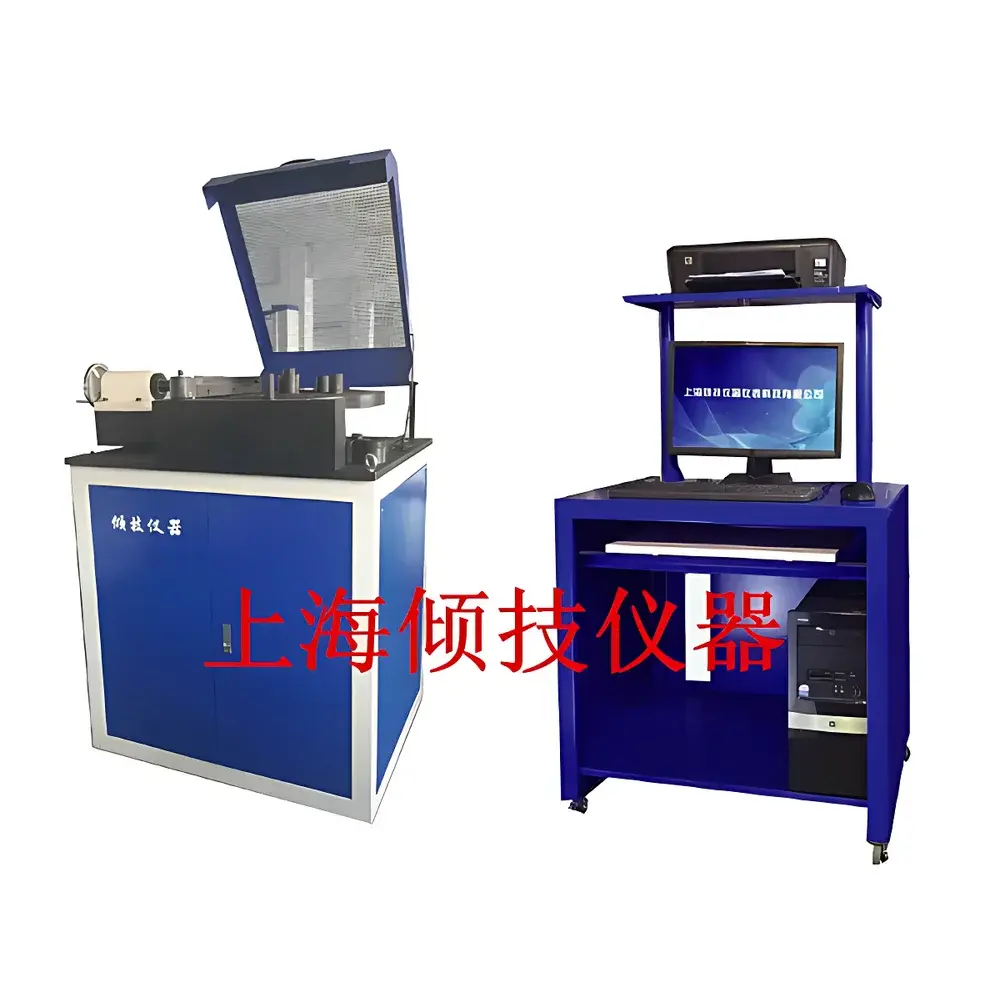
Shanghai-made Rebar Reverse Bending Testing Machine – Model RBM-200 (Torsion & Cyclic Bending Tester for Reinforcing Steel)
| Origin | Shanghai, China |
|---|---|
| Manufacturer Type | Authorized Distributor |
| Model | RBM-200 |
| Price | USD 8,700 (FOB Shanghai) |
| Max Torque | 200 N·m |
| Torque Measurement Range | 180 N·m |
| Torque Resolution | 0.2 N·m |
| Torsion Angle Range | ±180° |
| Motor Power | 1.5 kW |
| Bend Diameter Capacity | ≤ Φ40 mm |
| Forward Bend Angle | 0–180° adjustable |
| Reverse Bend Angle | 0–20° adjustable |
| Bend Speed | 0–1080°/min (programmable) |
| Roller Center Distance | 205 mm |
| Test Platform Diameter | Φ580 mm |
| Dimensions (L×W×H) | 1250 × 950 × 1200 mm |
| Weight | 1450 kg |
| Power Supply | 3-phase 380 V AC |
Overview
The RBM-200 Rebar Reverse Bending Testing Machine is a fully automated, microprocessor-controlled mechanical testing system engineered for standardized cyclic bending evaluation of reinforcing steel bars—particularly deformed (ribbed) rebar per ASTM A615, ISO 6935-2, GB/T 1499.2, and YB/T 5126. It implements a dual-directional bending protocol: first a forward bend to 180° around a fixed-diameter mandrel, followed by a controlled reverse bend of up to 20°, simulating real-world fatigue and ductility demands in structural concrete applications. The machine employs a closed-loop servo control architecture built upon a 32-bit ARM microcontroller platform (licensed from ARM Ltd., UK), integrated with high-resolution optical encoders and precision torque transducers. This ensures traceable angular positioning, repeatable moment application, and compliance-grade data acquisition for quality assurance in steel production, construction materials certification, and third-party testing laboratories.
Key Features
- Programmable bidirectional bending sequence: forward bend (0–180°) + reverse bend (0–20°), both independently adjustable via software interface
- High-fidelity torque measurement using calibrated load cells with ±1% full-scale accuracy and 0.2 N·m resolution
- Angular position feedback via industrial-grade optical encoder; bending angle accuracy: ±1% of set value
- Variable-speed bending actuation: 0–1080°/min, digitally regulated to maintain ±1% speed tolerance across the range
- Rigid cast-iron frame with reinforced test platform (Φ580 mm) and precision-machined roller assembly (center distance: 205 mm)
- Compliant mandrel configuration supporting rebar diameters up to Φ40 mm per ISO 6935-2 Annex A and GB/T 1499.2 Clause 8.2
- Integrated safety interlocks including emergency stop, over-torque cutoff, and physical guard barriers meeting ISO 13857 requirements
Sample Compatibility & Compliance
The RBM-200 accommodates hot-rolled, cold-worked, and thermomechanically treated deformed steel bars conforming to ASTM A615/A615M (Grade 40/60), ISO 6935-2:2015, GB/T 1499.2–2018, JIS G 3112, and DIN 488-2. Mandrel diameters are selected per standard-specified ratios (e.g., 3×, 4×, or 5× bar diameter), and the system supports automatic logging of mandrel ID, bar batch number, and environmental conditions (optional hygrometer/thermometer integration). All test procedures and data outputs align with ISO/IEC 17025:2017 clause 7.2 (method validation) and support audit readiness for GLP/GMP environments. Calibration certificates are traceable to CNAS-accredited national standards.
Software & Data Management
The embedded Windows-based control software provides real-time graphical display of bending moment vs. angle, moment vs. time, and angle vs. time curves. Each test generates an ASCII- and CSV-compatible report containing raw sensor timestamps, interpolated torque/angle values at 10 Hz sampling rate, pass/fail flags per selected standard, and operator metadata. Audit trails record user login, parameter changes, calibration events, and test execution history—fully compliant with FDA 21 CFR Part 11 requirements when deployed with electronic signature modules. Data export supports LIMS integration via ODBC or RESTful API (optional license).
Applications
- Quality conformance testing of reinforcing steel supplied to civil infrastructure projects (bridges, high-rises, dams)
- Ductility verification for seismic-grade rebar under low-cycle fatigue conditions
- Process validation in rolling mill QA/QC labs prior to shipment
- Third-party certification testing per EN 10080, AS/NZS 4671, or CSA G30.18
- Research on strain-hardening behavior and plastic hinge formation in bent rebar zones
- Interlaboratory comparison studies coordinated under ILAC MRA frameworks
FAQ
What standards does the RBM-200 directly support out-of-the-box?
ASTM A615, ISO 6935-2:2015, GB/T 1499.2–2018, YB/T 5126–1993, JIS G 3112:2010, and DIN 488-2:2016.
Can the system perform continuous low-cycle bending fatigue tests?
Yes—it supports programmable multi-cycle sequences (up to 999 cycles) with configurable dwell times, reversal thresholds, and automatic pass/fail evaluation per cycle.
Is torque calibration traceable to international standards?
Yes—factory calibration is performed using NIST-traceable torque standards; optional annual recalibration service includes CNAS-report documentation.
What maintenance intervals are recommended for long-term accuracy?
Optical encoder alignment check every 6 months; torque sensor zero-check before each test session; full mechanical inspection and lubrication annually.
Does the machine support remote diagnostics and firmware updates?
Yes—via secure Ethernet connection using TLS-encrypted remote desktop (Windows Remote Assistance) and signed firmware update packages.



