
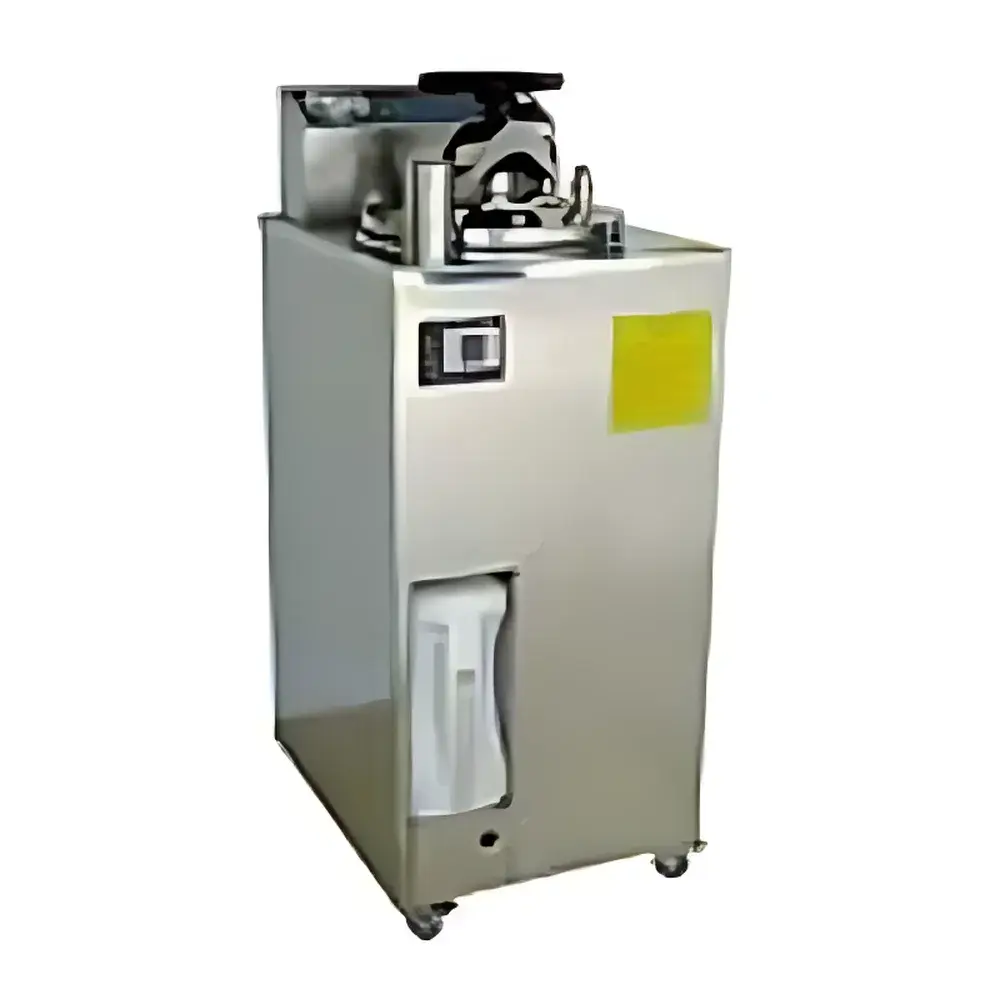
Shanghai-made Vertical Steam Sterilizer YXQ-LS-100A
| Origin | Shanghai, China |
|---|---|
| Manufacturer Type | Authorized Distributor |
| Origin Category | Domestic (China) |
| Model | YXQ-LS-100A |
| Capacity | 100 L |
| Max Operating Temperature | 135 °C |
| Max Working Pressure | 0.22 MPa |
| Power Rating | 4 kW |
| Voltage/Frequency | 220 V ±10%, 50 Hz ±2% |
| External Dimensions (W×D×H) | 600 × 500 × 1260 mm |
| Chamber Diameter × Height | Ø400 × 760 mm |
| Basket Dimensions (Ø × H × Qty) | Ø360 × 240 mm × 3 units |
| Control Modes | Standard exhaust / Pulse exhaust / No exhaust |
Overview
The YXQ-LS-100A is a vertically oriented, microprocessor-controlled steam sterilizer engineered for reliable thermal decontamination of laboratory and pathology instruments, glassware, culture media, and porous loads in compliance with internationally recognized sterilization standards—including ISO 17665-1 (Moist Heat Sterilization) and EN 285 (Large Steam Sterilizers). It operates on the principle of saturated steam under controlled pressure and temperature to achieve microbial lethality through protein denaturation and nucleic acid disruption. Designed for routine use in histopathology labs, clinical research facilities, and academic core laboratories, this unit delivers consistent, traceable, and repeatable sterilization cycles across diverse load configurations. Its vertical architecture optimizes floor space while maintaining full accessibility to the chamber and integrated baskets—critical for high-throughput tissue processing workflows where sterility assurance directly impacts diagnostic integrity.
Key Features
- Compliant handwheel-type quick-opening door with integrated safety interlock mechanism—meets Clause 49 of the Regulations for Safety Supervision of Pressure Vessels (P.R. China), preventing accidental opening under pressure.
- Double-layer construction: inner chamber and outer casing fabricated from medical-grade SUS304 stainless steel—resistant to acidic, alkaline, and saline corrosion encountered during repeated autoclaving and cleaning cycles.
- Intelligent microcomputer control system with real-time digital display of temperature, pressure, time, and phase status; supports programmable cycle selection and parameter recall.
- Dual safety redundancy: pressure-activated relief valve (auto-venting at ≥0.25 MPa) and independent overtemperature cutoff (activation at ≥140 °C).
- Self-sealing silicone gasket with auto-expansion technology ensures leak-tight integrity during pressurization; integrated cold-air purge function eliminates non-condensable gases prior to sterilization.
- Automated water level monitoring with audible/visual low-water alarm and automatic power cutoff to prevent dry-heating damage.
- Three configurable sterilization protocols: standard gravity displacement, pulsed air-steam exchange (for porous or wrapped loads), and no-exhaust mode (for liquid media sterilization with minimized boil-over risk).
- Post-cycle functions include automatic chamber drainage, acoustic end-of-cycle alert, and graceful system shutdown.
Sample Compatibility & Compliance
The YXQ-LS-100A accommodates standard pathology lab loads including stainless-steel instrument sets, borosilicate glassware, autoclavable plastic containers, paraffin-embedded tissue cassettes, and agar-based culture media bottles. Its 100 L chamber volume and three removable Ø360 × 240 mm stainless steel baskets support batch processing aligned with CLSI EP25-A and ISO 15189 pre-analytical requirements. The unit conforms to Chinese GB 8599–2008 (Large Steam Sterilizers) and incorporates design elements compatible with GLP and GMP documentation practices—including cycle logging capability (via optional RS232/USB interface), time-stamped event records, and operator-accessible parameter verification. While not certified to FDA 21 CFR Part 11 out-of-the-box, its control architecture permits integration with validated electronic lab notebook (ELN) systems when paired with compliant data acquisition modules.
Software & Data Management
The embedded controller stores up to 99 user-defined programs with editable setpoints for temperature (0–135 °C), dwell time (0–999 min), and exhaust strategy. Cycle execution logs—including actual temperature/pressure profiles, start/end timestamps, and fault codes—are retained in non-volatile memory for post-run review. Optional PC connectivity enables export of CSV-formatted sterilization reports for audit trails, internal quality reviews, or regulatory submissions. Firmware supports calibration offset adjustments for temperature and pressure sensors, ensuring long-term metrological consistency traceable to NIST-traceable reference standards. All operational parameters adhere to documented change control procedures per ISO/IEC 17025 Clause 7.6.
Applications
This sterilizer serves critical roles in histology core labs—sterilizing tissue processors, embedding centers, microtome accessories, and staining racks—prior to handling formalin-fixed specimens. It is routinely deployed for decontaminating reusable surgical instruments in veterinary and teaching hospitals, validating media sterility in microbiology training, and preparing sterile reagents for IHC and molecular pathology workflows. Its pulse-exhaust mode enhances penetration into wrapped instrument packs and cellulose-based tissue cassettes, while the no-exhaust mode prevents thermal shock and overflow in liquid-filled flasks—supporting USP guidelines for terminal sterilization of aqueous preparations.
FAQ
What is the maximum allowable load weight per basket?
Maximum recommended load per basket is 15 kg to ensure uniform steam penetration and mechanical stability during cycling.
Does the unit support validation with biological indicators (BIs)?
Yes—the chamber geometry and steam distribution profile are compatible with standard Geobacillus stearothermophilus spore strips (e.g., ATCC 7953) placed at geometrically defined challenge locations per ISO 11140-1.
Can the sterilizer be integrated into a building’s central steam supply?
No—it is self-contained and generates steam via internal electric heating elements; external steam input is neither required nor supported.
Is routine calibration of temperature and pressure sensors required?
Yes—annual verification against certified reference standards is recommended; sensor offsets can be adjusted via administrator-level access in the control menu.
What maintenance intervals are advised for the door gasket and safety valves?
Inspect gasket integrity before each use; replace every 12 months or after 500 cycles. Test pressure relief valve functionality quarterly using manual lift-lever verification per manufacturer instructions.
Related Products



