
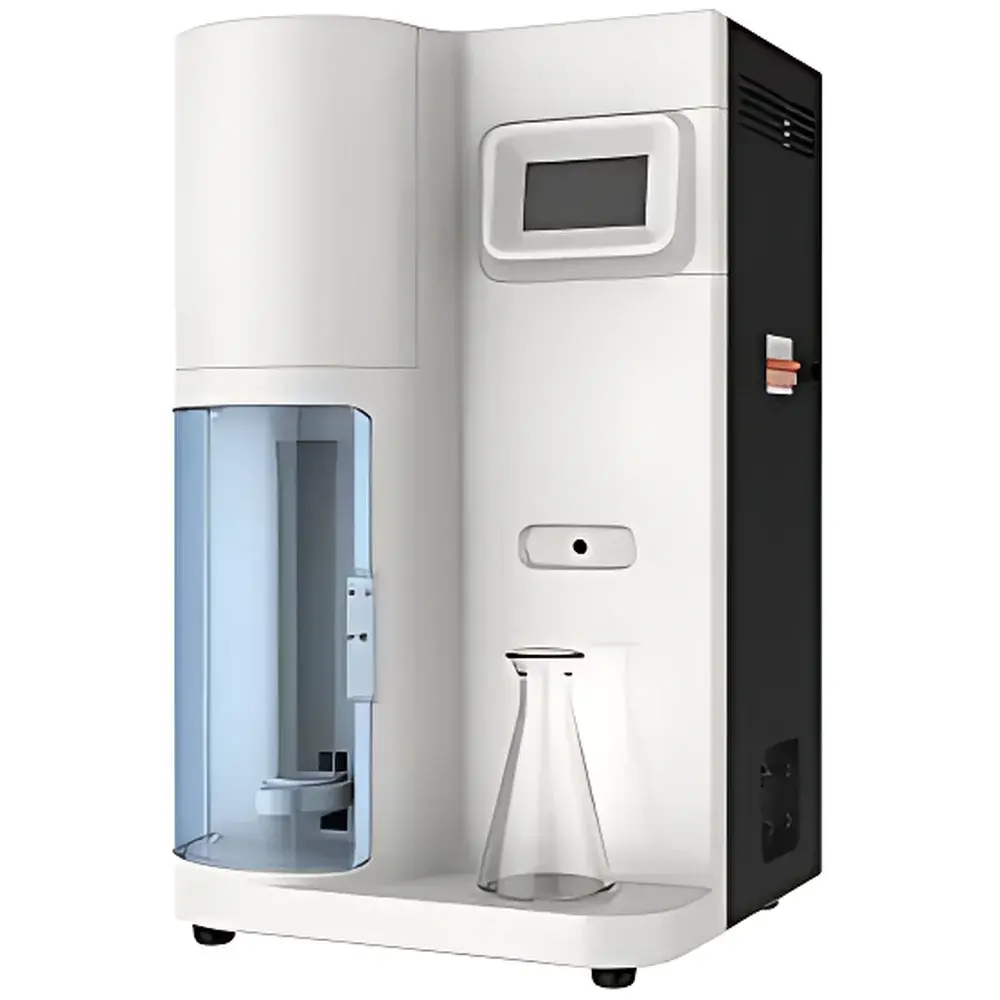
Shanghai Sonnen KA05 Semi-Automatic Kjeldahl Nitrogen Determinator for Cation Exchange Capacity (CEC) Analysis
| Brand | Sonnen |
|---|---|
| Origin | Shanghai, China |
| Model | KA05 |
| Instrument Type | Semi-Automatic Kjeldahl Nitrogen Determinator |
| Automation Level | Semi-Automatic |
| Compliance | GB/T 22923–2008, NY/T 295–1995, LY/T 1243–1999, HJ 717–2014, JJF 109–2012 |
| Measuring Range | 0.06–240 mg N per sample |
| CEC | 0.07–14 cmol/kg |
| LOD | 0.05 cmol/kg |
| Recovery Rate | >99.5% |
| Repeatability (RSD) | ≤0.5% |
| Sample Capacity | ≤5 g solid or ≤15 mL liquid |
| Distillation Time | 3–9 min/sample |
| Steam Flow Rate | 0–30 mL/min (adjustable) |
| Cooling Water Consumption | <2 L/min (at ≤20 °C) |
| Power Supply | AC 220 V ±10%, 50 Hz |
| Rated Power | 1800 W |
| Net Weight | 30 kg |
| Safety Certifications | ISO 9001, CE |
Overview
The Shanghai Sonnen KA05 Semi-Automatic Kjeldahl Nitrogen Determinator is a dedicated analytical platform engineered for the accurate quantification of cation exchange capacity (CEC) in soils and total nitrogen content across diverse matrices—including agricultural feedstocks, environmental samples, pharmaceutical excipients, and industrial fertilizers. Its operational principle follows the classical Kjeldahl method: organic nitrogen is digested under acidic conditions (typically with concentrated H₂SO₄ and catalysts), converted to ammonium sulfate, then liberated as ammonia gas via alkaline distillation, and finally captured in boric acid solution for titrimetric quantification. The instrument integrates controlled steam distillation, precise reagent delivery, and endpoint detection based on colorimetric titration—fully aligned with internationally recognized standard protocols including ISO 5983-1, AOAC 984.13, and the Chinese national standards GB/T 22923–2008 and HJ 717–2014. Designed for laboratory environments requiring regulatory traceability, the KA05 delivers high reproducibility (RSD ≤0.5%) and recovery rates exceeding 99.5%, making it suitable for GLP-compliant soil testing labs, agronomy research centers, and environmental monitoring agencies.
Key Features
- Integrated semi-automatic workflow: automated dilution water addition, reagent dosing, steam generation, and distillation—reducing manual intervention while preserving method flexibility.
- Intelligent steam generator with dual-level water level detection, pressure and temperature sensors, thermal cut-off switches, and anti-dry-burn logic—ensuring stable, safe vapor output within defined safety margins (0–30 mL/min adjustable flow).
- Corrosion-resistant fluid handling system featuring PTFE diaphragm pumps, chemically inert ABS engineering plastic front panel, and sealed acrylic safety hood around digestion tube zone.
- Color TFT touchscreen interface enabling programmable distillation duration, delay/offset timing (0–3600 s), and automatic parameter saving for method recall.
- Real-time cooling water flow monitoring with low-pressure alarm and auto-shutdown upon flow interruption—compliant with lab water conservation guidelines (minimum 1.5 L/min circulation).
- Dual-mode operation: seamless switching between manual and automated distillation modes for method validation or atypical sample types.
- Built-in CEC and nitrogen calculators—accepts user-input sample mass and titrant volume to directly output cmol/kg (CEC) or mg N/g results without external spreadsheet processing.
- Expandability-ready architecture:预留 interfaces for future integration of automatic potentiometric titration modules and smart reagent bucket sensing systems.
Sample Compatibility & Compliance
The KA05 accommodates solid samples up to 5 g (e.g., air-dried sieved soils, compost, fertilizers) and liquid samples up to 15 mL (e.g., digestates, plant tissue extracts, dairy whey). It meets the procedural requirements of multiple official methods: NY/T 295–1995 for neutral soils, LY/T 1243–1999 for forest soils, and HJ 717–2014 for total nitrogen in environmental solids. All hardware and software components are validated per JJF 109–2012 (Calibration Specification for Kjeldahl Nitrogen Determinators), and the system supports audit-ready documentation for ISO/IEC 17025-accredited laboratories. CE marking confirms conformity with EU Machinery Directive 2006/42/EC and Electromagnetic Compatibility Directive 2014/30/EU.
Software & Data Management
The embedded control firmware enables full method parameter logging—including distillation time, steam flow setpoint, delay duration, and reagent volumes—with timestamped storage on internal flash memory. While the base configuration does not include network connectivity or electronic signature capabilities, the system architecture supports future upgrades compliant with FDA 21 CFR Part 11 requirements (e.g., role-based access control, electronic audit trails, and data integrity safeguards) when integrated with validated third-party LIMS or ELN platforms. Calibration records, maintenance logs, and performance verification reports (e.g., recovery checks using certified reference materials like NIST SRM 2710a) can be exported via USB port in CSV format.
Applications
- Soil fertility assessment: routine CEC determination for agricultural land evaluation, liming recommendation, and cation balance modeling.
- Environmental compliance: monitoring nitrogen retention capacity in remediated soils, landfill cover materials, and biosolid-amended substrates.
- Feed and food quality control: protein estimation in cereal grains, oilseeds, and dairy products via nitrogen-to-protein conversion (N × 6.25).
- Fertilizer formulation QA/QC: verification of total N content in urea, ammonium nitrate, and slow-release compounds.
- Pharmaceutical raw material screening: quantification of amine-containing excipients or residual nitrogen in API intermediates.
- Forestry and ecological research: comparative CEC profiling across soil horizons, parent material types, and land-use histories.
FAQ
What standards does the KA05 comply with for soil CEC analysis?
It adheres to NY/T 295–1995 (neutral soils), LY/T 1243–1999 (forest soils), and GB/T 22923–2008 (general soil CEC), all referenced in its design validation and user documentation.
Can the KA05 be upgraded to fully automatic titration?
Yes—the instrument includes pre-wired interfaces for optional automatic titrator integration and reagent level sensing, facilitating future automation expansion without hardware replacement.
Is the system compatible with GLP or ISO/IEC 17025 workflows?
While the base unit lacks electronic signatures or audit trail functionality, its deterministic operation, calibration traceability, and method documentation support GLP-aligned use; full 17025 compliance requires supplementary procedural controls and external data management systems.
What safety protections are implemented during steam generation?
The steam generator incorporates pressure transducers, dual independent temperature sensors, thermal cut-off switches, real-time water level monitoring (capacitive + float), and dry-run prevention logic—all certified under CE machinery safety directives.
How is cooling water consumption minimized?
A closed-loop recirculation mode with flow-rate regulation (1.5–2 L/min), real-time pressure monitoring, and automatic shutdown on flow loss reduce dependency on municipal water supply and align with sustainable lab practices.




