
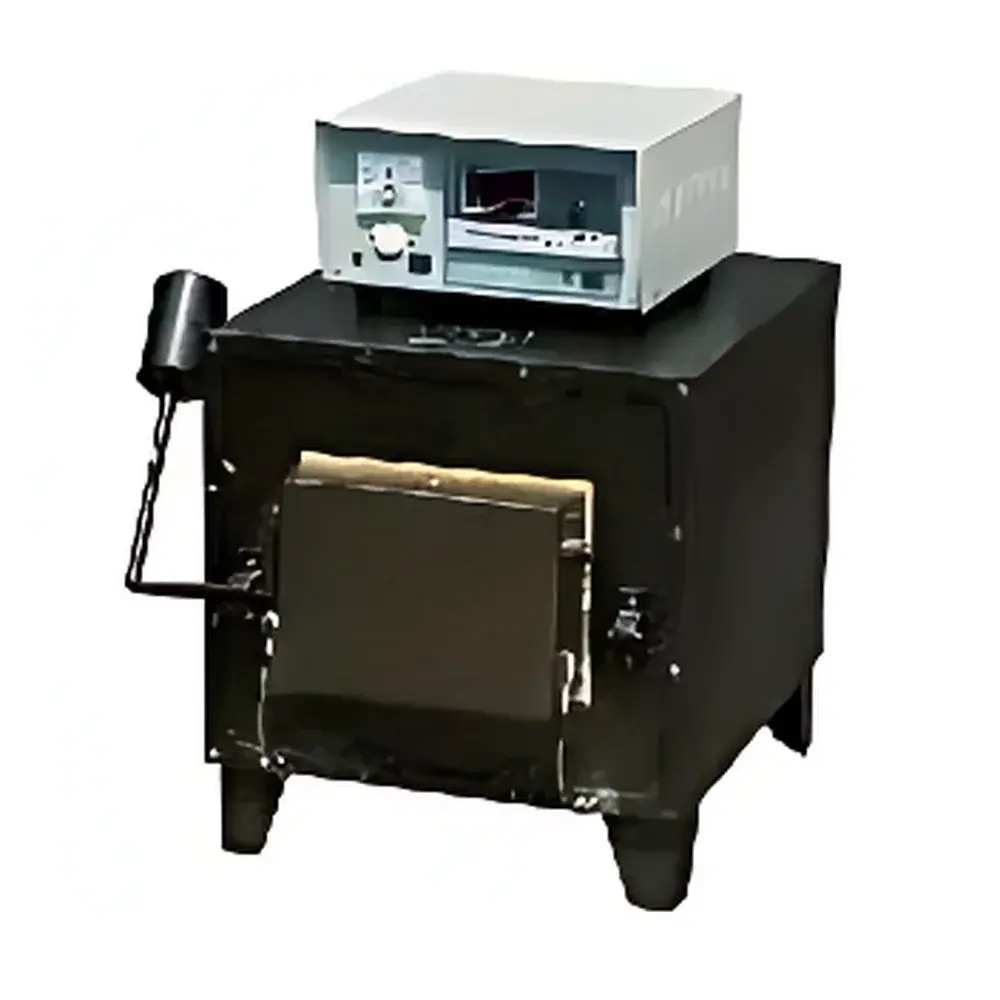
Shanghai Xinrui SX-8-10 High-Reproducibility Box-Type Muffle Furnace
| Origin | Shanghai, China |
|---|---|
| Voltage | 380 V AC |
| Power Rating | 8 kW |
| Internal Chamber Dimensions | 400 × 250 × 160 mm (L × W × H) |
| Maximum Operating Temperature | 1000 °C |
| Heating Element Type | Kanthal A1 resistance wire |
| Insulation | Multi-layer ceramic fiber + refractory brick composite |
| Compliance | Designed per GB/T 10066.1–2004 (General requirements for electric resistance furnaces) |
| Warranty | 12 months parts and labor |
Overview
The Shanghai Xinrui SX-8-10 is a benchtop box-type muffle furnace engineered for precision-controlled, repeatable high-temperature thermal processing in analytical laboratories, materials research facilities, and quality control environments. Operating on the principle of resistive heating via embedded Kanthal A1 alloy heating elements, the furnace delivers uniform temperature distribution across its insulated chamber—critical for applications requiring strict thermal homogeneity, such as ashing of organic samples, heat treatment of small metallic specimens, and pre-sintering of ceramic precursors. With a maximum rated temperature of 1000 °C and a robust thermal architecture featuring dual-layer insulation (ceramic fiber blanket backed by high-density refractory brick), the SX-8-10 achieves rapid heat-up rates while maintaining stable setpoint accuracy within ±5 °C at 1000 °C under steady-state conditions. Its muffle design isolates the heating chamber from combustion byproducts and external contaminants, ensuring sample integrity during prolonged thermal exposure.
Key Features
- Sturdy welded steel outer casing with electrostatic epoxy-polyester powder coating for corrosion resistance and mechanical durability
- Refractory ceramic chamber lined with alumina-silica fiberboard, rated for continuous operation up to 1000 °C
- Front-loading door mechanism utilizing gravity-assisted lever latch—ensures consistent sealing pressure without manual tightening or gasket compression fatigue
- Independent over-temperature protection circuit with K-type thermocouple backup sensor and automatic cut-off at 1050 °C
- Integrated digital PID temperature controller with 0.1 °C resolution, programmable ramp/soak profiles (up to 9 segments), and real-time deviation monitoring
- Energy-efficient thermal design: surface temperature remains below 65 °C at ambient conditions during full-load operation, complying with IEC 61000-3-2 harmonic emission limits
Sample Compatibility & Compliance
The SX-8-10 accommodates standard crucibles (alumina, quartz, nickel, and stainless steel), porcelain boats, and ceramic setters up to 120 mm in height. Its chamber geometry supports ASTM E1529–22 (Standard Test Methods for Determining Ignition Resistance of Materials) specimen trays and USP heavy metals testing protocols. The furnace meets essential safety and performance criteria outlined in GB/T 10066.1–2004 and aligns with general laboratory infrastructure requirements for ISO/IEC 17025-accredited testing laboratories. While not intrinsically certified for hazardous location use (e.g., Class I Div 2), it is suitable for installation in ventilated fume hood enclosures when processing volatile or halogenated organics.
Software & Data Management
The unit includes RS485 serial interface (Modbus RTU protocol) for integration into centralized lab monitoring systems. Optional USB-to-RS485 adapters enable direct connection to Windows-based data acquisition platforms. Temperature logging can be configured to export CSV-formatted time-stamped records—including setpoint, actual temperature, power output %, and alarm status—for audit-ready documentation. When deployed in GLP/GMP-regulated workflows, the controller supports user-level access control (three-tier password protection) and optional 21 CFR Part 11-compliant electronic signature modules via third-party middleware (e.g., LabArchives or Empower 3 extensions).
Applications
- Quantitative ash content determination per AOAC 942.05 and EPA Method 200.7
- Thermal conditioning of calibration standards (e.g., NIST SRM 1977a) prior to XRF analysis
- Controlled oxidation of metal coupons for corrosion rate studies (ASTM G1–03)
- Pre-firing of catalyst supports and battery electrode coatings prior to sintering
- Heat treatment of tool steels (annealing, stress relieving, tempering) in R&D prototyping
- Residue ignition in pharmaceutical residual solvent testing (ICH Q5C)
FAQ
What is the recommended maintenance interval for the heating elements?
Kanthal A1 elements typically sustain >5,000 hours of operation at ≤90% of max rated temperature; visual inspection and resistance measurement are advised every 500 operating hours.
Can this furnace be used for inert-atmosphere processing?
No—this is an air-atmosphere muffle furnace. For controlled atmospheres (N₂, Ar, reducing gases), a sealed tube furnace with gas inlet/outlet ports and pressure regulation is required.
Is the temperature controller factory-calibrated?
Yes—the integrated K-type thermocouple and PID controller undergo traceable calibration against NIST-traceable reference standards prior to shipment; certificate included.
Does the furnace comply with CE marking requirements?
It conforms to EN 61000-6-3 (EMC emission) and EN 61000-6-2 (immunity), but does not carry CE marking due to non-EU manufacturer origin; EU customers must perform local conformity assessment per Directive 2014/35/EU.
What is the typical thermal recovery time after door opening?
From 1000 °C, with door open for 10 seconds, recovery to ±5 °C tolerance requires approximately 4.2 minutes under no-load conditions.



