
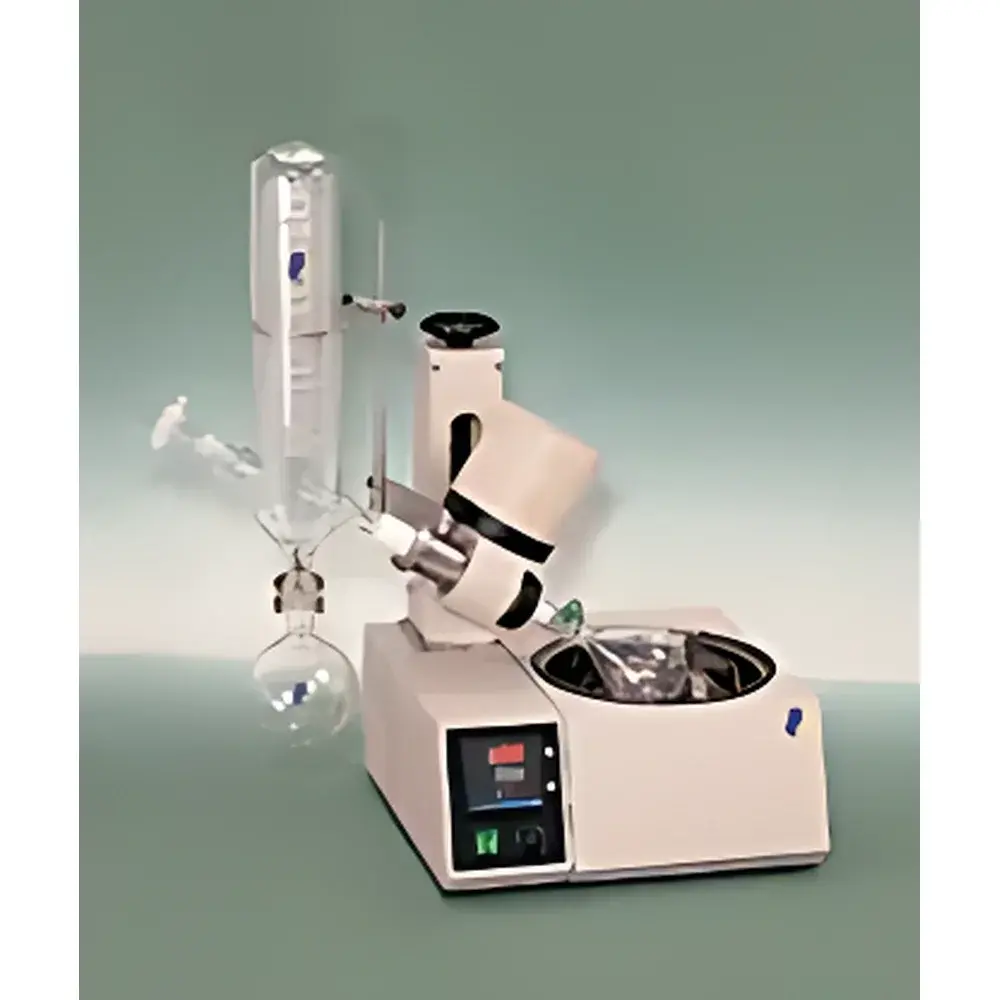
Shanghai Zhenjie RE-52AA Rotary Evaporator
| Origin | Shanghai, China |
|---|---|
| Manufacturer Type | Authorized Distributor |
| Product Origin | Domestic (China) |
| Model | RE-52AA |
| Price | USD 830 (FOB Shanghai) |
| Lift Mechanism | Motorized Vertical Lift |
| Rotational Speed Range | 0–120 rpm |
| Heating Bath Temperature Range | Ambient to 100 °C |
| Condenser Type | Vertical Large-Diameter Dual Coiled Tube |
| Maximum Rotating Flask Capacity | 2 L |
| Collection Flask Capacity (Standard Ground-Glass Joint) | 2 L |
| Total Power Consumption | 1.2 kW |
Overview
The Shanghai Zhenjie RE-52AA Rotary Evaporator is a benchtop vacuum distillation system engineered for reliable solvent removal, concentration, and gentle compound recovery under reduced pressure. Based on the fundamental principle of rotary evaporation—where simultaneous rotation, heating, and vacuum lower the boiling point of solvents while enhancing surface area and mass transfer—the RE-52AA delivers consistent performance for routine purification workflows in academic teaching labs, QC laboratories, and small-scale R&D settings. Its modular architecture supports standard ISO/KS/GB ground-glass joints (24/29 and 29/32), ensuring compatibility with widely adopted laboratory glassware. Designed for operation at ambient-to-100 °C heating bath temperatures and rotational speeds adjustable from 0 to 120 rpm, the system enables precise control over evaporation kinetics—critical when handling thermolabile natural products, pharmaceutical intermediates, or polymer solutions.
Key Features
- Motorized vertical lift mechanism for reproducible, hands-free flask positioning—reducing operator variability and improving ergonomics during repeated batch processing.
- Vertical large-diameter dual coiled condenser with high surface-area geometry, optimized for efficient vapor condensation across a broad range of solvent polarities (e.g., dichloromethane, ethyl acetate, ethanol, water).
- Stainless steel heating bath with PID temperature control, maintaining ±1 °C stability over the full 20–100 °C operating range (ambient start-up supported).
- PTFE-coated rotating shaft and sealed gear motor ensure long-term corrosion resistance and low-maintenance operation in organic solvent environments.
- Integrated vacuum regulation port compatible with diaphragm or oil-sealed vacuum pumps; optional vacuum controller available for programmable ramp-and-hold profiles.
- 2 L standard rotating flask and 2 L collection flask—both equipped with precision-ground 29/32 ball磨 joints—facilitate rapid assembly, leak-tight sealing, and easy cleaning per GLP-compliant lab practices.
Sample Compatibility & Compliance
The RE-52AA accommodates samples ranging from 50 mL to 2000 mL in volume, supporting common applications including post-extraction concentrate thickening, reaction mixture workup, and preparative chromatography fraction solvent removal. It complies with general electrical safety requirements per GB 4793.1–2019 (equivalent to IEC 61010-1) for laboratory equipment. While not certified to UL or CE standards out-of-the-box, its design aligns with core mechanical and thermal safety expectations for Class II laboratory evaporators. Users performing regulated work (e.g., pharmaceutical process development under GMP) may integrate the unit into validated systems using documented IQ/OQ protocols—particularly when paired with calibrated temperature sensors, vacuum transducers, and audit-trail-capable external controllers.
Software & Data Management
The RE-52AA operates as a standalone analog-controlled instrument without embedded digital firmware or onboard data logging. All operational parameters—including bath temperature setpoint, rotation speed, and lift position—are adjusted manually via front-panel dials and switches. For laboratories requiring traceability, it is recommended to pair the unit with external validation-grade instrumentation: a calibrated PT100 probe for bath temperature verification, a tachometer for rpm confirmation, and a digital vacuum gauge with recording capability. When integrated into larger workflow platforms, the RE-52AA can be monitored via SCADA-compatible analog outputs (0–10 V or 4–20 mA) when retrofitted with optional sensor modules—an approach commonly adopted in pilot-scale chemistry labs seeking alignment with FDA 21 CFR Part 11 data integrity principles.
Applications
- Concentration of natural product extracts (e.g., plant alkaloids, essential oils) without thermal degradation.
- Removal of low-boiling solvents (acetone, hexane, ether) following column chromatography or liquid–liquid extraction.
- Preparative-scale solvent exchange (e.g., DMSO to methanol) for crystallization screening studies.
- Teaching demonstrations of colligative properties, vapor pressure depression, and phase equilibria in undergraduate organic chemistry laboratories.
- Stabilization of heat-sensitive APIs prior to lyophilization or spray drying steps in early-phase formulation development.
FAQ
What vacuum level is recommended for optimal performance with the RE-52AA?
A stable vacuum of 10–50 mbar (7.5–37.5 torr) is typically sufficient for most common solvents; final selection depends on solvent boiling point, bath temperature, and desired evaporation rate.
Can the RE-52AA be used with aggressive solvents like chloroform or THF?
Yes—provided all seals are intact and the condenser coolant temperature remains ≥15 °C below the solvent’s dew point; PTFE components provide chemical resistance, but prolonged exposure to strong oxidizers or fluorinated solvents should be avoided.
Is the heating bath filled with water or oil by default?
The bath is designed for either water (≤100 °C) or silicone oil (up to 200 °C); however, the RE-52AA’s specified max temperature is 100 °C, so water is the standard and recommended medium.
Does the unit include a vacuum pump or chiller?
No—vacuum generation and coolant circulation require externally sourced equipment; we recommend pairing with a two-stage diaphragm pump and a recirculating chiller capable of −5 °C output for maximum condensation efficiency.
What maintenance intervals are advised for long-term reliability?
Inspect PTFE seals and ground-glass joints monthly; clean condenser coils quarterly with isopropanol; verify bath temperature accuracy annually using a NIST-traceable thermometer.
Related Products



