
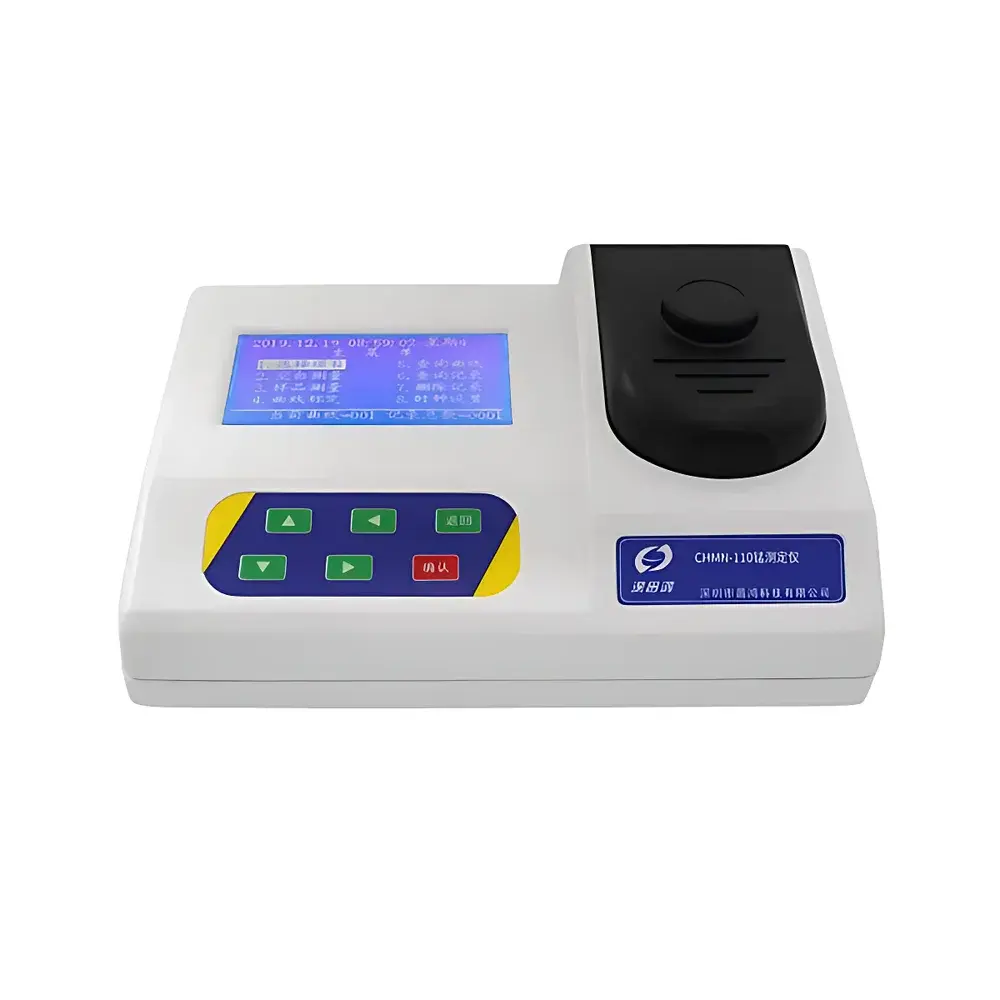
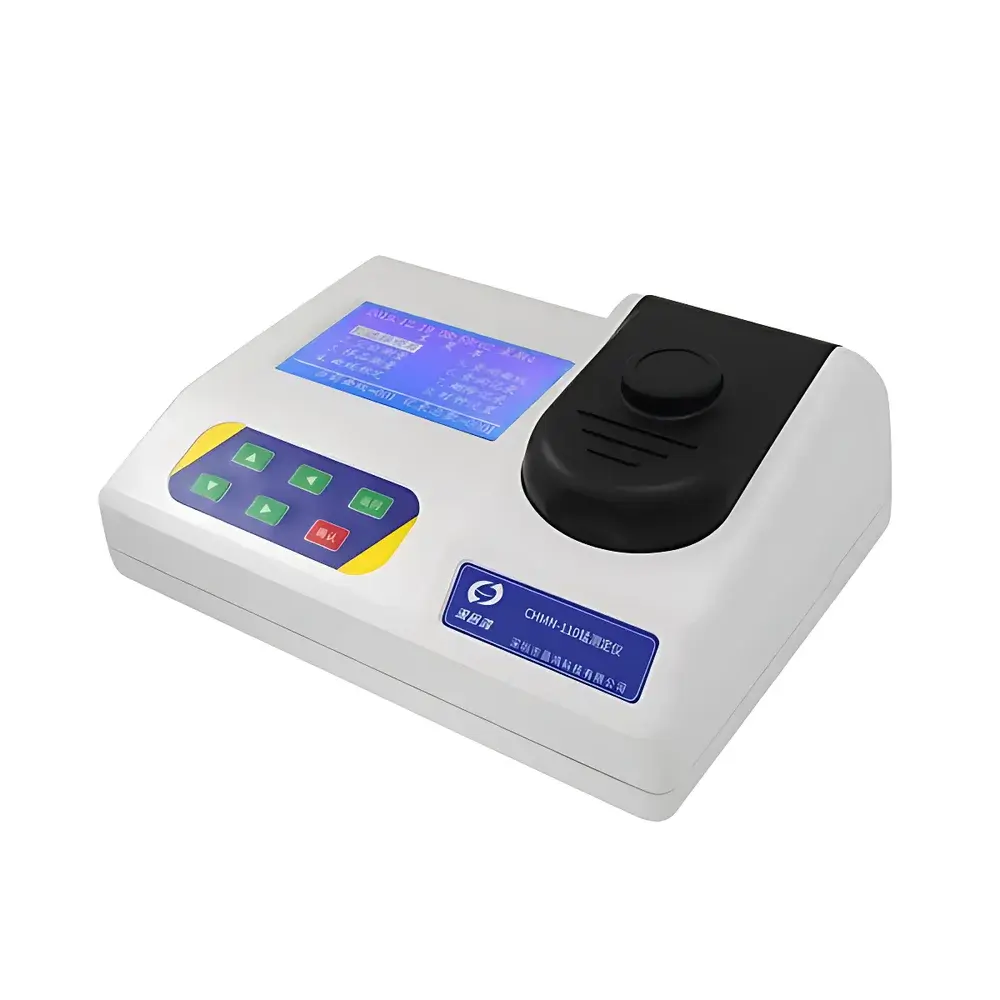
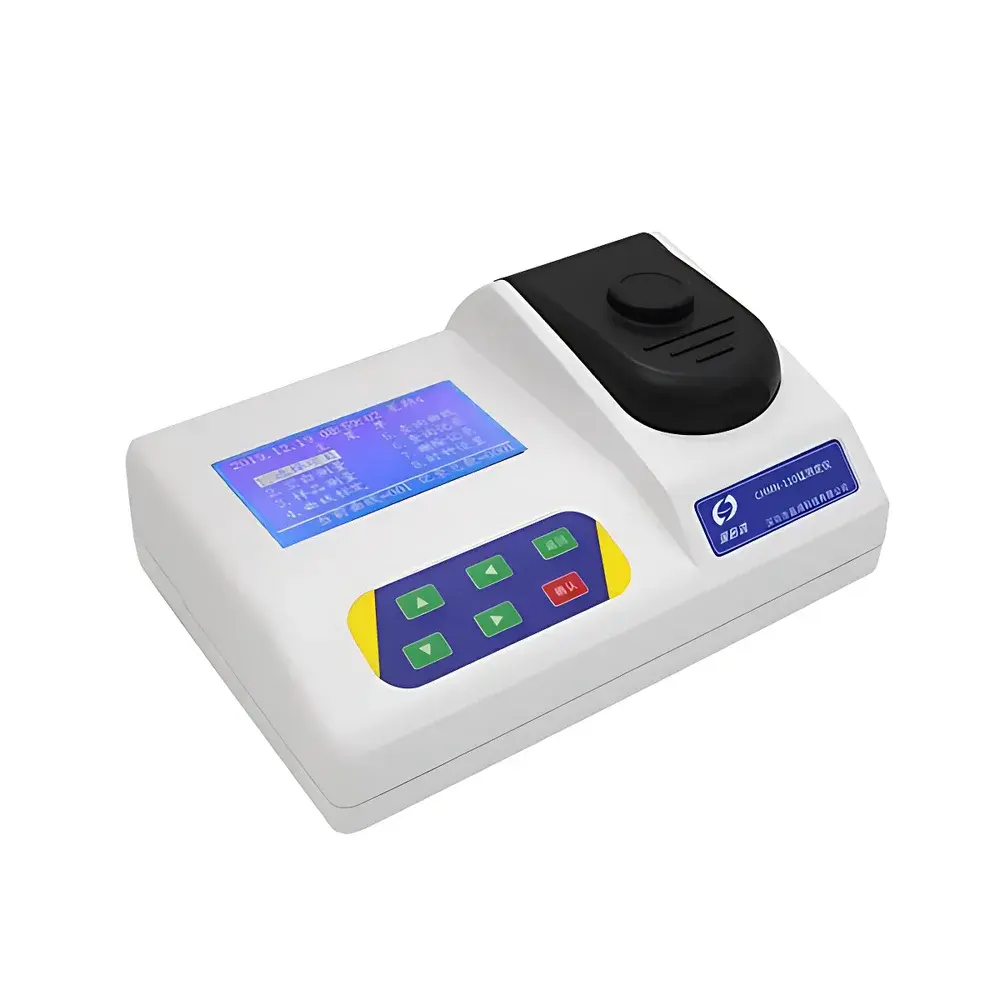
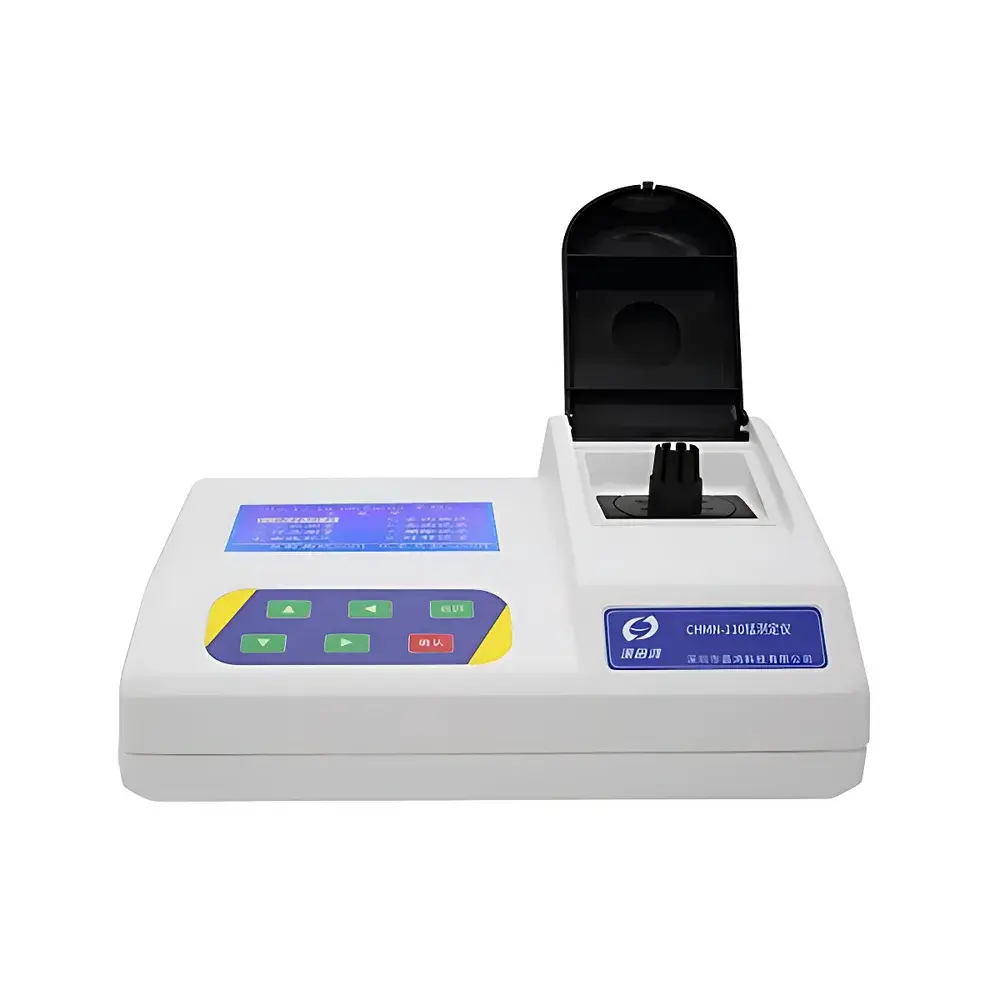
Shenchanghong CHMN-110 Benchtop Manganese Photometric Analyzer
| Brand | Shenchanghong |
|---|---|
| Origin | Guangdong, China |
| Manufacturer Type | Direct Manufacturer |
| Origin Category | Domestic (China) |
| Model | CHMN-110 |
| Instrument Type | Benchtop Laboratory Analyzer |
| Detection Principle | Photometry (Visible Spectrophotometry at Fixed Wavelength) |
| Target Analyte | Manganese (Mn²⁺) |
| Measurement Range | 0.02–5.00 mg/L |
| Accuracy (Max. Error) | ≤ ±5% FS |
| Repeatability (RSD) | ≤ 3% |
| Optical Stability | Absorbance Drift < 0.002 A in 20 min |
| Dimensions (W×D×H) | 266 × 200 × 130 mm |
| Weight | < 1.0 kg |
| Operating Temperature | 5–40 °C |
| Relative Humidity | ≤ 85% RH |
| Power Supply | AC 220 V ± 10%, 50 Hz ± 0.5 Hz |
| Display | Backlit LCD with Chinese Interface |
| Data Storage | Internal Memory for Measurement Records & Custom Calibration Curves |
| Housing Material | Corrosion-Resistant ABS Plastic |
| Microcontroller | 16-bit Low-Power MCU Architecture |
Overview
The Shenchanghong CHMN-110 is a dedicated benchtop photometric analyzer engineered for the quantitative determination of dissolved manganese (Mn²⁺) in aqueous environmental samples. It operates on the principle of visible-range spectrophotometry, utilizing a stable monochromatic cold light source and a precision narrow-band optical filter system centered at the optimal absorption wavelength for the manganese–colorimetric reagent complex (typically ~525 nm, per standard APHA 3110 B or ISO 11969 protocols). The instrument employs microprocessor-controlled photometric measurement, automatic zeroing, and linear calibration algorithms to convert absorbance readings directly into manganese concentration (mg/L) without manual calculation. Designed for routine analysis in municipal water quality laboratories, environmental monitoring stations, and industrial effluent control facilities, the CHMN-110 delivers trace-level sensitivity (detection limit ≈ 0.01 mg/L, based on 3σ of blank) and robust performance under variable ambient conditions.
Key Features
- High-stability imported cold-light source coupled with thermally compensated narrow-band interference filters ensures long-term photometric integrity and minimizes spectral drift.
- Optical system optimized for minimal stray light (< 0.5%) and high signal-to-noise ratio, contributing to absorbance stability < 0.002 A over 20 minutes—critical for batch analysis reproducibility.
- Integrated 16-bit low-power microcontroller enables precise analog-to-digital conversion, real-time baseline correction, and embedded linear regression for calibration curve fitting.
- Backlit LCD display with full Chinese menu navigation simplifies operation for non-specialist technicians; supports both factory-installed and user-defined calibration curves (up to 10 stored profiles).
- Durable ABS polymer housing provides resistance to common laboratory reagents (e.g., acidic permanganate digestants, EDTA buffers) and mechanical impact during transport or daily use.
- Benchtop footprint (266 × 200 × 130 mm) and sub-1 kg mass facilitate placement in confined lab spaces or mobile field labs with stable AC power access.
Sample Compatibility & Compliance
The CHMN-110 is validated for use with clarified, filtered water samples meeting standard pretreatment requirements per ISO 5667-3 and EPA Method 200.7. Compatible matrices include drinking water, surface water (rivers, lakes), groundwater, wastewater influent/effluent, and industrial process water—provided turbidity is 2 mg/L, Cu²⁺ > 0.5 mg/L) are masked or removed prior to analysis. While not certified to ISO/IEC 17025 or USP out-of-the-box, the instrument’s documented repeatability (≤3% RSD) and accuracy (≤±5% error vs. NIST-traceable Mn standards) support internal method validation under GLP-compliant QA/QC frameworks. Data output adheres to basic electronic record principles suitable for audit trails when paired with external logging software.
Software & Data Management
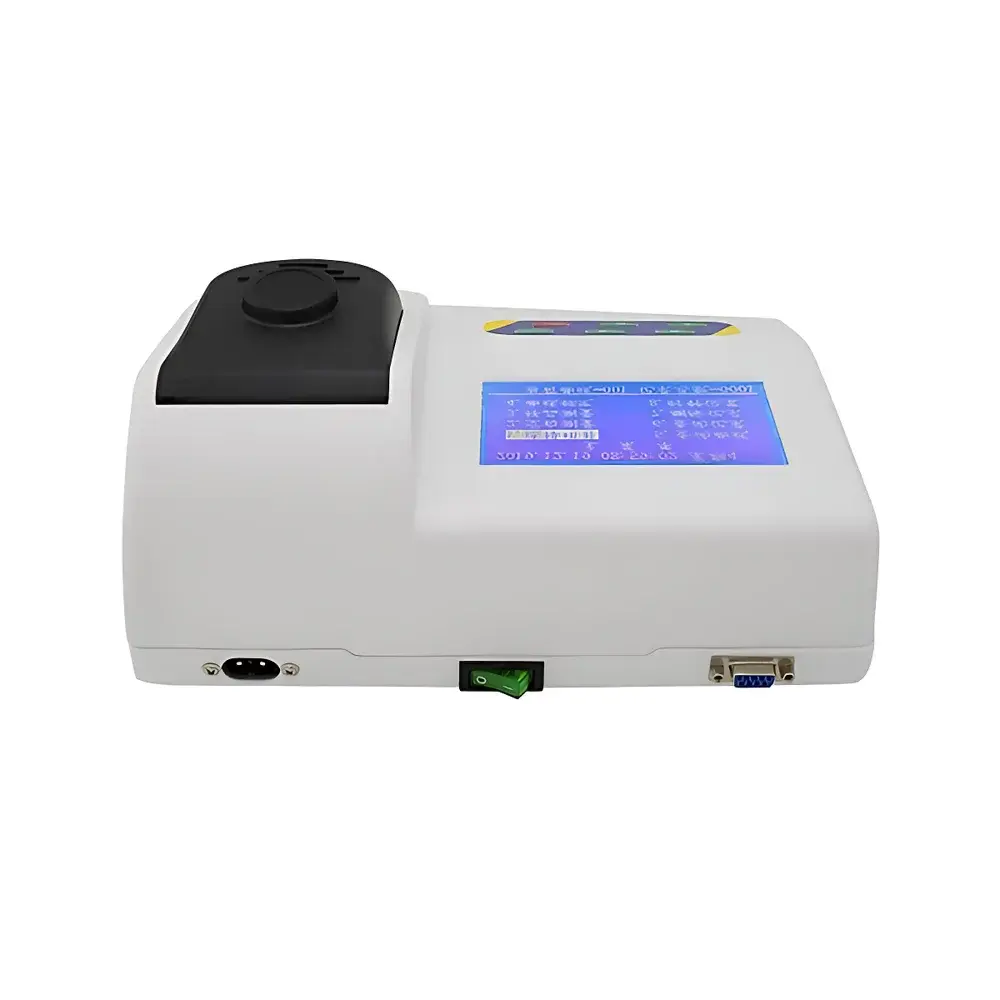
The CHMN-110 features embedded firmware supporting on-device data retention for up to 500 measurement records, including sample ID, date/time stamp, measured absorbance, and calculated Mn concentration. Calibration parameters—including slope, intercept, correlation coefficient (r²), and verification point residuals—are stored per curve. Although no proprietary PC software is bundled, raw CSV export is achievable via optional RS-232 interface (standard DB9 port) using terminal emulation tools compliant with ANSI X3.64. All calibration and measurement logs meet minimum ALCOA+ criteria (Attributable, Legible, Contemporaneous, Original, Accurate) when manually transcribed or exported—sufficient for Tier-1 environmental reporting under China’s HJ/T 91-2002 and comparable regional regulatory frameworks.
Applications
- Regulatory compliance monitoring of Mn in potable water supplies against WHO (0.1 mg/L), EU Drinking Water Directive (0.05 mg/L), and China’s GB 5749-2022 (0.1 mg/L) limits.
- Effluent characterization from mining operations, steel manufacturing, battery recycling, and electroplating facilities where Mn discharge requires continuous tracking.
- Research-grade quantification in limnological studies assessing redox-driven Mn cycling in anoxic sediments or hypolimnetic zones.
- Quality assurance testing of ion-exchange resins, activated carbon filters, and oxidation-filtration systems used in Mn removal technologies.
- Educational use in university environmental chemistry labs for teaching colorimetric assay fundamentals, Beer–Lambert law application, and analytical uncertainty propagation.
FAQ
What sample pretreatment is required before analysis?
Samples must be filtered through a 0.45 µm membrane and acidified to pH < 2 with ultrapure HNO₃ if storage exceeds 24 h. High-turbidity or colored samples require digestion per APHA 3110 B or dilution to fall within the 0.02–5.00 mg/L linear range.
Can the CHMN-110 measure other metals?
No—the optical path, filter set, and pre-programmed algorithm are specifically configured for manganese-specific colorimetry using formaldoxime or PAN reagents; it is not a multi-element platform.
Is the instrument compatible with international calibration standards?
Yes—NIST SRM 3192 (aqueous Mn solution) and CRM batches certified to ISO Guide 34 may be used for initial calibration and periodic verification; certificate traceability must be maintained per ISO/IEC 17025 Clause 6.6.
How often should the optical system be verified?
Absorbance stability should be checked daily using a sealed neutral density filter (OD 1.0); full photometric validation with certified reference materials is recommended weekly or after any maintenance event.
Does the CHMN-110 support GLP-compliant electronic signatures?
No—user authentication and electronic signature functionality are not embedded; however, printed reports generated via RS-232 export can be manually signed and archived to satisfy paper-based GLP documentation requirements.
Related Products







