
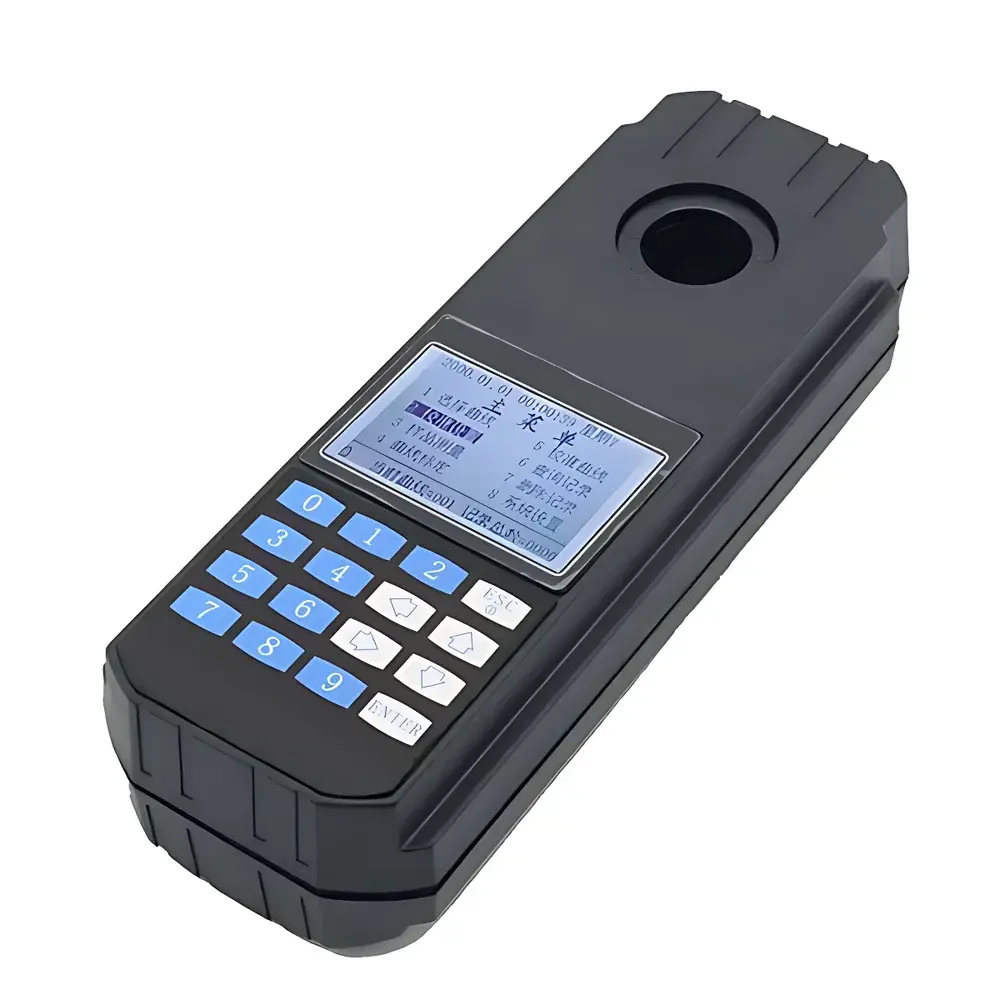
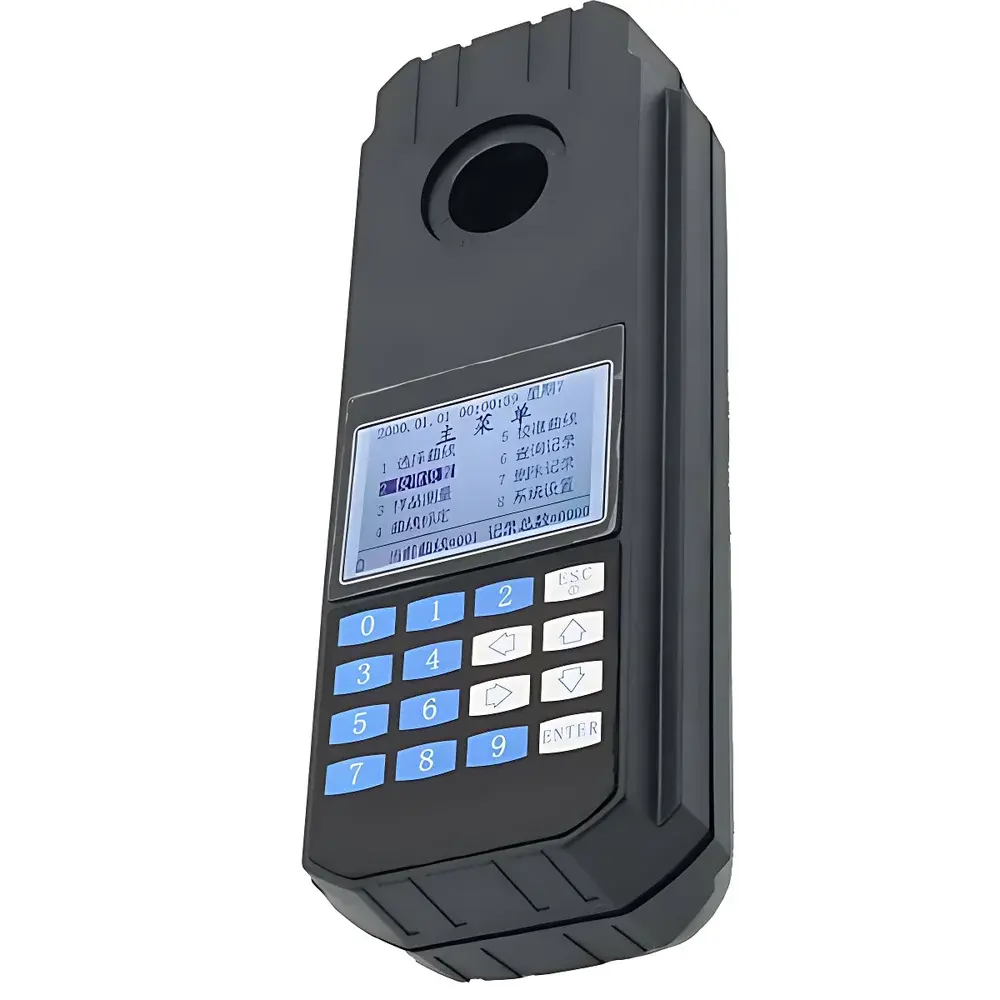
Shenchanghong PCHYS-240 Portable Sulfate Analyzer
| Brand | Shenchanghong |
|---|---|
| Origin | Guangdong, China |
| Manufacturer Type | Direct Manufacturer |
| Country of Origin | China |
| Model | PCHYS-240 |
| Price | Upon Request |
| Measurement Range | 5–200.00 mg/L |
| Accuracy | ≤ ±5% FS |
| Repeatability | ≤ 3% RSD |
| Optical Drift | < 0.002 A in 20 min |
| Dimensions | 80 mm × 230 mm × 55 mm |
| Weight | 500 g |
| Operating Temperature | 5–40 °C |
| Relative Humidity | ≤ 85% RH |
| Power Supply | 4 × AA batteries |
| IP Rating | IP65 |
| Data Storage | 20 calibration curves + 199 timestamped measurements (including absorbance, transmittance, and sulfate concentration with yyyy-mm-dd hh:mm:ss) |
Overview
The Shenchanghong PCHYS-240 Portable Sulfate Analyzer is a field-deployable photometric instrument engineered for rapid, on-site quantification of sulfate (SO₄²⁻) concentration in aqueous samples using the barium chloride–turbidimetric method or a standardized colorimetric assay (e.g., based on turbidity development or complexation with specific reagents). It employs a narrow-band cold light source and fixed-wavelength optical detection—typically at 420 nm or 610 nm depending on the selected chemistry—to minimize spectral interference and ensure stable baseline performance. The device integrates a 16-bit low-power microcontroller, real-time clock (RTC), and embedded firmware calibrated against NIST-traceable sulfate standards. Designed for compliance with common environmental monitoring protocols—including those referenced in EPA Method 375.4, ISO 9297:2000 (Water quality — Determination of sulfate — Turbidimetric method), and GB/T 5750.5-2006 (Standard Methods for Examination of Drinking Water: Inorganic Nonmetallic Indices)—the PCHYS-240 delivers traceable, reproducible results without requiring laboratory infrastructure.
Key Features
- Compact, handheld form factor (80 × 230 × 55 mm; 500 g) optimized for field deployment and mobile water quality surveys.
- IP65-rated ABS polymer housing providing dust-tight, water-resistant, and corrosion-resistant operation in humid, outdoor, or industrial environments.
- Cold LED light source with narrow-band optical filtering ensures minimal thermal drift and long-term photometric stability (< 0.002 A drift over 20 minutes).
- Large backlit LCD display with intuitive menu navigation and real-time visualization of concentration (mg/L), absorbance (A), and transmittance (%T).
- Onboard data management supporting storage of up to 20 user-defined calibration curves and 199 fully timestamped measurement records (year-month-day hour:minute:second).
- Built-in data retention during power loss, preserving calibration settings and historical readings without external memory cards or cloud dependency.
- Low-power design powered exclusively by four standard AA alkaline batteries—enabling continuous operation for >10 hours under typical usage conditions.
Sample Compatibility & Compliance
The PCHYS-240 is validated for use with raw and treated drinking water, surface water, groundwater, municipal wastewater, and moderately contaminated industrial effluents. Sample matrix tolerance has been verified per ISO/IEC 17025 guidelines for interference assessment: chloride concentrations up to 1,000 mg/L, nitrate up to 50 mg/L, and suspended solids < 50 mg/L do not significantly bias sulfate recovery (±5% error limit maintained). All factory calibrations are performed using potassium sulfate reference standards traceable to CRM 8223 (NIST). The instrument meets general requirements for field-portable analyzers under ISO 7027 (Water quality — Determination of turbidity) and supports documentation workflows compatible with GLP and basic GMP record-keeping practices. While not inherently 21 CFR Part 11 compliant due to lack of electronic signature architecture, audit trails—including calibration date/time, operator ID (manually entered), and measurement metadata—are exportable via manual transcription for regulatory reporting.
Software & Data Management
No proprietary PC software or driver installation is required. All configuration, calibration, and data review occur directly on-device via tactile keypad input. Calibration routines support both single-point (zero + one standard) and multi-point (up to five points) linear regression using pre-prepared standard solutions. Each stored curve retains slope, intercept, correlation coefficient (r²), and date/time stamp. Measurement records include full metrological context: sample ID (user-entered), measured absorbance, calculated concentration, % transmittance, and full timestamp. Data may be manually transcribed or photographed for inclusion in LIMS or QA/QC reports. Firmware supports language-independent numeric entry and unit consistency (mg/L only), minimizing interpretation errors across multilingual field teams.
Applications
- Routine surveillance of sulfate levels in municipal water distribution systems to comply with WHO guideline values (250 mg/L) and national drinking water standards.
- Field verification of sulfate removal efficiency in ion exchange, reverse osmosis, or lime softening units at water treatment plants.
- Baseline and post-remediation monitoring of sulfate contamination in acid mine drainage (AMD) sites and abandoned mining zones.
- Quality control testing of process water in pharmaceutical manufacturing, where sulfate is a critical inorganic impurity per ICH Q5D and USP .
- Educational use in environmental science laboratories for teaching spectrophotometric principles, calibration theory, and regulatory compliance frameworks.
FAQ
What sulfate detection method does the PCHYS-240 employ?
It uses a standardized colorimetric or turbidimetric reaction—typically barium chloride precipitation or a chromogenic complex formation—followed by fixed-wavelength photometric measurement.
Is the instrument suitable for seawater analysis?
Not recommended for undiluted seawater due to high ionic strength and chloride interference; dilution and matrix-matched calibration are required for semi-quantitative estimation.
Can calibration curves be edited or deleted in the field?
Yes—users may overwrite, rename, or delete any of the 20 stored calibration profiles using the device’s setup menu.
Does the analyzer include validation documentation?
Each unit ships with a factory calibration certificate referencing standard reference materials, plus a declaration of conformity to GB/T 18204.2–2014 (Chinese national standard for hygiene inspection methods).
How often must the optical path be cleaned?
The cuvette chamber and lens surface should be wiped with lint-free tissue and ethanol after every 10 measurements in turbid or high-salinity samples to maintain optical integrity.
Related Products







