
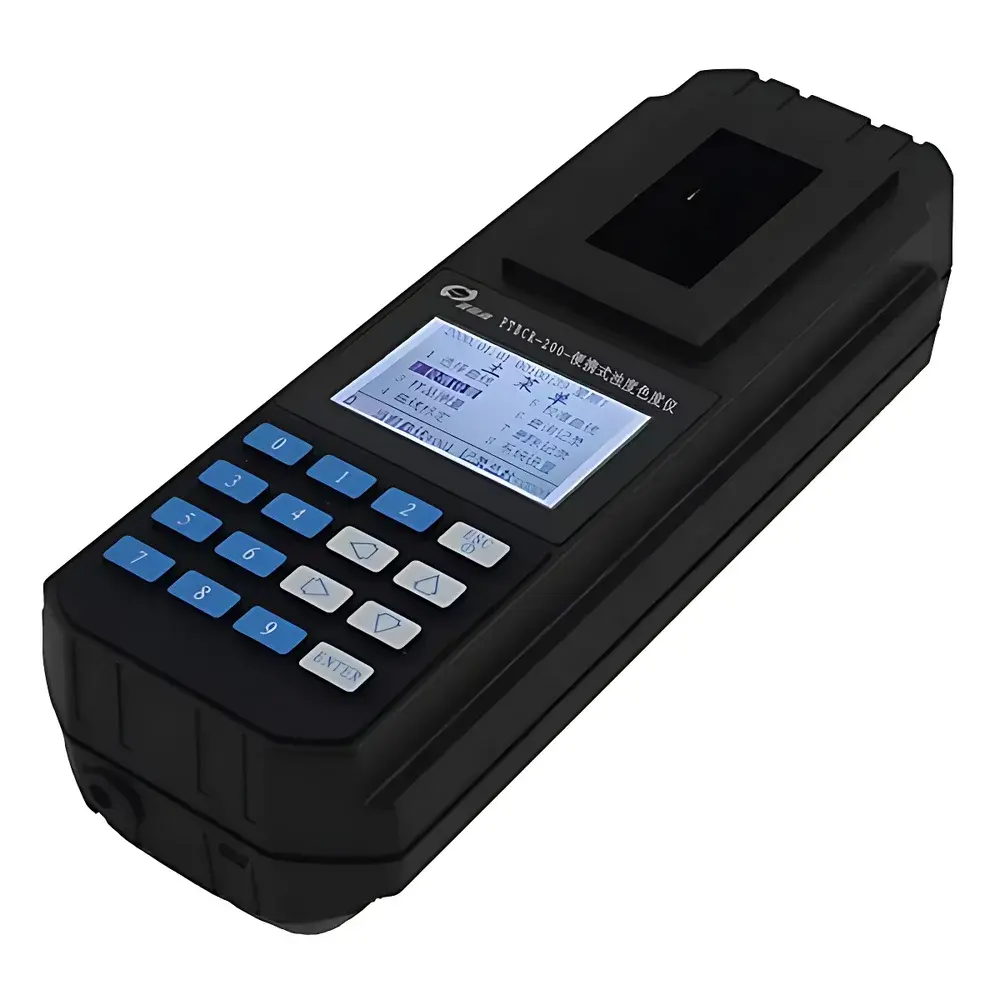
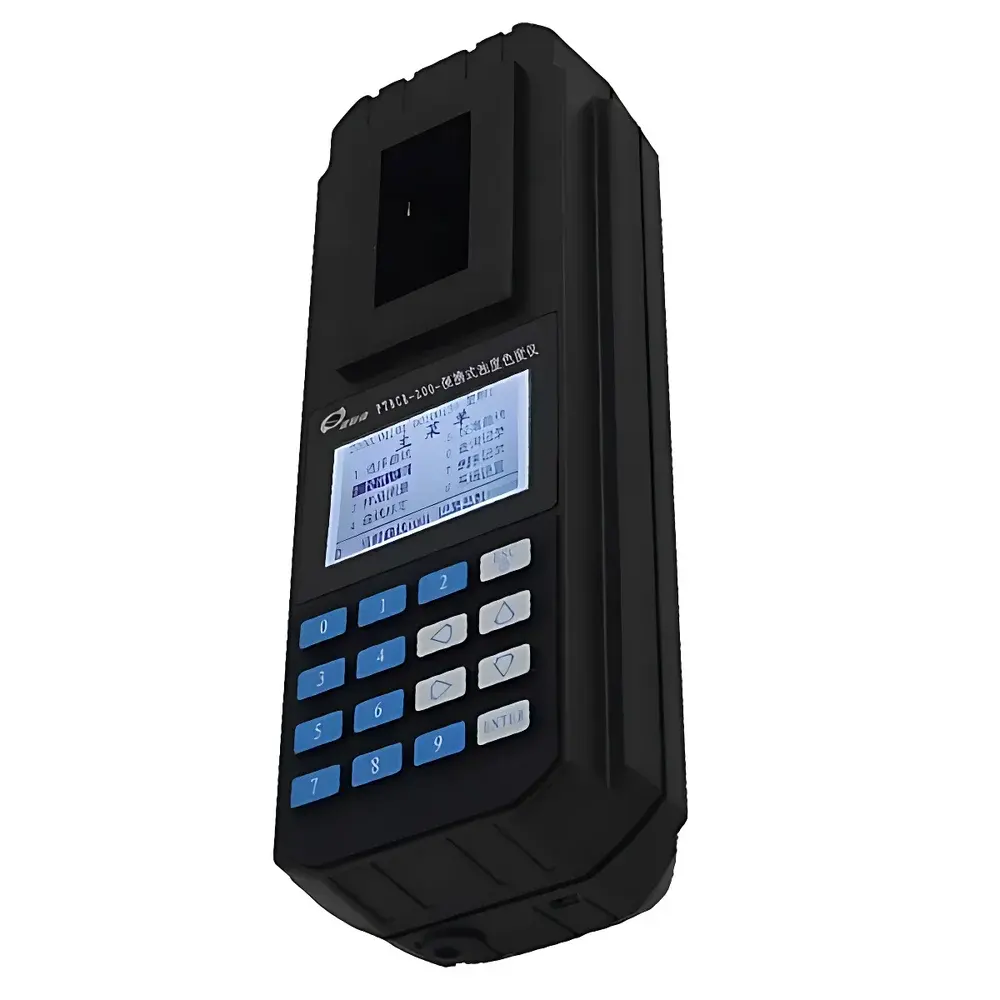
Shenchanghong PTBCR-200 Portable Turbidity and Color Analyzer
| Brand | Shenchanghong |
|---|---|
| Origin | Guangdong, China |
| Manufacturer Type | Direct Manufacturer |
| Country of Origin | China |
| Model | PTBCR-200 |
| Product Type | Portable |
| Turbidity Range | 0.00–400 NTU |
| Color Range | 1.0–500 PCU |
| Resolution | 0.01 PCU |
| Operating Temperature | 5–40 °C |
| Accuracy | ≤ ±2 % F.S. (Turbidity), ≤ ±3 % F.S. (Color) |
| Repeatability | ≤ ±2 % F.S. |
| Drift | < 0.002 A/h |
| Power | Rechargeable Li-ion Battery |
| Weight | 1.0 kg |
| Dimensions | 80 × 230 × 55 mm |
| IP Rating | IP65 |
| Data Storage | 20 calibration curves + 199 measurement records |
| Interface | USB |
Overview
The Shenchanghong PTBCR-200 Portable Turbidity and Color Analyzer is an integrated optical instrument engineered for simultaneous, field-deployable measurement of turbidity (NTU) and true color (PCU) in aqueous samples. It operates on the principle of nephelometric detection for turbidity—measuring scattered light intensity at 90° relative to the incident beam—and spectrophotometric analysis for color using narrow-band interference filters and a stabilized cold-light source. Designed for compliance with ISO 7027 (turbidity) and APHA Standard Methods 2120B (platinum-cobalt color scale), the PTBCR-200 delivers traceable, repeatable results under variable environmental conditions. Its compact form factor, IP65-rated enclosure, and extended battery life support unattended operation in municipal water distribution networks, pharmaceutical process water lines, beverage production facilities, and public health field surveys—without reliance on laboratory infrastructure.
Key Features
- Optical architecture incorporating high-stability, long-life imported LED light sources and precision narrow-band interference filters—ensuring minimal spectral drift and high photometric reproducibility.
- 16-bit low-power microcontroller platform enabling up to six months of standby time on a single charge; optimized firmware supports automatic zero calibration and dark-current compensation.
- Ruggedized ABS housing with IP65 ingress protection—resistant to dust, splashing water, and mild chemical exposure encountered during field sampling or plant-floor use.
- Onboard data management: stores 20 user-defined calibration curves and 199 measurement records with timestamping; supports data export via standard USB 2.0 interface for traceability and audit readiness.
- Integrated power management with rechargeable lithium-ion battery (included), delivering >10 hours of continuous operation per full charge; battery status indicator displayed in real time.
- Non-volatile memory with power-loss recovery—retains calibration settings and measured data even after unexpected shutdown.
Sample Compatibility & Compliance
The PTBCR-200 is validated for use with clarified, filtered, and raw water matrices—including potable water, purified water (PW), WFI pre-checks, soft drinks, beer, pharmaceutical rinse solutions, and environmental surface waters. It conforms to key regulatory and methodological frameworks: ISO 7027:2016 for turbidimetric measurement (using formazin standards), ASTM D1889–07 for turbidity in industrial waters, and APHA 2120B for platinum-cobalt (PCU) color quantification. While not FDA 21 CFR Part 11–compliant out-of-the-box, its audit-ready data logging (with operator ID prompts, timestamps, and calibration history) supports GLP/GMP-aligned workflows when paired with controlled documentation practices. The instrument requires no reagents for turbidity measurement and uses only certified PCU reference standards for color verification.
Software & Data Management
The PTBCR-200 operates autonomously without external software but interfaces seamlessly with Windows-based desktop applications via USB virtual COM port. Exported CSV files contain sample ID, measurement date/time, turbidity (NTU), color (PCU), operator code (if entered), and calibration version—structured for direct import into LIMS, Excel, or statistical process control (SPC) platforms. Firmware updates are delivered via encrypted HEX file; version history and calibration logs are accessible through diagnostic mode. All stored calibrations are protected by optional 4-digit password lock, satisfying basic data integrity requirements per ISO/IEC 17025 Clause 7.7.
Applications
- Real-time monitoring of filter efficiency and coagulation performance in drinking water treatment plants.
- QC release testing of purified water in pharmaceutical manufacturing (aligned with USP and EP 2.2.2).
- In-process color verification of syrups, fruit juices, and alcoholic beverages during blending and bottling.
- Field assessment of source water quality by environmental health departments and WHO-supported surveillance programs.
- Validation support for clean-in-place (CIP) rinse cycles where turbidity spikes indicate residual particulate carryover.
- Educational use in university environmental engineering labs for method comparison studies (e.g., ISO 7027 vs. EPA 180.1).
FAQ
Does the PTBCR-200 require annual recalibration by an accredited lab?
No—user-performed calibration using NIST-traceable formazin or StablCal® standards is sufficient for routine use; however, annual verification against primary standards is recommended for GLP environments.
Can the instrument measure turbidity below 0.1 NTU with reliable precision?
Yes—the 0.01 PCU resolution and low-drift optical path enable stable readings down to 0.05 NTU, though uncertainty increases near detection limit per ISO 7027 Annex C.
Is the USB interface compatible with macOS or Linux systems?
The device enumerates as a CDC ACM serial device; native drivers exist for Windows, while macOS and Linux require manual ttyACM configuration—drivers and command-line utilities are available upon request.
What maintenance is required for long-term optical stability?
Annual inspection of cuvette holder alignment and LED output verification using factory-provided reference cells is advised; no user-serviceable optics are present.
How is traceability ensured for field-collected data?
Each measurement record includes embedded UTC timestamp, instrument serial number, calibration ID, and operator code—enabling full chain-of-custody reconstruction in regulated audits.




