
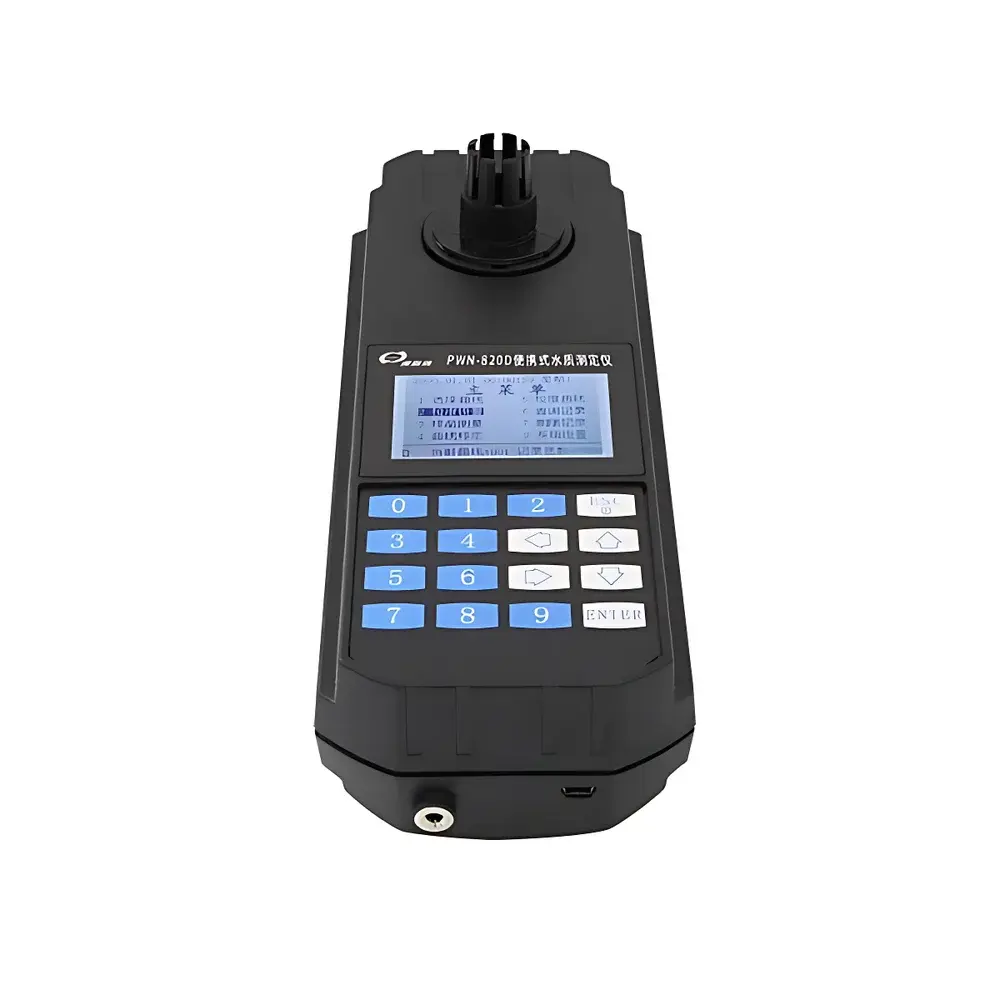
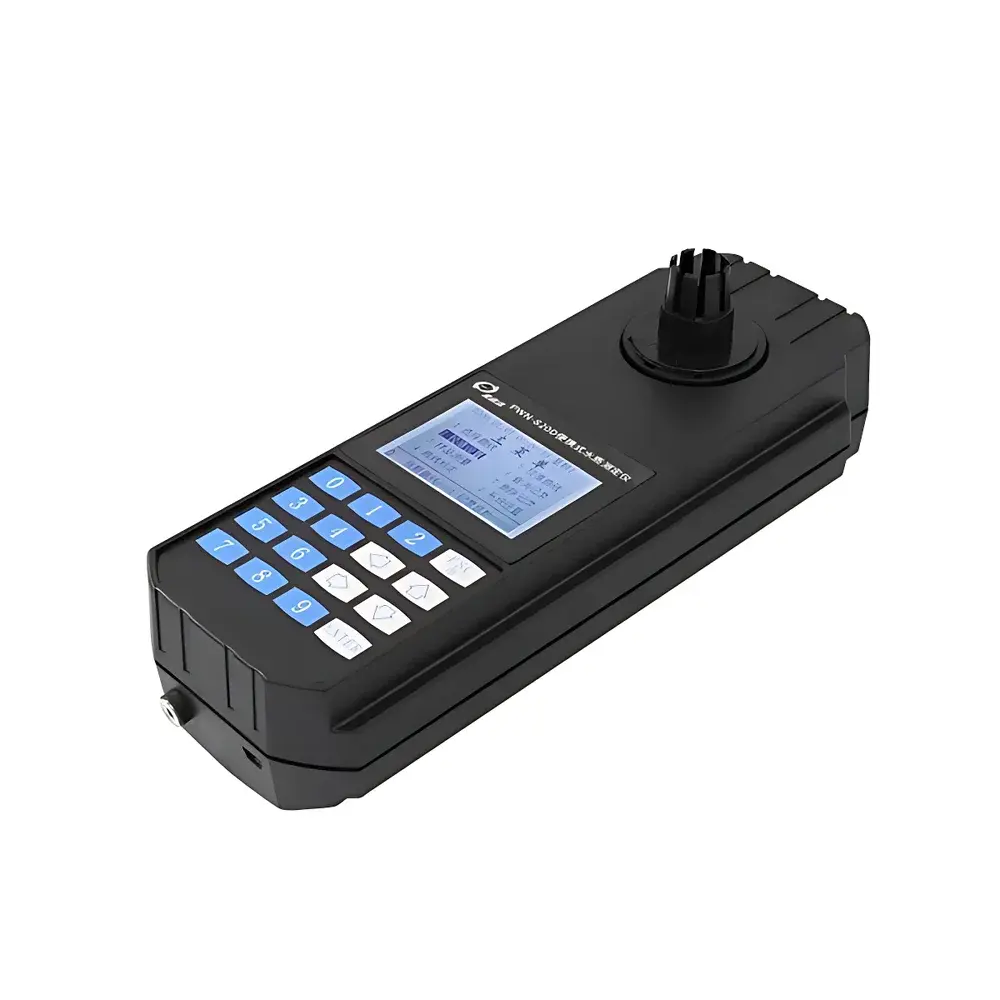
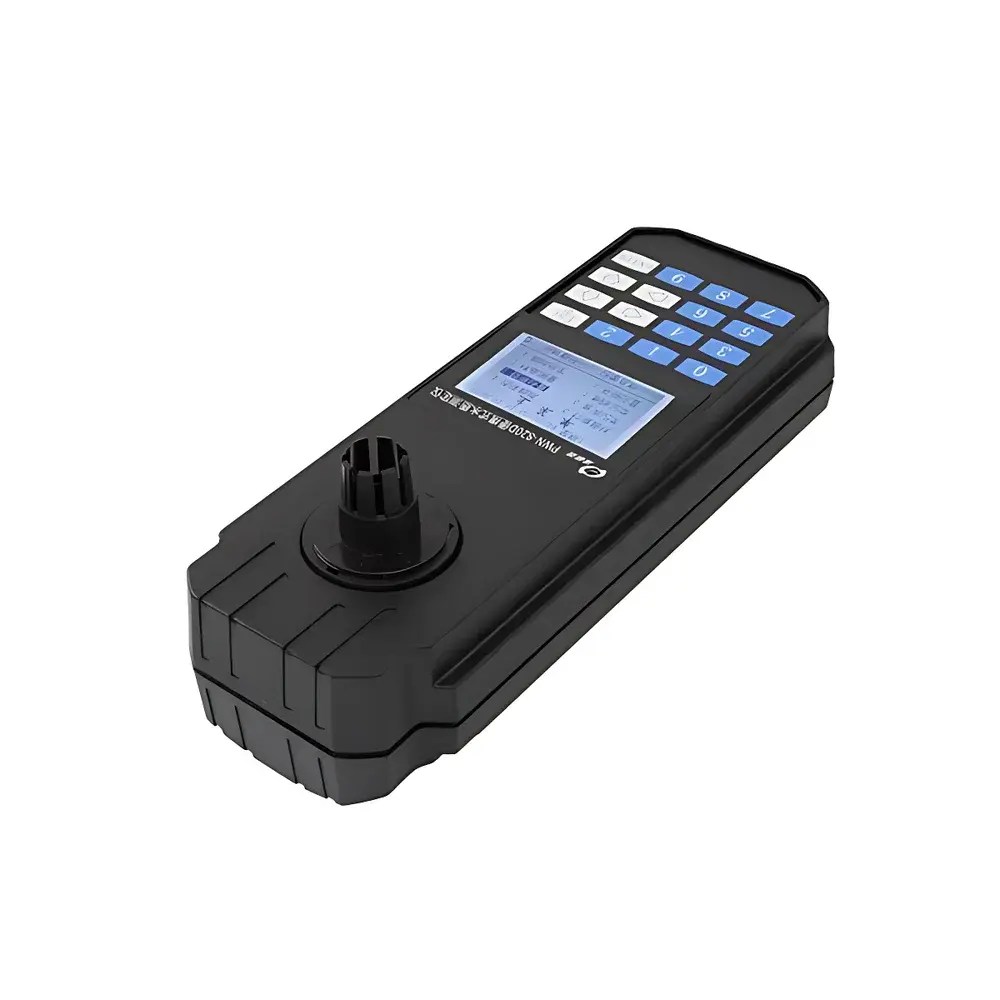
Shenchanghong PWN-820D Portable Ammonia Nitrogen and Total Nitrogen Analyzer
| Brand | Shenchanghong |
|---|---|
| Origin | Guangdong, China |
| Manufacturer Type | Direct Manufacturer |
| Country of Origin | China |
| Model | PWN-820D |
| Instrument Type | Portable |
| Measurement Principle | Colorimetric Method (Nesslerization & Alkaline Persulfate Digestion) |
| Ammonia Nitrogen Range | 0.02–25 mg/L |
| Total Nitrogen Range | 0.05–100 mg/L |
| Detection Limit (NH₃-N) | 0.02 mg/L |
| Accuracy (NH₃-N) | ≤ ±3% ± 0.2 mg/L |
| Accuracy (TN) | ≤ ±5% ± 0.2 mg/L |
| Repeatability | ≤ 3% RSD |
| Optical Drift | < 0.002 A in 20 min |
| Chloride Interference Tolerance | ≤ 2000 mg/L (for COD-compatible digestion module) |
| Dimensions (Analyzer) | 80 × 230 × 55 mm |
| Dimensions (Digestion Unit) | 105 × 160 × 90 mm |
| Batch Capacity | 10 samples per run |
| Analysis Time | ≤ 10 min per sample (post-digestion) |
| Data Storage | 199 measurement records with timestamp (YYYY-MM-DD hh:mm:ss), plus 30 user-defined calibration curves |
| Interface | USB port for data export and PC connectivity |
| Enclosure Rating | IP65 |
| Power | DC 12 V (AC/DC adapter included) |
Overview
The Shenchanghong PWN-820D is a field-deployable, dual-parameter analyzer engineered for simultaneous quantitative determination of ammonia nitrogen (NH₃-N) and total nitrogen (TN) in freshwater, wastewater, surface water, and groundwater samples. It implements standardized colorimetric methodologies compliant with ISO 7150-1 (ammonia nitrogen via Nessler reagent) and ISO 11905-1 (total nitrogen via alkaline potassium persulfate digestion followed by spectrophotometric detection at 220 nm and 275 nm). The instrument integrates a dedicated 4-position digital digestion unit with independent PID temperature control (120–165 °C range, ±0.5 °C stability), decoupled from the optical measurement module to eliminate thermal cross-talk and ensure metrological integrity during sequential or parallel operation. Its compact form factor, IP65-rated ABS housing, and ultra-low-power 16-bit microcontroller architecture support extended battery-free operation in remote sampling campaigns, emergency response scenarios, and routine regulatory monitoring where laboratory access is impractical.
Key Features
- Independent digestion and photometric modules—eliminates thermal interference and maintains long-term optical baseline stability
- PID-controlled digestion block with programmable ramp-hold profiles and automatic countdown timer
- Narrow-band interference filter optical system with cold LED light source (λ = 420 nm for NH₃-N; dual-wavelength 220/275 nm for TN correction)
- High-precision analog-to-digital conversion with 12-bit resolution and auto-zero referencing
- Onboard data management: stores up to 199 time-stamped results (including absorbance, transmittance, and concentration) and 30 customizable calibration curves
- USB interface compliant with CDC/ACM class protocols—enables direct data export to Windows/Linux systems without proprietary drivers
- Robust mechanical design: shock-absorbing molded ABS enclosure, sealed keypad, and corrosion-resistant sample compartment
- Extended operational autonomy: optimized firmware reduces average current draw to 6 months standby on internal backup power
Sample Compatibility & Compliance
The PWN-820D accommodates standard 16 mm OD borosilicate glass digestion/cuvette tubes (supplied) and is validated for use with EPA Method 350.1 (ammonia) and EPA Method 351.2 (total Kjeldahl nitrogen equivalent via persulfate oxidation). It meets the functional requirements of China’s HJ 535–2009 (ammonia nitrogen) and HJ 636–2012 (total nitrogen) standards. Chloride tolerance up to 2000 mg/L ensures reliable performance in brackish influents and industrial effluents without pre-treatment. All firmware logic adheres to GLP-aligned audit trail principles: every calibration event, zero adjustment, and result generation is immutably timestamped and stored in non-volatile memory. No cloud dependency or external authentication is required—full data sovereignty remains with the end-user.
Software & Data Management
No proprietary software installation is required. The device appears as a standard USB mass-storage device when connected; measurement logs export as UTF-8–encoded CSV files with header rows compatible with Excel, LabArchives, and LIMS platforms. Timestamps follow ISO 8601 (e.g., “2024-06-15T08:23:41”). Calibration curve coefficients (linear, quadratic, or polynomial) are retained across power cycles and support manual entry of reference values traceable to NIST SRM 2161a (ammonia) or certified TN standards. Data encryption is not implemented—consistent with field instrument security models where physical custody defines chain-of-custody integrity.
Applications
- Regulatory compliance monitoring at municipal wastewater treatment plants (influent, effluent, sludge supernatant)
- Environmental field surveys for eutrophication assessment in lakes, rivers, and reservoirs
- Industrial pretreatment verification (food processing, pharmaceutical manufacturing, textile dyeing)
- Emergency spill response—rapid screening of ammonia release incidents near aquifers or surface water intakes
- Educational laboratories requiring portable, standards-aligned instrumentation for water chemistry curricula
- Third-party environmental testing contractors performing ISO/IEC 17025–accredited on-site analyses
FAQ
Does the PWN-820D require annual factory recalibration?
No. The optical system is factory-calibrated using NIST-traceable neutral density filters and does not drift under normal operating conditions. Users perform daily zero checks with deionized water; full verification against certified reference materials is recommended quarterly.
Can the digestion unit be used independently for other tests?
Yes—the 4-position heater supports any ASTM D1253– or ISO 6060–compliant digestion protocol requiring temperatures between 100 °C and 165 °C and durations up to 60 minutes.
Is method validation documentation provided?
Yes. Each unit ships with a Certificate of Conformance detailing linearity (R² ≥ 0.999 over stated ranges), limit of detection (LOD), limit of quantitation (LOQ), and inter-day precision (≤3% RSD, n=5 days).
What maintenance is required beyond routine cleaning?
None. The solid-state LED光源 and interference filters have no consumable lifetime; only periodic wiping of the optical window with ethanol-moistened lens tissue is advised.
Is the instrument suitable for marine water analysis?
It is validated for salinities up to 5 g/L (5000 mg/L TDS). For seawater (>19 g/L), dilution and chloride correction per Standard Methods 4500-NH₃ G must be applied manually.







