
Shenchanghong TN-2E Total Nitrogen Analyzer (UV Method)
| Brand | Shenchanghong |
|---|---|
| Origin | Guangdong, China |
| Manufacturer Type | Direct Manufacturer |
| Country of Origin | China |
| Model | TN-2E |
| Measurement Method | UV Spectrophotometry (with optional chromotropic acid method support) |
| Range | 0.05–100 mg/L |
| Accuracy | ≤ ±5% FS |
| Detection Limit | ≤ 0.05 mg/L (as N) |
| Resolution | 0.01 mg/L |
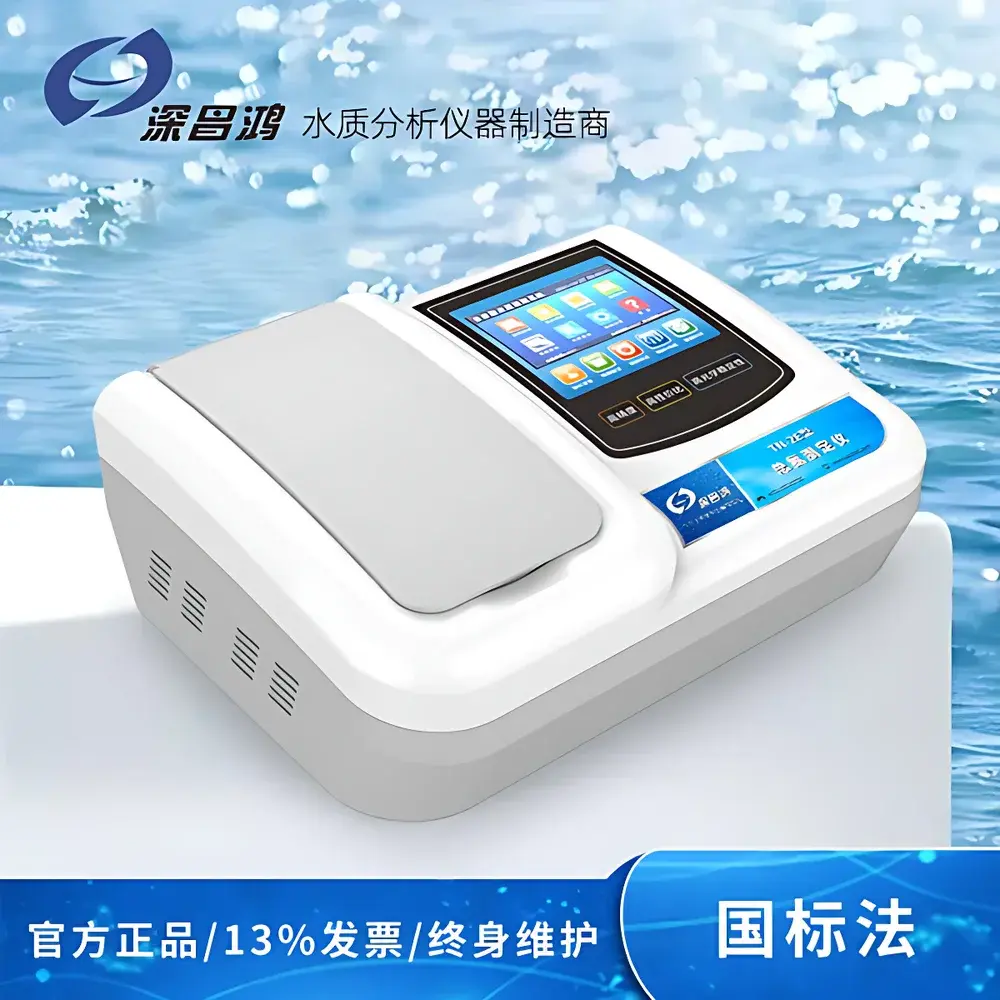
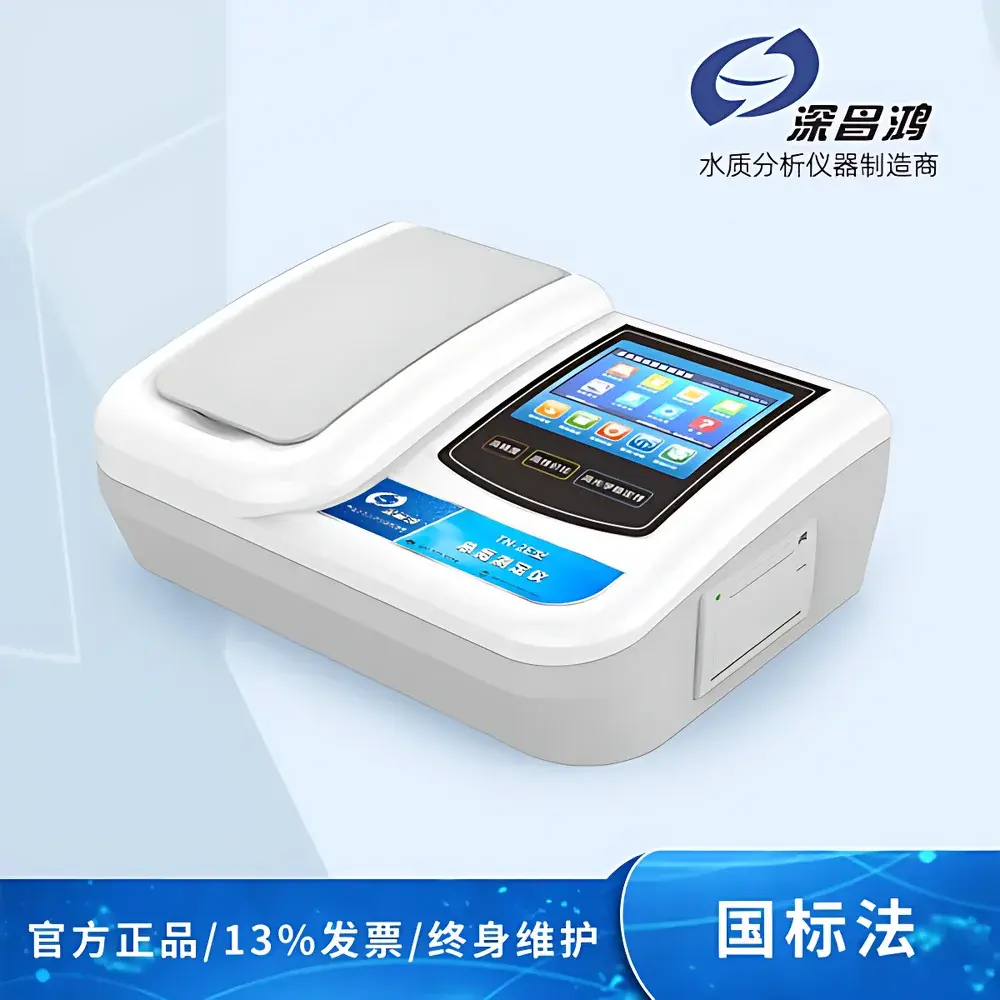
| Display | 7-inch color TFT touchscreen with bilingual (English/Chinese) UI |
| Optical System | Cold light source, narrow-band interference optics, 16-step adjustable intensity |
| Repeatability | ≤ ±3% RSD |
| Optical Stability | ≤ 0.002 A/20 min |
| Digestion Temperature | 125 °C (adjustable up to 200 °C) |
| Digestion Time | 30 min (programmable) |
| Temperature Control Accuracy | ≤ ±1.0 °C |
| Sample Throughput | 16 samples per batch (optional 20/25/36-position digestion blocks) |
| Data Storage | 100,000 records (including timestamp, operator ID, concentration, unit, calibration data) |
| Calibration Capacity | 250 factory curves + 3,500 user-defined curves |
| Connectivity | USB port for PC data transfer |
| Safety Features | Dual thermal protection (auto-shutdown at ≥200 °C), digestion timer with audible alert, insulated digestion hood |
| Dimensions (Analyzer) | 400 × 300 × 140 mm |
| Weight (Analyzer) | 2.6 kg |
| Dimensions (Digester) | 260 × 355 × 135 mm |
| Weight (Digester) | 5.5 kg |
Overview
The Shenchanghong TN-2E Total Nitrogen Analyzer is a benchtop laboratory instrument engineered for accurate, reliable quantification of total nitrogen (TN) in aqueous environmental samples using ultraviolet (UV) spectrophotometric detection following high-temperature alkaline persulfate digestion. This method conforms to widely accepted regulatory frameworks—including EPA Method 351.2, ISO 11905-1, and HJ 636-2012—ensuring compatibility with routine water quality compliance testing. The system adopts a modular architecture: the analyzer and digestion unit operate independently to eliminate thermal crosstalk and preserve optical stability during measurement. Its cold-light, narrow-band interference optical path minimizes spectral drift, while 16-level light intensity adjustment enables dynamic optimization across wide concentration ranges without hardware recalibration.
Key Features
- Modular design isolates the photometric module from the digestion unit, preventing thermal interference and enhancing long-term baseline stability.
- Cold-light source and precision narrow-band interference filters deliver consistent spectral output, with optical drift controlled to ≤0.002 A over 20 minutes.
- 7-inch full-color capacitive touchscreen supports bilingual (English/Chinese) operation, embedded contextual help, and intuitive workflow navigation.
- Comprehensive calibration management: stores up to 3,750 curves (250 preloaded + 3,500 user-defined), each retaining full metadata—standard concentrations, corresponding absorbance values, calibration date, and operator ID.
- Robust data integrity: 100,000 measurement records stored locally, including sample ID, concentration, unit, timestamp, operator code, and digestion parameters.
- Dual-layer thermal safety: programmable digestion timer with audible alert; automatic power cutoff if block temperature exceeds 200 °C.
- Multi-point temperature calibration eliminates nonlinearity errors inherent in common thermistor-based digesters, ensuring ±1.0 °C control accuracy across the 0–200 °C range.
- One-touch curve recovery restores factory defaults and user calibrations after accidental data loss.
- USB interface enables direct data export to Windows-based PCs; included software supports GLP-compliant audit trail generation and report formatting.
Sample Compatibility & Compliance
The TN-2E is validated for use with surface water, groundwater, municipal wastewater, industrial effluents, and treated discharge streams. Sample matrix tolerance has been verified per ISO 8466-1 for linearity and spike recovery (≥92–105% for 0.5–50 mg/L N spikes). Digestion efficiency meets EPA 351.2 requirements for oxidizable nitrogen species (organic N, ammonia, nitrate, nitrite) under standardized 125 °C/30 min alkaline persulfate conditions. Instrument design supports adherence to ISO/IEC 17025:2017 documentation requirements, and data export functionality facilitates alignment with FDA 21 CFR Part 11 when paired with validated third-party LIMS or ELN platforms.
Software & Data Management
Onboard firmware implements hierarchical user access (administrator/operator), password-protected method editing, and timestamped calibration logs. All measurements include embedded digital signatures (operator ID, instrument serial number, firmware version). USB data export generates CSV files compatible with Excel, MATLAB, or laboratory informatics systems. Optional PC software provides graphical calibration verification, trend analysis of QC samples, and customizable PDF reporting compliant with internal QA protocols. Audit trails record all parameter changes, curve modifications, and data deletions—supporting GLP/GMP traceability requirements.
Applications
- Regulatory monitoring of TN in municipal wastewater treatment plant influent/effluent per national discharge standards (e.g., China’s GB 18918-2002).
- Research-grade nitrogen budgeting in limnological and estuarine studies.
- Process control in industrial pretreatment systems handling nitrogen-rich effluents (e.g., food processing, pharmaceutical manufacturing).
- Educational laboratories requiring robust, low-maintenance instrumentation for undergraduate environmental chemistry curricula.
- Field-deployable operation via external 12 V DC power supply (optional adapter kit), enabling mobile lab applications.
FAQ
What digestion method does the TN-2E support?
The instrument is optimized for alkaline potassium persulfate UV digestion (HJ 636-2012 / EPA 351.2); chromotropic acid method capability is available via optional reagent kits and method configuration.
Can the TN-2E comply with ISO/IEC 17025 documentation requirements?
Yes—the system records full calibration metadata, operator IDs, timestamps, and instrument status logs, enabling traceable method validation and uncertainty estimation per Clause 7.7.
Is remote data retrieval supported?
Direct network connectivity is not built-in, but USB-exported CSV files integrate seamlessly with cloud-based LIMS or enterprise data warehouses via standard ETL workflows.
What maintenance is required for optical stability?
No routine lamp replacement is needed (LED cold-light source rated for >50,000 hours); annual verification of wavelength accuracy and photometric linearity using NIST-traceable neutral density filters is recommended.
How are calibration curves validated?
Each curve includes stored reference absorbance values for all calibration points; users may re-run standards to generate residual plots and calculate R², LOD, and LOQ per ICH Q2(R2) guidelines.
Related Products







