

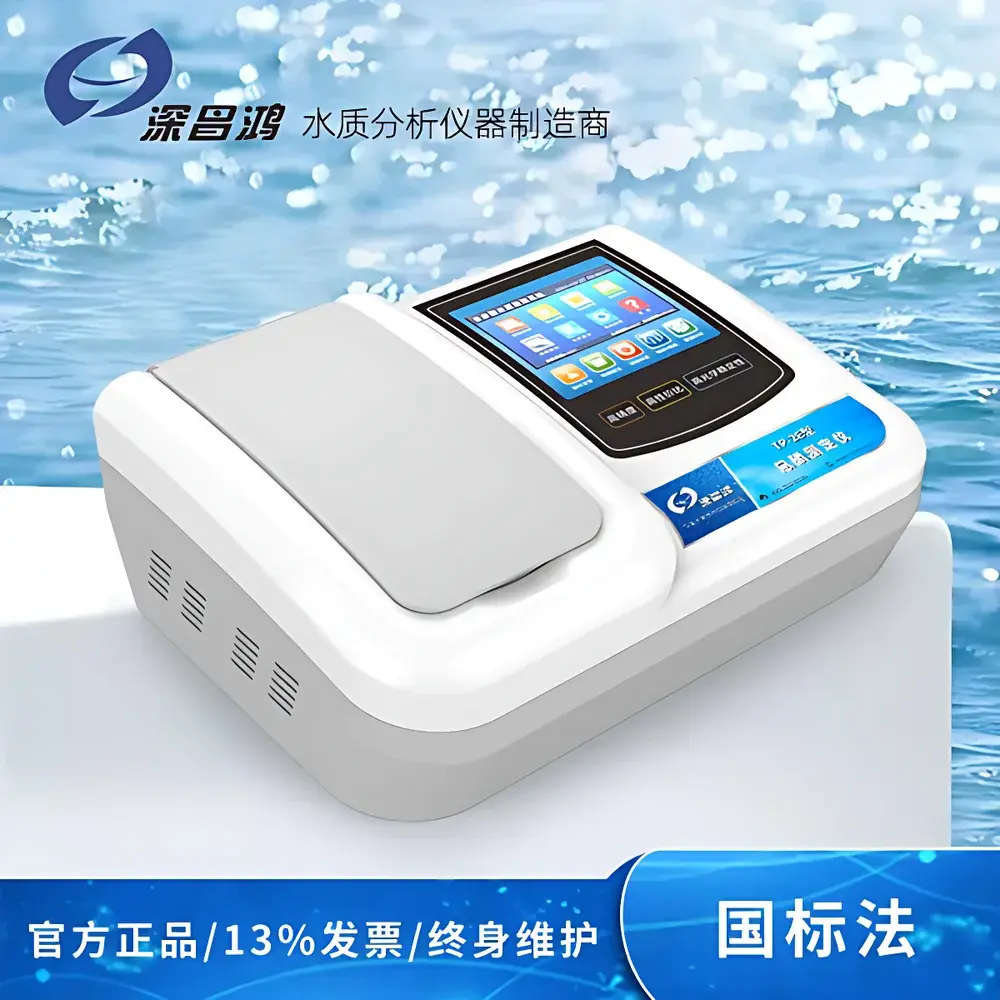
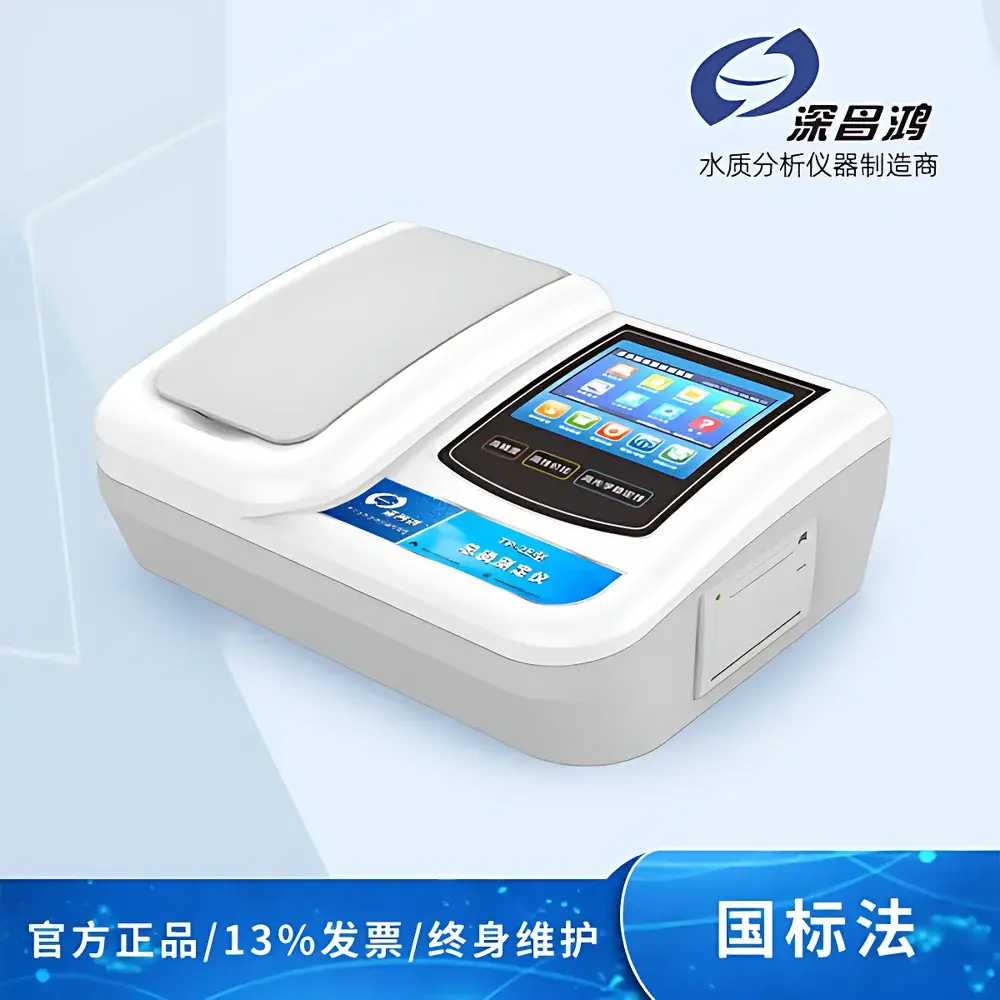
Shenchanghong TP-2E Total Phosphorus Analyzer (UV-Vis Spectrophotometric Method)
| Brand | Shenchanghong |
|---|---|
| Origin | Guangdong, China |
| Manufacturer Type | OEM Manufacturer |
| Country of Origin | China |
| Model | TP-2E |
| Measurement Parameter | Total Phosphorus |
| Instrument Type | Laboratory Benchtop Analyzer |
| Measurement Principle | UV-Vis Spectrophotometry (Molybdenum Blue Method) |
| Measurement Range | 0.00–10.00 mg/L as P |
| Accuracy | ≤ ±5% of Full Scale |
| Detection Limit | 0.02 mg/L |
| Resolution | 0.01 mg/L |
| Repeatability | ≤ 3% RSD |
| Optical Stability | ≤ 0.002 A/20 min |
| Digestion Temperature | 120 °C |
| Digestion Time | 30 min |
| Batch Capacity | 16 samples (optional 20/25/36-position digestion blocks) |
| Power Consumption | < 500 W |
| Net Weight | Analyzer: 2.6 kg |
| Digestion Unit | 5.5 kg |
| Dimensions (Analyzer) | 400 × 300 × 140 mm |
| (Digestor) | 260 × 355 × 135 mm |
Overview
The Shenchanghong TP-2E Total Phosphorus Analyzer is a dedicated laboratory-grade spectrophotometric system engineered for accurate, trace-level quantification of total phosphorus (TP) in water and wastewater matrices. It implements the standardized molybdenum blue colorimetric method—per ASTM D515-89 and ISO 6878:2004—following acid persulfate digestion to convert all phosphorus species (orthophosphate, condensed phosphates, organically bound phosphorus) into reactive orthophosphate. The system comprises two physically separated modules: a UV-Vis photometer with cold-light narrow-band interference optics and a temperature-controlled digestion unit operating at 120 °C for precisely 30 minutes. This modular architecture eliminates thermal cross-talk between digestion and optical measurement, ensuring long-term photometric stability and metrological integrity across repeated analytical cycles.
Key Features
- Modular dual-unit design: Independent digestion and spectrophotometric measurement units prevent thermal drift and maintain optical system stability during high-temperature sample preparation.
- Cold-light, narrow-band interference optical system with 16-step adjustable light intensity calibration—enabling dynamic range optimization without hardware modification or manual filter changes.
- Full-color capacitive touchscreen interface supporting both English and Chinese languages, integrated contextual help menus, and guided workflow prompts for novice and experienced operators alike.
- Comprehensive curve management: Stores up to 250 factory-preloaded calibration curves and allows user-defined curve creation (up to 3,500 additional curves), each retaining full metadata including standard concentrations, corresponding absorbance values, calibration date, and operator ID.
- Digestion unit equipped with multi-point non-linear temperature compensation—correcting sensor-induced deviations across the operational range—and featuring dual safety mechanisms: automatic power cutoff above 200 °C and programmable auto-shutdown post-digestion.
- Robust data governance: 100,000-test storage capacity with timestamped records, parameter names, concentration values, units, operator codes, and detection timestamps—fully compliant with GLP documentation requirements.
- One-touch calibration recovery function preserves regulatory continuity by restoring original factory and user calibration profiles following accidental data loss or system reset.
Sample Compatibility & Compliance
The TP-2E is validated for use with surface water, groundwater, municipal and industrial wastewater, effluent discharge streams, and treated drinking water sources. Sample volumes are standardized at 10 mL per digestion vial (16 mm × 150 mm borosilicate glass tubes). All digestion reagents—including potassium persulfate and sulfuric acid—are supplied in pre-formulated kits to ensure stoichiometric consistency and minimize analyst-induced variability. The instrument conforms to key international standards governing phosphorus analysis: ASTM D515-89 (Standard Test Method for Phosphorus in Water), ISO 6878:2004 (Water Quality — Determination of Total Phosphorus — Ammonium Molybdate Spectrophotometric Method), and China’s HJ 670–2013 (Determination of Total Phosphorus in Water Quality — Molybdenum Antimony Resistance Spectrophotometric Method). Its data structure supports audit-ready reporting for laboratories operating under ISO/IEC 17025 or EPA-approved QA/QC protocols.
Software & Data Management
Data acquisition, calibration, and reporting are managed through an embedded real-time operating system with non-volatile flash memory. All measurements include automatic date/time stamping, operator ID logging, and full traceability of calibration history. USB 2.0 interface enables direct export of CSV-formatted datasets to external PCs for integration with LIMS or statistical analysis platforms (e.g., Microsoft Excel, JMP, or R). Optional software packages provide extended functionality including trend charting, QC control chart generation (X-bar/R charts), and automated report templates aligned with ISO 17025 clause 7.8 requirements. Audit trail features record all configuration changes, calibration events, and data deletions—supporting compliance with FDA 21 CFR Part 11 when used in regulated environmental testing environments.
Applications
The TP-2E serves as a primary analytical tool in municipal wastewater treatment plants for monitoring influent, effluent, and sludge supernatant phosphorus loads; in environmental monitoring agencies conducting routine surface water quality assessments under national surveillance programs; in industrial facilities performing self-monitoring of process water and discharge compliance; and in academic and research laboratories investigating eutrophication dynamics, nutrient cycling, and phosphorus removal efficiency of tertiary treatment technologies. Its sub-0.02 mg/L detection limit and ≤3% repeatability make it suitable for low-concentration applications such as oligotrophic lake monitoring and advanced oxidation process validation.
FAQ
What digestion method does the TP-2E employ?
It uses acid persulfate digestion at 120 °C for 30 minutes to achieve complete oxidation of organic and condensed phosphorus species into orthophosphate.
Is the instrument compatible with third-party reagents?
While optimized for Shenchanghong-certified reagent kits, users may validate alternative reagents against certified reference materials (CRMs) per ISO Guide 34 and ISO/IEC 17025 clause 5.4.2.
Can calibration curves be exported or backed up externally?
Yes—calibration parameters, standard point data, and curve equations can be saved via USB to external storage for archival or cross-instrument transfer.
Does the system support remote diagnostics or firmware updates?
Firmware updates are performed locally via USB; remote diagnostics are not supported, preserving network security and data integrity in regulated lab environments.
What maintenance intervals are recommended for optical alignment and digestion block calibration?
Optical alignment verification is recommended annually using NIST-traceable neutral density filters; digestion block temperature calibration should be verified quarterly using a calibrated PT100 probe per ISO/IEC 17025 clause 6.4.10.







