
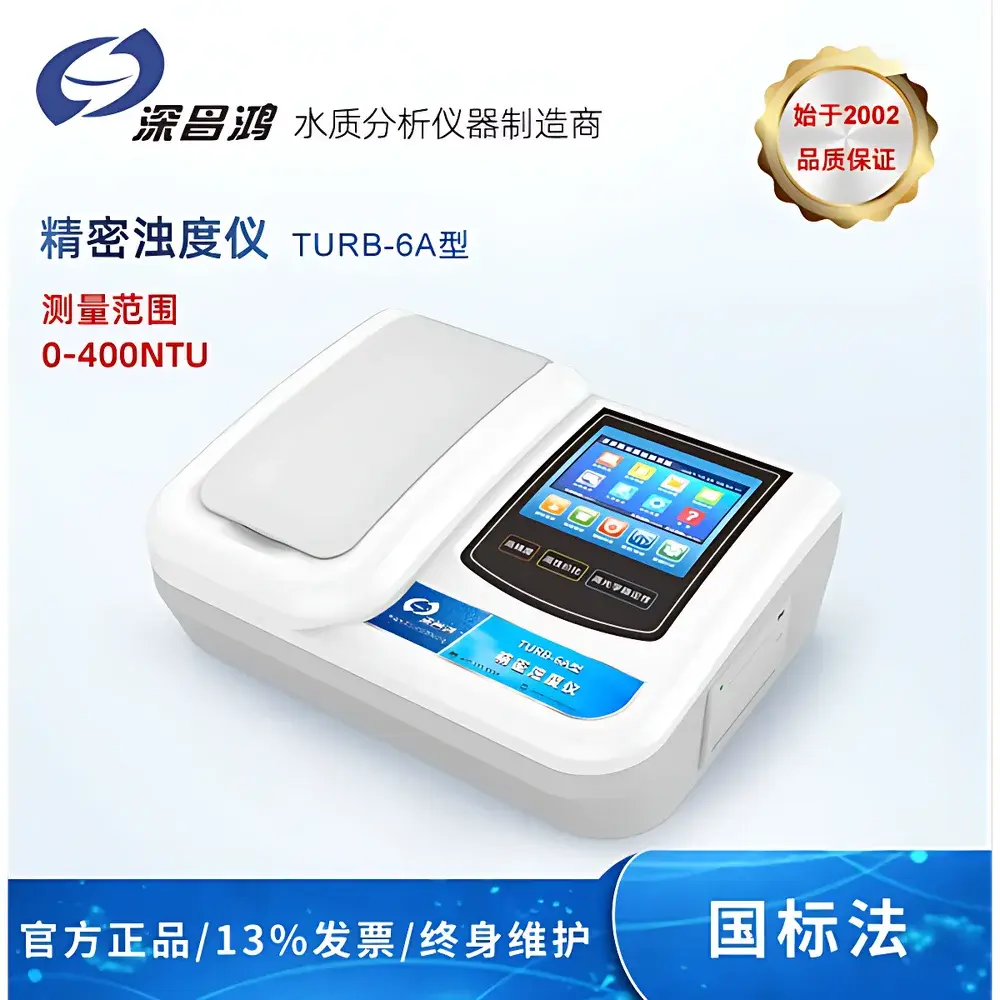
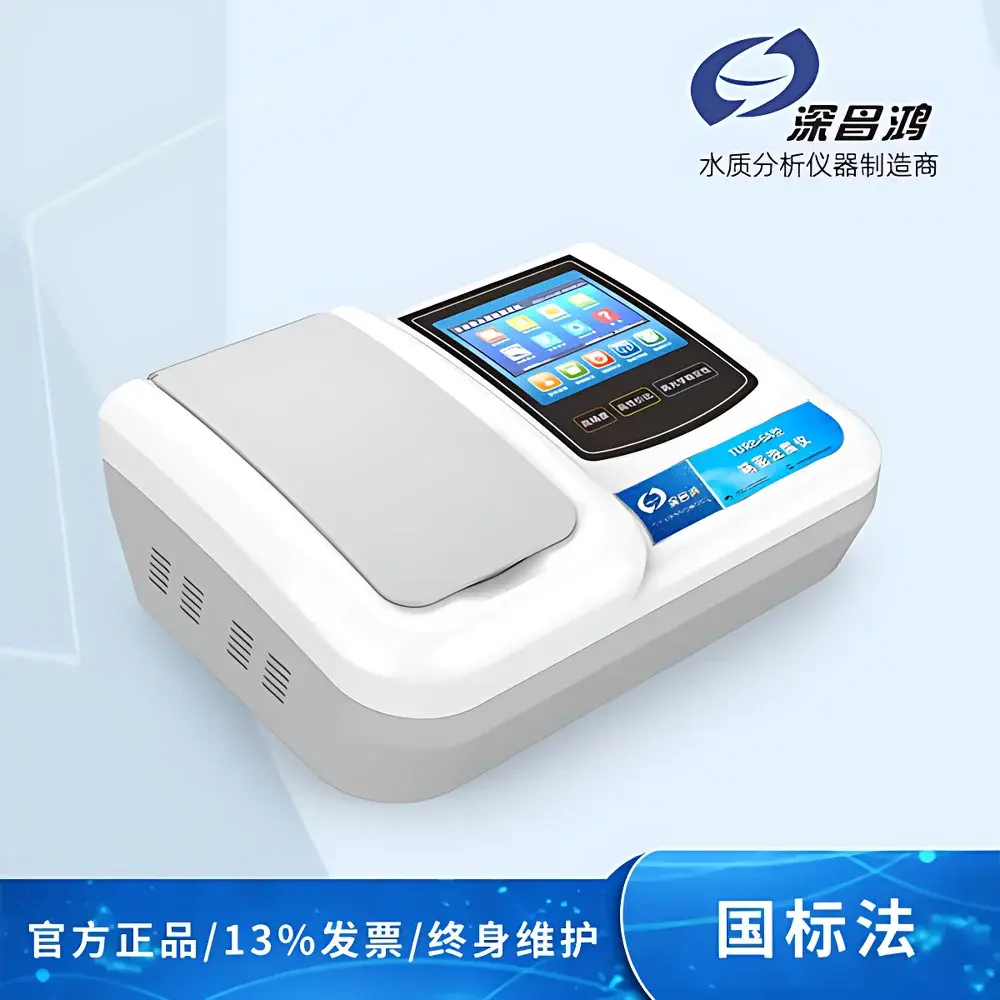
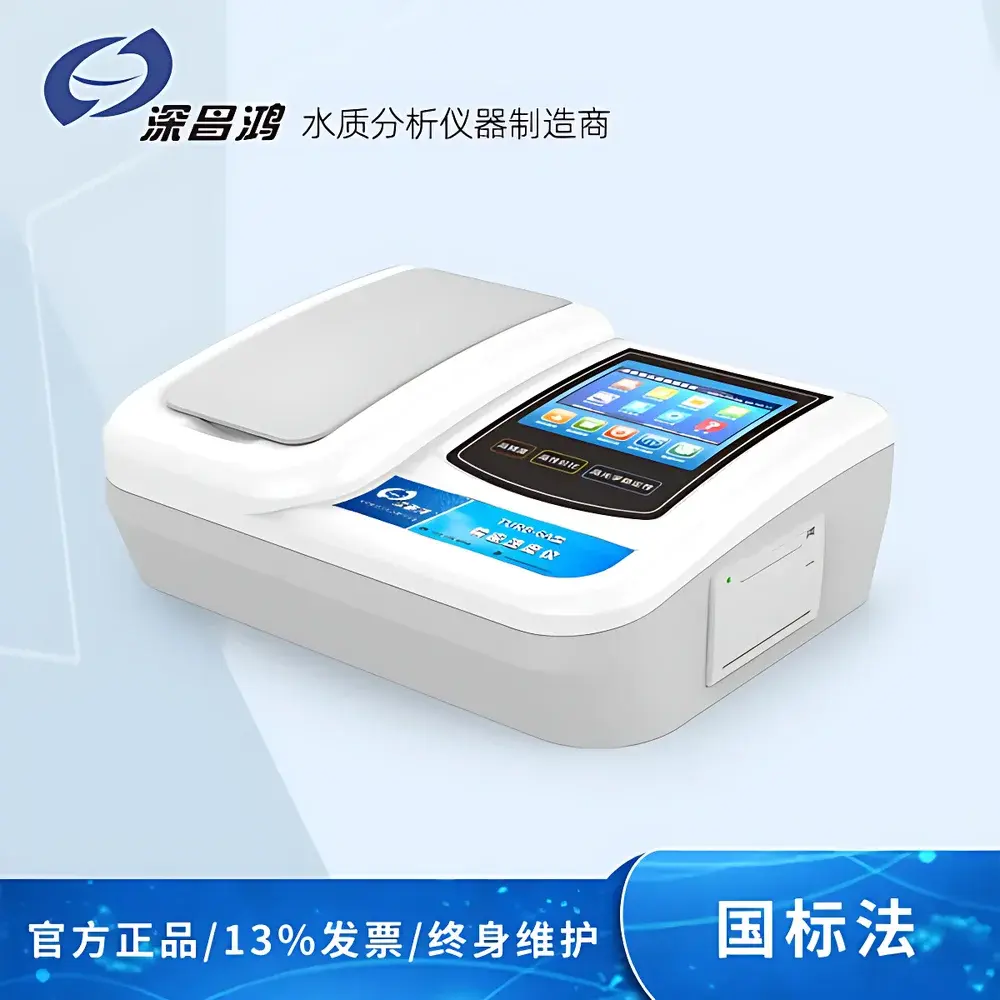
Shenchanghong TURB-6A Benchtop Turbidimeter
| Brand | Shenchanghong |
|---|---|
| Origin | Guangdong, China |
| Manufacturer Type | Direct Manufacturer |
| Origin Category | Domestic (China) |
| Model | TURB-6A |
| Form Factor | Benchtop / Laboratory |
| Measurement Range | 0.00–400 NTU |
| Resolution | 0.01 NTU |
| Operating Temperature | 5–40 °C |
| Accuracy | ≤ ±2 % FS |
| Repeatability | ≤ ±2 % |
| Optical Stability | ≤ 0.002 A/20 min |
| Display | Color Touchscreen (English & Chinese) |
| Dimensions | 400 × 300 × 140 mm |
| Weight | 2.6 kg |
| Power Supply | AC (220 ± 22) V, (50 ± 0.5) Hz |
| Power Consumption | < 100 W |
| Humidity Limit | ≤ 85 % RH (non-condensing) |
| Data Storage | 3,500 calibration curves + 100,000 measurement records (non-volatile) |
| Interface | USB port for PC connectivity |
| Calibration | Built-in self-calibration function |
| Recovery | One-touch system restore |
| Print Support | Integrated thermal or external printer support (via USB or serial) |
Overview
The Shenchanghong TURB-6A Benchtop Turbidimeter is a precision optical instrument engineered for reliable, traceable turbidity quantification in laboratory and quality control environments. It operates on the principle of nephelometry—measuring the intensity of light scattered at 90° from a collimated incident beam—as standardized in ISO 7027 and EPA Method 180.1. The instrument employs a stable cold-light LED source with narrow-band interference optics, minimizing spectral drift and thermal noise to ensure long-term photometric integrity. With a measurement range spanning 0.00 to 400 NTU and a resolution of 0.01 NTU, the TURB-6A supports both low-level clarity verification (e.g., purified water, pharmaceutical rinse solutions) and high-turbidity industrial effluent analysis. Its optical architecture is optimized for reproducibility under routine lab conditions—no warm-up time required, and optical stability maintained at ≤ 0.002 A over 20 minutes—making it suitable for GLP-compliant workflows where baseline consistency is critical.
Key Features
- Cold-light LED source with narrow-band interference optical path ensures minimal thermal drift and extended lamp lifetime (>100,000 hours)
- High-resolution color touchscreen interface with dual-language (English/Chinese) firmware for intuitive navigation and real-time data visualization
- Built-in self-calibration routine enables user-initiated optical zeroing and gain adjustment—reducing reliance on external standards during routine operation
- One-touch system recovery preserves factory settings and user configurations, mitigating risk of accidental parameter corruption
- Non-volatile memory stores up to 3,500 user-defined calibration curves and 100,000 timestamped measurement records—including absorbance values, standard concentrations, calibration date/time, and operator ID—for full traceability
- USB interface supports direct data export to Windows-based PCs; compatible with spreadsheet software and LIMS integration via CSV or TXT export protocols
- Integrated print functionality allows selective or batch printing of results, calibration logs, and curve metadata—supporting audit-ready documentation
Sample Compatibility & Compliance
The TURB-6A accepts standard 25-mm round glass or quartz cuvettes (included), accommodating sample volumes of 10–35 mL. It is validated for use with aqueous matrices including potable water, surface water, wastewater, industrial process streams, and pharmaceutical rinse waters. Instrument performance conforms to ISO 7027:2016 (nephelometric method), meets accuracy requirements outlined in ASTM D6508-21 (Standard Practice for Turbidity Measurements in Water), and aligns with USP and EP 2.2.13 turbidity test specifications for purified and water-for-injection applications. While not FDA 21 CFR Part 11–certified out-of-the-box, its audit trail capabilities—including immutable calibration metadata and operator-tagged records—facilitate validation under GMP/GLP frameworks when deployed with controlled access and documented SOPs.
Software & Data Management
Data acquisition and reporting are managed entirely onboard via embedded firmware—no proprietary software installation required. All stored curves retain full calibration context: reference standard values, measured detector response (absorbance), ambient temperature at time of calibration, and user-assigned ID. Exported datasets include ISO-compliant headers (e.g., “NTU”, “Date”, “Time”, “Operator_ID”, “Cuvette_ID”) and adhere to UTF-8 encoding for international character compatibility. USB transfer supports drag-and-drop file retrieval; no drivers needed on Windows 10/11 systems. For enterprise integration, raw .CSV files can be ingested into SQL-based LIMS or statistical process control (SPC) platforms without transformation.
Applications
- Drinking water treatment: verification of filtration efficiency and post-disinfection clarity
- Environmental monitoring: compliance testing of surface water and wastewater discharge per national regulatory thresholds
- Pharmaceutical manufacturing: routine assessment of Water for Injection (WFI) and Purified Water (PW) per USP/EP monographs
- Food & beverage QC: monitoring clarity of juices, syrups, and brewing wort pre-filtration
- Academic research: kinetic studies of particle aggregation, coagulant dosing optimization, and membrane fouling characterization
- Industrial process control: real-time turbidity feedback in chemical synthesis, bioreactor harvest, and catalyst recovery loops
FAQ
What turbidity standards are supported for calibration?
The TURB-6A is compatible with formazin, StablCal®, and AMCO AEPA-1 standards. Users may input custom calibration equations or select from preloaded standard curves.
Is the instrument suitable for field use?
No—it is designed exclusively as a benchtop laboratory instrument. It requires stable AC power, controlled ambient temperature (5–40 °C), and protection from vibration and direct sunlight.
How is data integrity ensured during power interruption?
All calibration data and measurement records are written to non-volatile flash memory; no data loss occurs during unexpected shutdown.
Can multiple operators be assigned unique IDs?
Yes—up to 99 alphanumeric operator codes can be configured and logged with each calibration and measurement event.
Does the device support automatic range switching?
No—range selection is manual but optimized for stability; users select either Low (0.00–20 NTU) or High (0–400 NTU) mode depending on expected sample turbidity.



