
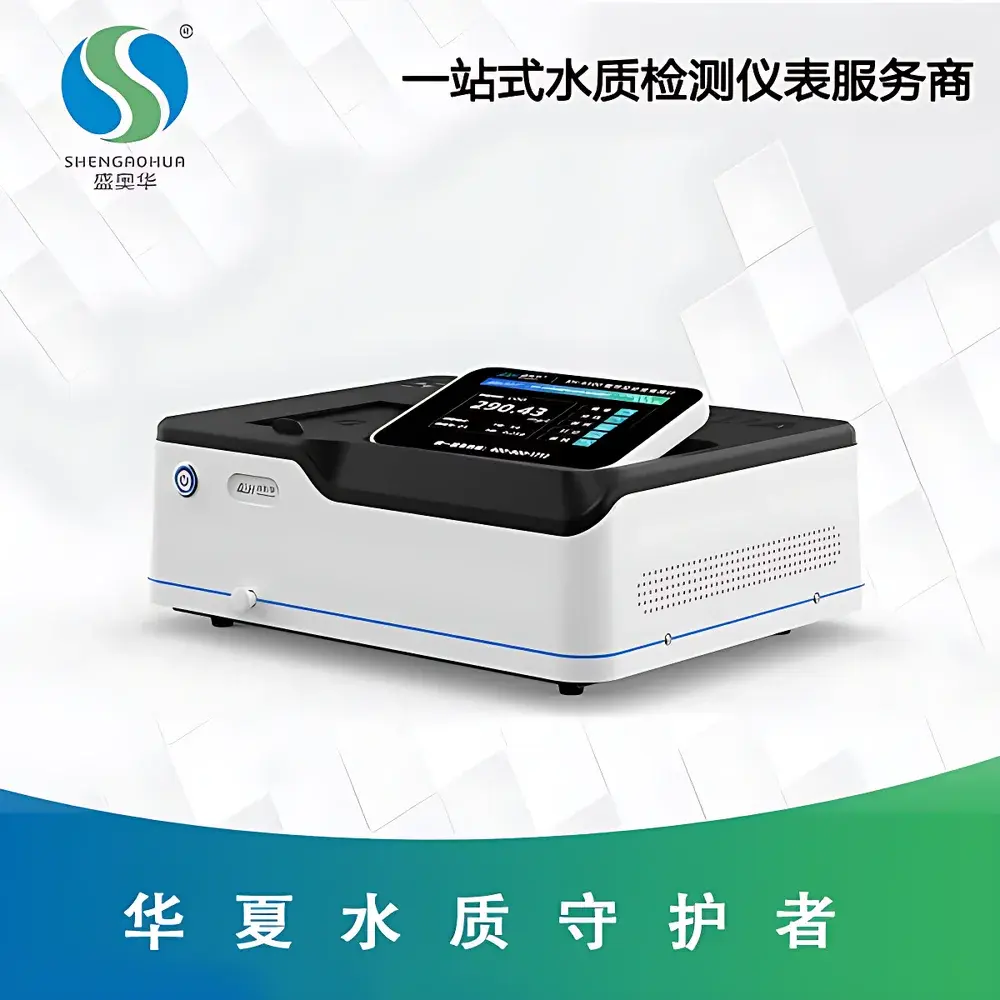
Shengaohua SH-90 Total Nitrogen Analyzer
| Brand | Shengaohua |
|---|---|
| Origin | Jiangsu, China |
| Manufacturer Type | Direct Manufacturer |
| Country of Origin | China |
| Model | SH-90 |
| Detection Method | UV Spectrophotometric Method (Alkaline Potassium Persulfate Digestion) |
| Measurement Range | 0.01–100 mg/L (segmented) |
| Accuracy | ≤ ±5% |
| Detection Limit | 0.01 mg/L |
| Resolution | 0.01 mg/L |
| Wavelength Range | 190–1100 nm |
| Wavelength Repeatability | ≤ 0.2 nm |
| Data Storage Capacity | 5 million records |
| Digestion Temperature | 123 °C |
| Digestion Time | 30 min |
| Total Assay Time | 50 min |
| Sample Throughput | 12 / 16 / 24 / 30 samples per batch (configurable) |
| Dimensions | 485 × 438 × 190 mm |
| Power Supply | AC 220 V ±10%, 50 Hz |
| Operating Temperature | −5 to 45 °C |
| Control Interface | 7-inch HD capacitive touchscreen |
| Pre-installed Calibration Curves | 100 (5 factory-standard, 95 user-editable) |
| Connectivity | USB port for PC-based data management (optional), thermal printer interface |
Overview
The Shengaohua SH-90 Total Nitrogen Analyzer is a benchtop laboratory instrument engineered for precise, reproducible quantification of total nitrogen (TN) in aqueous environmental and industrial wastewater matrices. It implements the standardized alkaline potassium persulfate digestion method followed by ultraviolet spectrophotometric detection at 220 nm and 275 nm—fully compliant with ISO 11905-1, HJ 636–2012 (China), and equivalent regulatory protocols adopted by municipal water utilities and third-party environmental testing laboratories. The system integrates digestion, cooling, optical measurement, and data processing into a single platform, eliminating manual transfer steps that introduce contamination or analytical variability. Its dual-wavelength correction algorithm compensates for nitrate interference and organic absorbance background, ensuring robust performance across complex sample types including digested sludge filtrates, surface water, effluent from pharmaceutical manufacturing, and high-turbidity textile dyeing wastewater.
Key Features
- 7-inch high-resolution capacitive touchscreen interface with intuitive icon-driven navigation and multilingual on-screen prompts (English pre-configured)
- Dual-wavelength UV-Vis photometer (190–1100 nm spectral range) with ≤0.2 nm wavelength repeatability for high-fidelity absorbance acquisition
- Integrated intelligent digestion module with PID-controlled heating (up to 200 °C), preset 123 °C/30 min digestion protocol, and active cooling stage to prevent post-digestion degradation
- Onboard calibration curve library supporting 100 stored methods: five NIST-traceable reference curves preloaded; remaining 95 fully customizable and password-protected for lab-specific matrix adaptation
- Automated baseline correction and blank subtraction routines minimizing operator-dependent error
- USB host interface enabling direct firmware updates, method import/export, and secure data export in CSV or PDF formats compatible with LIMS integration
- Optional thermal printer support for GLP-compliant hardcopy reporting with timestamp, operator ID, and batch ID
Sample Compatibility & Compliance
The SH-90 accommodates standard 10 mm pathlength quartz or high-transmission glass cuvettes and accepts liquid samples ranging from clarified drinking water to pretreated municipal wastewater (TSS < 50 mg/L recommended). It meets critical regulatory requirements for routine environmental monitoring: methodology alignment with EPA Method 351.2 (UV-Persulfate Oxidation), ISO 11905-1 (Water Quality — Determination of Total Nitrogen — Part 1: Modified Alkaline Persulfate Oxidation Method), and China’s HJ 636–2012 standard. Instrument design supports audit-ready operation under GLP and ISO/IEC 17025 frameworks, with full electronic record retention—including raw absorbance values, digestion logs, calibration history, and user activity timestamps—for FDA 21 CFR Part 11 compliance when paired with validated PC software.
Software & Data Management
Embedded firmware provides real-time data visualization, automatic QC flagging (e.g., out-of-range absorbance, digestion temperature deviation), and configurable pass/fail thresholds per test batch. All measurements are time-stamped and tagged with operator ID, sample ID, and method version. Internal storage retains up to 5 million discrete result entries with metadata. USB connectivity enables bidirectional synchronization with Windows-based desktop software supporting statistical process control (SPC) charting, trend analysis across multi-day campaigns, and automated report generation compliant with ISO 17025 clause 7.8.2 (Reporting of Results). Data export formats include .csv (for Excel or R analysis), .pdf (with digital signature fields), and .xml (for LIMS ingestion).
Applications
- Regulatory compliance monitoring for TN discharge limits under national pollutant discharge permits (e.g., China’s “Emission Standard of Pollutants for Municipal Wastewater Treatment Plants” GB 18918–2002)
- Process control in activated sludge systems, MBR plants, and denitrification optimization studies
- Quality assurance in pharmaceutical API synthesis where residual nitrogen species impact purity specifications
- Research-grade nutrient budgeting in limnological and estuarine ecosystem studies
- Validation of TN removal efficiency in advanced oxidation or electrochemical treatment pilot systems
- Accredited environmental testing laboratories performing ISO/IEC 17025 scope expansions for nitrogen speciation
FAQ
What digestion chemistry does the SH-90 employ?
It uses alkaline potassium persulfate oxidation at 123 °C for 30 minutes, converting all nitrogen species (organic N, ammonia, nitrite, nitrate) to nitrate prior to dual-wavelength UV detection.
Is the instrument suitable for high-salinity seawater samples?
Yes—when used with appropriate dilution and matrix-matched calibration; chloride interference is minimized by the 220/275 nm correction algorithm per ISO 11905-1 Annex B.
Can calibration curves be transferred between SH-90 units?
Yes—via USB flash drive using encrypted .cal file format; curve integrity is verified via checksum upon import.
Does the system support remote diagnostics or firmware updates?
Firmware updates are performed locally via USB; remote diagnostic capability requires optional Ethernet module (not included standard).
How is data integrity ensured during power interruption?
Non-volatile flash memory preserves all pending measurements and system logs; digestion cycles automatically resume at pre-interruption temperature setpoint upon power restoration.







