
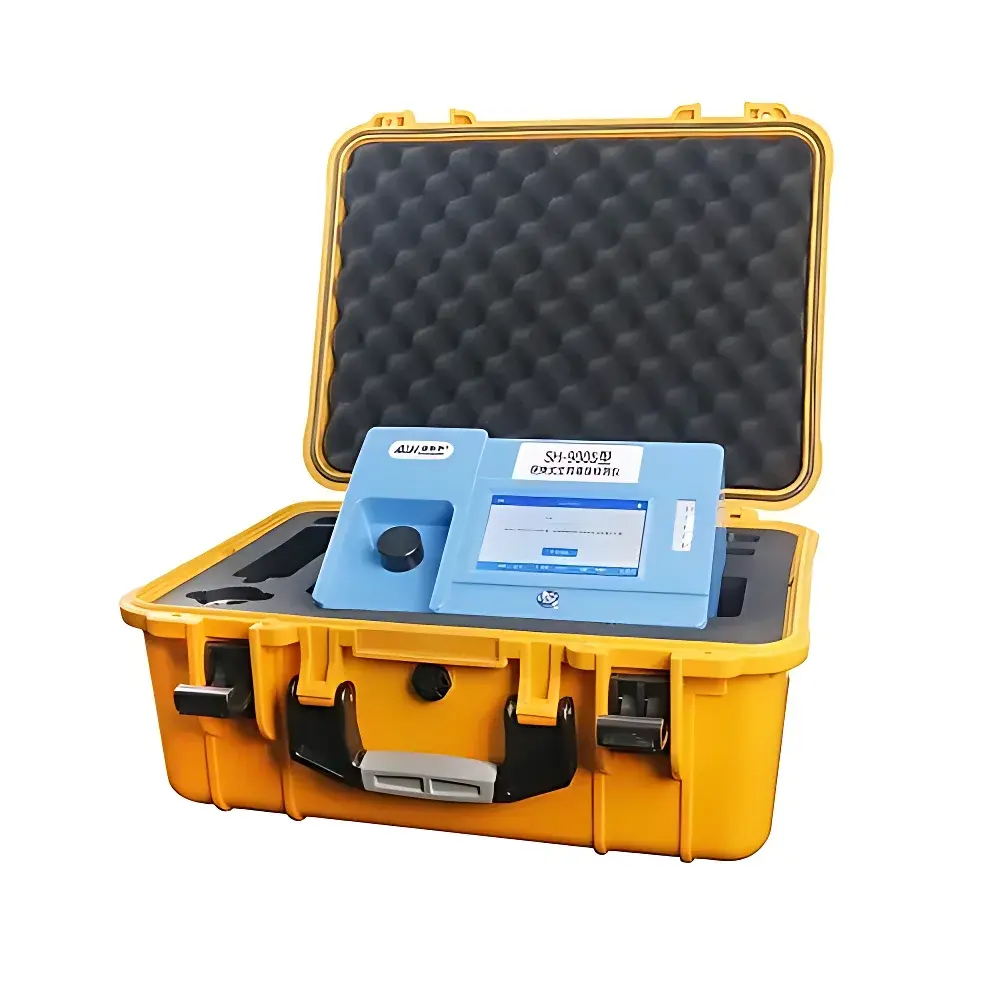
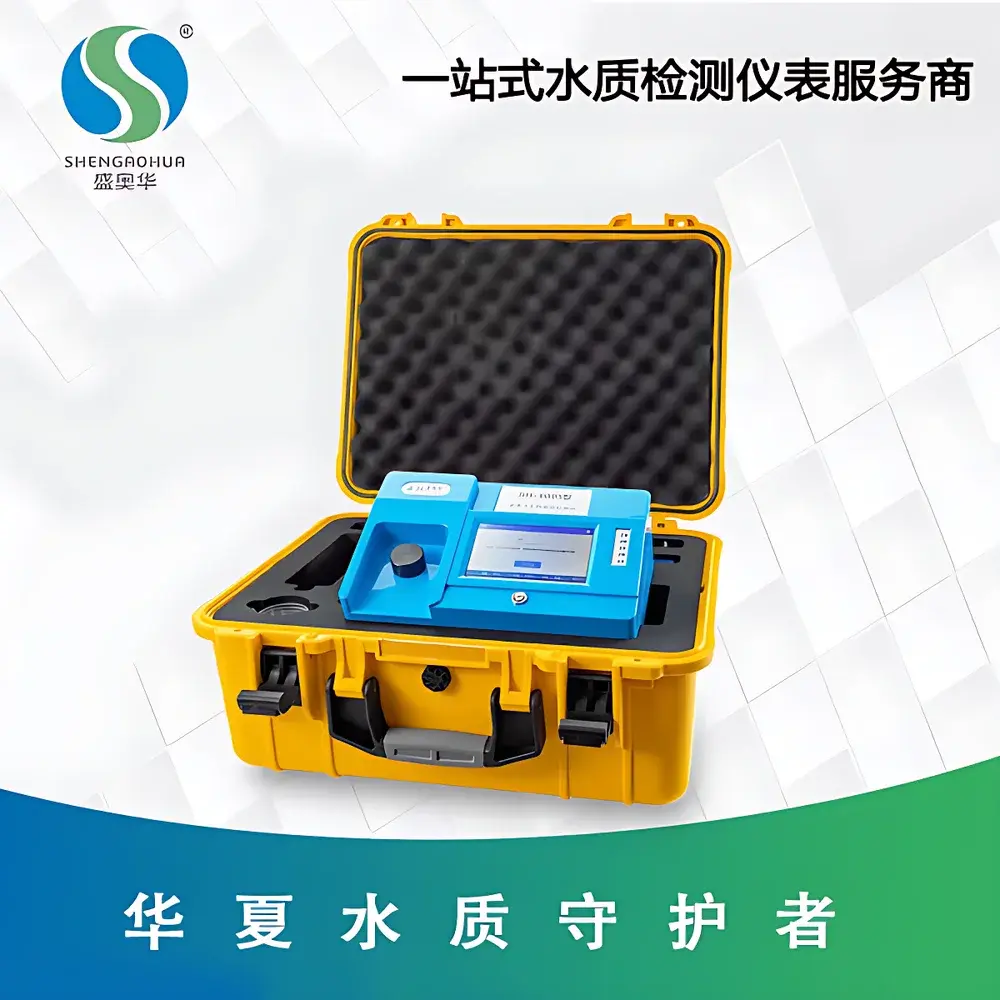
Shengaohua SH-9005 Portable Water Toxicity Analyzer Using Bioluminescent Bacteria
| Brand | Shengaohua |
|---|---|
| Origin | Jiangsu, China |
| Manufacturer Type | Direct Manufacturer |
| Country of Origin | China |
| Model | SH-9005 |
| Instrument Type | Portable |
| Biological Sensor | Bioluminescent Bacteria (Vibrio qinghaiensis, Photobacterium phosphoreum, or Vibrio fischeri) |
| Operating Temperature | 5–40 °C |
| Reagent Storage Temperature | –18 °C (1-year stability) |
| Repeatability | ≤10% RSD (at 2 mg/L ZnSO₄·7H₂O) |
| Detection Time | 5 minutes |
| Spectral Range | 300–1100 nm |
| Relative Light Units (RLU) Range | 0–65,535 |
| Inhibition Rate Range | –100% to +100% |
| Water Sample RSD | ≤±15% |
| Blank Inhibition Variability | ≤15% |
| Data Storage | 4 GB internal (expandable), >100,000 records |
| Communication Interfaces | USB, Bluetooth, Wi-Fi, 4G |
| Display | Capacitive touchscreen |
| IP Rating | IP65 |
| Battery Life | >24 hours continuous operation |
| Compliance | GB/T 15441–1995, ISO 11348-3 |
| ATP Mode Supported | Yes |
| Built-in Thermal Printer | Yes |
| Geotagging & Pollution Mapping | Yes |
Overview
The Shengaohua SH-9005 Portable Water Toxicity Analyzer is an engineered field-deployable instrument designed for rapid, on-site assessment of acute aquatic toxicity using standardized bioluminescent bacterial bioassays. It operates on the principle of bioluminescence inhibition: viable, metabolically active luminous bacteria—such as Vibrio qinghaiensis, Photobacterium phosphoreum, or Vibrio fischeri—emit stable light under optimal conditions; exposure to toxicants disrupts cellular respiration and ATP synthesis, resulting in quantifiable reduction in photon emission. This photonic response is measured across a broad spectral range (300–1100 nm) with high dynamic resolution (0–65,535 RLU), enabling detection of cumulative toxic effects from complex mixtures—including heavy metals (e.g., Cu²⁺, Cd²⁺, Zn²⁺), organophosphates, phenols, cyanides, and polycyclic aromatic hydrocarbons—without prior compound identification. The system conforms rigorously to GB/T 15441–1995 and ISO 11348-3 protocols, ensuring regulatory alignment for environmental monitoring, emergency response, and pre-compliance screening in drinking water distribution networks, wastewater outfalls, and surface water bodies.
Key Features
- True field-portable architecture: IP65-rated enclosure, integrated thermal label printer, and capacitive touchscreen interface optimized for gloved operation in humid, dusty, or low-light environments.
- Dual-mode bioassay capability: Switch seamlessly between standardized luminescent bacteria toxicity testing and ATP-based microbial load quantification—enabling cross-validation and broader water quality profiling.
- Robust power management: High-capacity rechargeable battery supports >24 hours of continuous operation; USB-C charging ensures compatibility with universal power sources including solar chargers and vehicle adapters.
- Geospatial data integration: Real-time GPS tagging and embedded pollution mapping functionality allow field technicians to log toxicity hotspots, overlay results on GIS-compatible maps, and generate spatial trend reports.
- Multi-protocol connectivity: Simultaneous support for USB mass storage, Bluetooth 5.0, IEEE 802.11n Wi-Fi, and LTE Cat-1 4G enables secure, audit-ready data synchronization with laboratory information management systems (LIMS) or cloud-based dashboards.
- Calibration traceability and QC assurance: Pre-loaded control templates for ZnSO₄·7H₂O reference standard (2 mg/L); automatic calculation of inhibition rate, RLU deviation, and statistical repeatability per batch—fully documented in exportable CSV/Excel logs.
Sample Compatibility & Compliance
The SH-9005 accepts raw, filtered, or centrifuged aqueous samples—including surface water, groundwater, treated effluent, industrial discharge, and potable water—with minimal pretreatment. It accommodates turbidities up to 100 NTU and salinities up to 35 g/L without signal interference. All assay procedures follow internationally recognized endpoints defined in ISO 11348-3 (determination of inhibition of the light emission of Vibrio fischeri) and GB/T 15441–1995 (water quality—determination of acute toxicity using luminescent bacteria). The instrument’s firmware implements built-in audit trails compliant with GLP principles, recording operator ID, timestamp, GPS coordinates, reagent lot number, and raw RLU values for every measurement—facilitating FDA 21 CFR Part 11–ready documentation when paired with validated LIMS integration.
Software & Data Management
Powered by an Android-based embedded OS, the SH-9005 runs a purpose-built analytical application featuring guided workflow navigation, multilingual UI (English, Spanish, French, Arabic), and context-sensitive help prompts. Measurement data—including inhibition curves, RLU kinetics, geotagged metadata, and printable thermal reports—is stored locally on 4 GB eMMC flash memory (expandable via microSD). Export options include encrypted USB transfer, TLS-secured Wi-Fi upload to FTP/SFTP servers, and direct Bluetooth transmission to certified thermal printers. All datasets retain full traceability: each record contains digital signatures, calibration history, and version-stamped firmware revision logs—ensuring data integrity during regulatory inspections or third-party validation audits.
Applications
- Emergency response triage during chemical spills or accidental discharges—delivering actionable toxicity classification within 5 minutes.
- Routine surveillance at drinking water intake points, reservoirs, and distribution nodes to detect uncharacterized contaminants escaping conventional physicochemical analysis.
- Industrial compliance verification for wastewater pretreatment facilities subject to local discharge permits or ISO 14001 environmental management systems.
- Ecotoxicological research in limnology and marine science—supporting mixture toxicity modeling and QSAR validation studies.
- Field validation of constructed wetlands, biofilters, or advanced oxidation processes where biological endpoint monitoring complements abiotic parameter tracking.
FAQ
What bacterial strains are supported, and how are they qualified?
The SH-9005 is validated for use with Vibrio qinghaiensis (GB/T 15441–1995), Photobacterium phosphoreum, and Vibrio fischeri (ISO 11348-3). Lyophilized cultures are supplied with certificate of analysis confirming ≥1 × 10⁸ CFU/vial and ≥85% initial luminescence activity.
Can the instrument differentiate between cytotoxic and neurotoxic mechanisms?
No—the assay measures net metabolic inhibition; it does not resolve mode-of-action. However, its sensitivity to >5,000 known toxicants makes it ideal for hazard ranking and prioritization prior to targeted chemical analysis.
Is ATP mode quantitatively traceable to ISO 22192 or EN 16197 standards?
Yes—ATP measurements follow EN 16197:2012 methodology for microbial load estimation in water, with factory-calibrated luciferase-luciferin reagents and RLU-to-pg ATP conversion factors traceable to NIST SRM 1950.
How is data integrity maintained during offline field use?
All measurements are time-stamped, digitally signed, and stored with immutable metadata. Upon reconnection, the system performs hash-based reconciliation to prevent duplication or omission during sync.
Does the device support remote firmware updates and method validation packages?
Yes—over-the-air (OTA) updates are delivered via HTTPS with SHA-256 signature verification. Method validation kits—including reference standards, SOP templates, and uncertainty budget worksheets—are available upon request for ISO/IEC 17025 laboratories.
Related Products







