
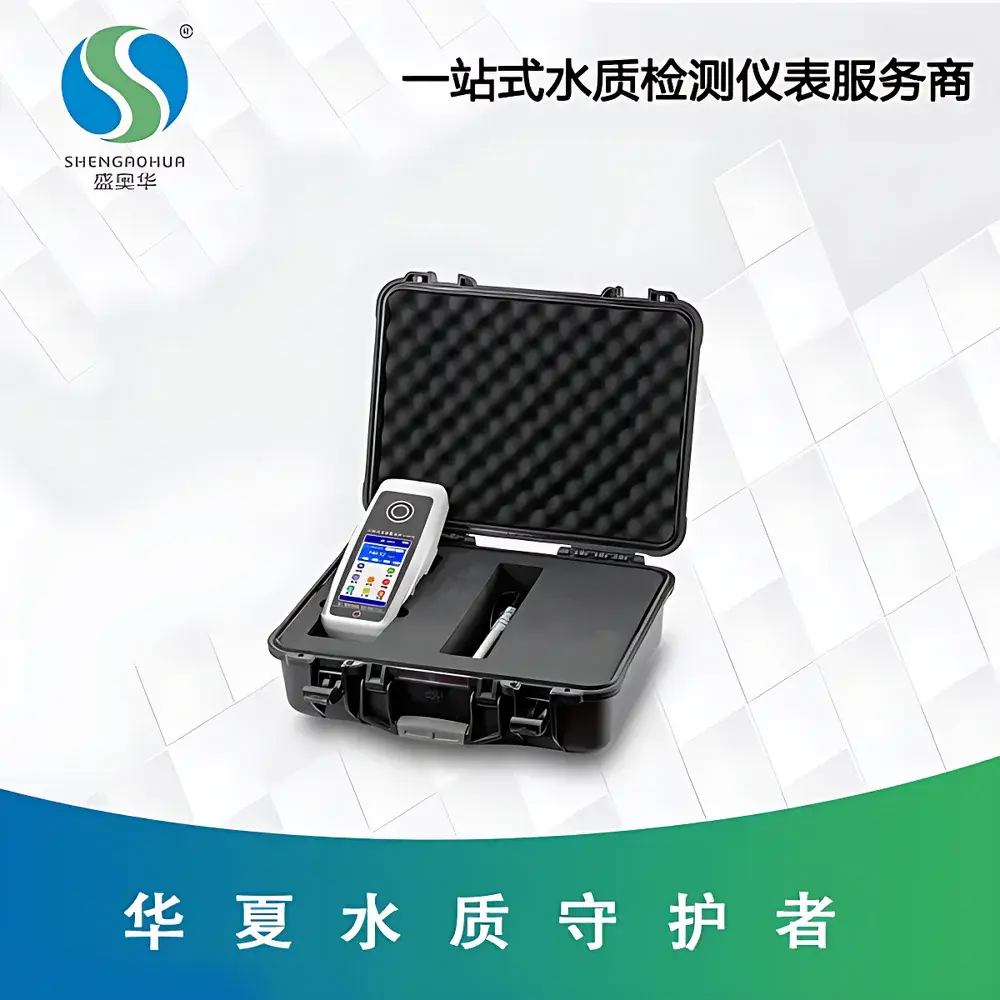
Shengaohua SH-9L(V11) Handheld Phycocyanin & Chlorophyll-a Fluorometer
| Brand | Shengaohua |
|---|---|
| Origin | Jiangsu, China |
| Manufacturer Type | Direct Manufacturer |
| Country of Origin | China |
| Model | SH-9L(V11) |
| Application | Portable phycocyanin and chlorophyll-a quantification in freshwater systems |
| Measurement Range | 0.1–200.0 / 2000.0 K cells/mL (cyanobacteria) |
| Accuracy | <8% FS |
| Repeatability | ±5% |
| Resolution | 0.03 / 0.01 µg/L (chlorophyll-a equivalent) |
| Electrode Type | Digital fluorescence-based sensor with real-time turbidity and optical path compensation |
| Display | 3.1-inch amber LCD |
| Operating Temperature | 5–45 °C |
| Max Pressure Rating | 1 bar |
| Sensor Diameter | 33.7 mm |
| Power Supply | DC 5 V ±5%, <50 mA |
| Housing Materials | POM, nylon, and 316 stainless steel |
| Cable Length | 3 m |
| Dimensions | 200 × 100 × 35 mm |
| Net Weight | 0.3 kg |
| User Calibration | Single-point calibration supported |
Overview
The Shengaohua SH-9L(V11) Handheld Phycocyanin & Chlorophyll-a Fluorometer is a field-deployable, reagent-free analytical instrument engineered for rapid, on-site quantification of cyanobacterial biomass in natural and engineered water systems. It operates on the principle of selective fluorometric excitation and detection: blue light (typically ~450–470 nm) excites phycocyanin—a dominant accessory pigment in cyanobacteria—while red-shifted emission (~640–680 nm) is measured to derive cell density. Simultaneously, chlorophyll-a fluorescence (excited at ~430–470 nm, emitted at ~670–680 nm) is resolved via spectral deconvolution or dual-channel detection, enabling parallel estimation of total phytoplankton biomass. Unlike spectrophotometric or HPLC-based methods, this fluorometer eliminates extraction steps, solvent use, and laboratory infrastructure, delivering results in seconds with minimal operator training. Its design adheres to core principles of environmental sensor metrology—including optical stability under variable turbidity, thermal drift mitigation, and signal-to-noise optimization—making it suitable for routine monitoring in compliance with national and regional water quality protocols.
Key Features
- Reagent-free operation using solid-state LED excitation and silicon photodiode detection—no consumables, no hazardous waste generation
- Digital fluorescence electrode with embedded microprocessor for real-time compensation of optical path attenuation and scattering effects induced by suspended solids and colored dissolved organic matter (CDOM)
- Ergonomic handheld form factor (200 × 100 × 35 mm; 0.3 kg) with IP67-rated housing components (POM body, 316 stainless steel sensor tip, nylon-reinforced cable)
- Integrated rechargeable lithium-ion battery supporting >12 hours of continuous field operation; USB-C charging interface compatible with universal 5 V power sources
- 3.1-inch high-contrast amber LCD display with intuitive Chinese/English bilingual menu navigation and on-screen calibration prompts
- On-device data logging via removable microSD card (up to 32 GB), storing timestamped readings with GPS metadata (when paired with external GNSS module)
Sample Compatibility & Compliance
The SH-9L(V11) is validated for direct immersion measurement in freshwater matrices including lakes, reservoirs, rivers, drinking water distribution systems, aquaculture ponds, and wastewater stabilization lagoons. It is not intended for seawater, highly viscous effluents, or samples with >500 NTU turbidity without pre-filtration. The instrument complies with general requirements for portable environmental sensors outlined in ISO 5667-3 (water sampling), ASTM D6502 (field fluorometric analysis of algal pigments), and China’s HJ 1001–2018 standard for in-situ cyanobacteria monitoring. While not certified to IEC 61000-6-2/4 for electromagnetic immunity or ATEX for hazardous locations, its low-power architecture and non-intrusive optical design meet typical field safety expectations for Class II, Division 2 environments per ANSI/ISA-12.12.01.
Software & Data Management
Data export is supported via FAT32-formatted microSD cards, generating CSV files with columns for date/time, temperature (via integrated NTC sensor), raw fluorescence intensity, compensated concentration (K cells/mL), and user-defined site ID. Optional PC software (Windows 10/11 compatible) enables batch import, outlier flagging based on statistical deviation thresholds, and alignment with historical datasets from other Shengaohua instruments (e.g., SH-8 series). Audit trails—including calibration timestamps, firmware version, and operator ID input—are retained locally but do not conform to FDA 21 CFR Part 11 requirements; users requiring electronic record integrity must implement third-party LIMS integration.
Applications
- Routine cyanobacterial bloom surveillance in municipal source water intakes to support early-warning decision-making
- Performance evaluation of algaecide dosing or ultrasonic treatment systems in aquaculture facilities
- Long-term trend analysis in ecological research projects tracking eutrophication dynamics across seasonal cycles
- QA/QC verification of grab-sample lab analyses (e.g., microscopy or spectrophotometry) during field campaigns
- Compliance monitoring for regulatory reporting under China’s “Blue Sky and Clear Water Protection Campaign” and local basin management plans
- Pre-commissioning verification of UV disinfection system efficacy where cyanobacteria-derived intracellular toxins are a concern
FAQ
Does the SH-9L(V11) require daily calibration?
No—single-point calibration using a factory-supplied reference standard is recommended before each deployment day or after extended storage (>72 h); field recalibration takes <60 seconds.
Can it distinguish between Microcystis and Anabaena species?
No—it reports total phycocyanin-active cyanobacteria density; taxonomic identification requires microscopy, qPCR, or flow cytometry.
Is the sensor suitable for deployment in flowing rivers?
Yes—its 1 bar pressure rating supports immersion up to 10 m depth; however, turbulent flow may induce air entrainment affecting signal stability; use with stilling well or submerged mounting bracket recommended.
What is the minimum detectable cell count for low-biomass oligotrophic lakes?
At 0.1 K cells/mL, detection assumes optimal optical clarity (<10 NTU) and ambient temperature ≥15 °C; sensitivity decreases linearly below 5 °C due to reduced phycocyanin quantum yield.
Does the device support Bluetooth or Wi-Fi connectivity?
No—wireless transmission is not implemented; data transfer is exclusively via microSD card or USB-C cable to host PC.







