
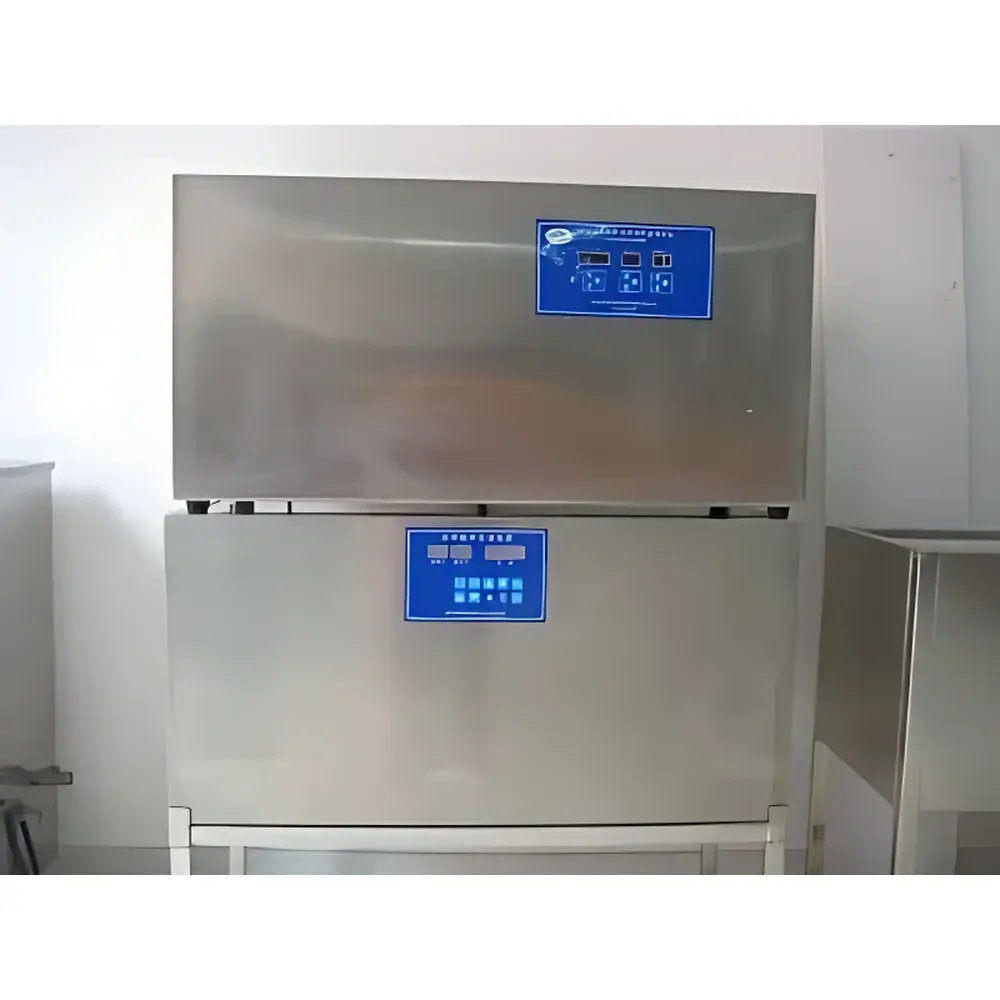
Shengyan SCQ-9100 Benchtop Ultrasonic Cleaner
| Brand | Shengyan Ultrasonics (SYCS) |
|---|---|
| Origin | Shanghai, China |
| Model | SCQ-9100 |
| Capacity | 26 L |
| Ultrasonic Frequency | 40 kHz |
| Ultrasonic Power | 600 W |
| Timer Range | 1–60 min |
| Lid | Sound-dampening cover included |
| Drain | Manual valve |
| Tank Material | Full SUS304 stainless steel |
| Internal Dimensions | 725 × 240 × 150 mm |
| Power Supply | 220 V / 50 Hz |
| Safety Features | Overload and overheat protection |
| Optional Frequencies | 25/40/60 kHz (model-dependent) |
| Compliance | Designed for GLP-aligned laboratory workflows |
Overview
The Shengyan SCQ-9100 is a benchtop ultrasonic cleaner engineered for reproducible, non-destructive cleaning of delicate and precision-critical components in regulated laboratory, clinical, and industrial environments. It operates on the principle of cavitation—generated by high-frequency (40 kHz) acoustic energy transmitted through an aqueous or solvent-based cleaning medium—producing microscopic implosions that dislodge particulate contamination, organic residues, biofilms, and entrapped air from complex geometries without mechanical abrasion. Its 26 L capacity and robust 600 W transducer array deliver uniform energy distribution across the full tank volume, making it suitable for batch processing of glassware, optical components, surgical instruments, PCBs, dental prosthetics, and microfluidic devices. The unit complies with fundamental requirements for cleaning process validation under ISO 13485 and ASTM F3215, and its construction supports routine use in environments requiring traceability and repeatable performance.
Key Features
- Full SUS304 stainless steel tank and basket—resistant to corrosion from alkaline, acidic, and organic solvents; superior to industry-standard SUS201/SUS202 alternatives.
- Dedicated 40 kHz piezoelectric transducers, incorporating U.S.-sourced ceramic chips and proprietary driver circuitry—optimized for stable output, extended service life (>10,000 hr MTBF), and reduced operational noise (≤55 dB at 1 m).
- Integrated safety architecture: dual-stage thermal cutoff, current-limiting overload protection, and automatic shutdown during dry-run conditions (standard on all models ≥22.5 L).
- Ergonomic front-panel timer with 1-minute resolution (1–60 min); no power or temperature adjustment—ensuring consistent, protocol-driven operation.
- Sound-dampening hinged lid with sealing gasket—reduces airborne noise and minimizes solvent evaporation during extended cycles.
- Manual drain valve positioned at tank base—enables complete fluid evacuation without tilting or disassembly.
- EMC-compliant power supply (IEC 61000-4 series) and reinforced insulation—meets CE marking requirements for Class I laboratory equipment.
Sample Compatibility & Compliance
The SCQ-9100 accommodates a broad range of sample types—including borosilicate glassware, fused silica optics, titanium implants, silicone tubing, stainless-steel watch movements, and FR-4 printed circuit boards—without surface pitting or dimensional alteration when operated within validated time/frequency/solvent parameters. Its tank geometry (725 × 240 × 150 mm) permits vertical immersion of tall vessels (e.g., NMR tubes, chromatography columns) and horizontal placement of large-area substrates (e.g., wafer carriers, microscope slides). While not certified for sterile processing per ISO 17664 or EN 15883, the unit supports pre-sterilization cleaning steps compliant with AAMI ST79 and USP . All wetted surfaces meet FDA 21 CFR 178.3570 indirect food-contact material guidelines, and documentation packages include material certifications (EN 10088-1), RoHS declarations, and electrical safety test reports (IEC 61010-1).
Software & Data Management
The SCQ-9100 is a standalone analog-controlled instrument with no embedded microprocessor or digital interface. This design prioritizes operational simplicity, electromagnetic resilience, and long-term serviceability—eliminating firmware vulnerabilities, calibration drift from software aging, or dependency on proprietary drivers. For laboratories requiring audit-ready records, external validation protocols may integrate calibrated timers, temperature loggers (for heated bath add-ons), and particle-counting verification (e.g., via light obscuration per ISO 21501-4). The unit’s fixed-frequency, fixed-power architecture ensures identical energy delivery across units—facilitating cross-site method transfer and multi-instrument qualification per ICH Q5A and EU GMP Annex 15.
Applications
- Laboratory Glassware Cleaning: Removal of protein residues, precipitates, and detergent films from volumetric flasks, pipettes, and filtration assemblies prior to trace-metal analysis (ICP-MS, AAS).
- Medical Device Preparation: Decontamination of reusable endoscopic components, orthodontic retainers, and dental handpieces before autoclaving or ethylene oxide sterilization.
- Electronics Manufacturing: Flux residue removal from SMT-assembled PCBs and solder paste stencil cleaning—validated per IPC-J-STD-001 and J-STD-033.
- Research Instrument Maintenance: Cleaning of HPLC injector ports, GC liner inserts, and SEM sample stubs to prevent carryover and baseline noise.
- Jewelry & Precision Mechanics: Non-abrasive restoration of engraved surfaces, watch balance springs, and optical lens mounts without micro-scratching.
FAQ
Is the SCQ-9100 suitable for cleaning delicate MEMS devices or semiconductor wafers?
Yes—when used with low-surface-tension, low-viscosity solvents (e.g., terpene-based or fluorinated carriers) and optimized dwell times (typically 3–8 min), it achieves sub-5 µm particle removal without damaging fragile structures. Validation per SEMI F20 is recommended.
Does the unit support integration into automated lab workflows via RS-232 or Ethernet?
No—the SCQ-9100 lacks digital communication ports. It is intended for manual, procedure-based operation in settings where deterministic repeatability outweighs remote control needs.
Can I use acetone or isopropanol as cleaning media?
Yes, but only in well-ventilated fume hoods and with explosion-proof transducer variants (not standard on SCQ-9100). Standard configuration is rated for aqueous and mild organic solutions only (flash point >60°C).
What maintenance is required to sustain cavitation efficiency?
Bi-weekly tank inspection for scale buildup, quarterly transducer face cleaning with soft brush and deionized water, and annual verification of timer accuracy against a traceable stopwatch are sufficient for GLP-conforming use.
Is a certificate of conformance available for IQ/OQ documentation?
Yes—Shengyan provides a factory-issued CoC listing materials, electrical safety test results, and dimensional verification. Custom 3Q documentation packages (including installation and operational qualification templates) are available upon request.



