
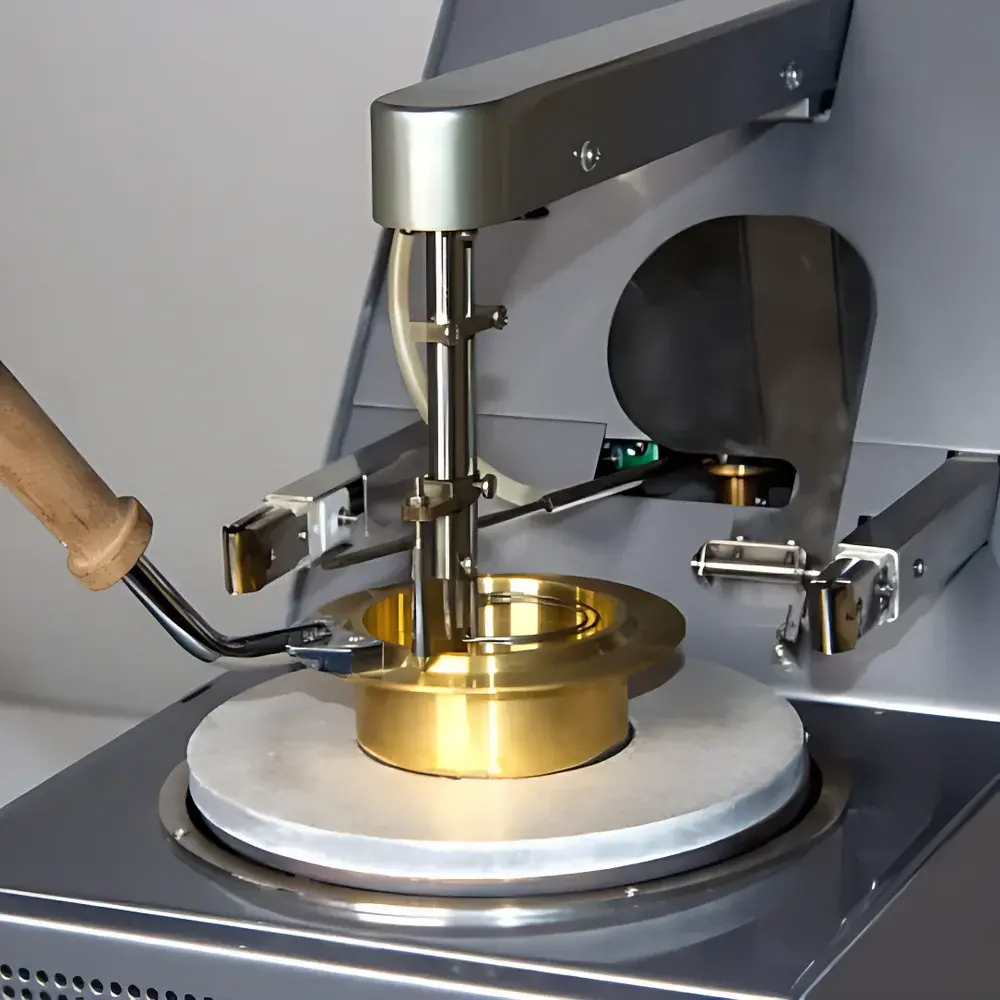
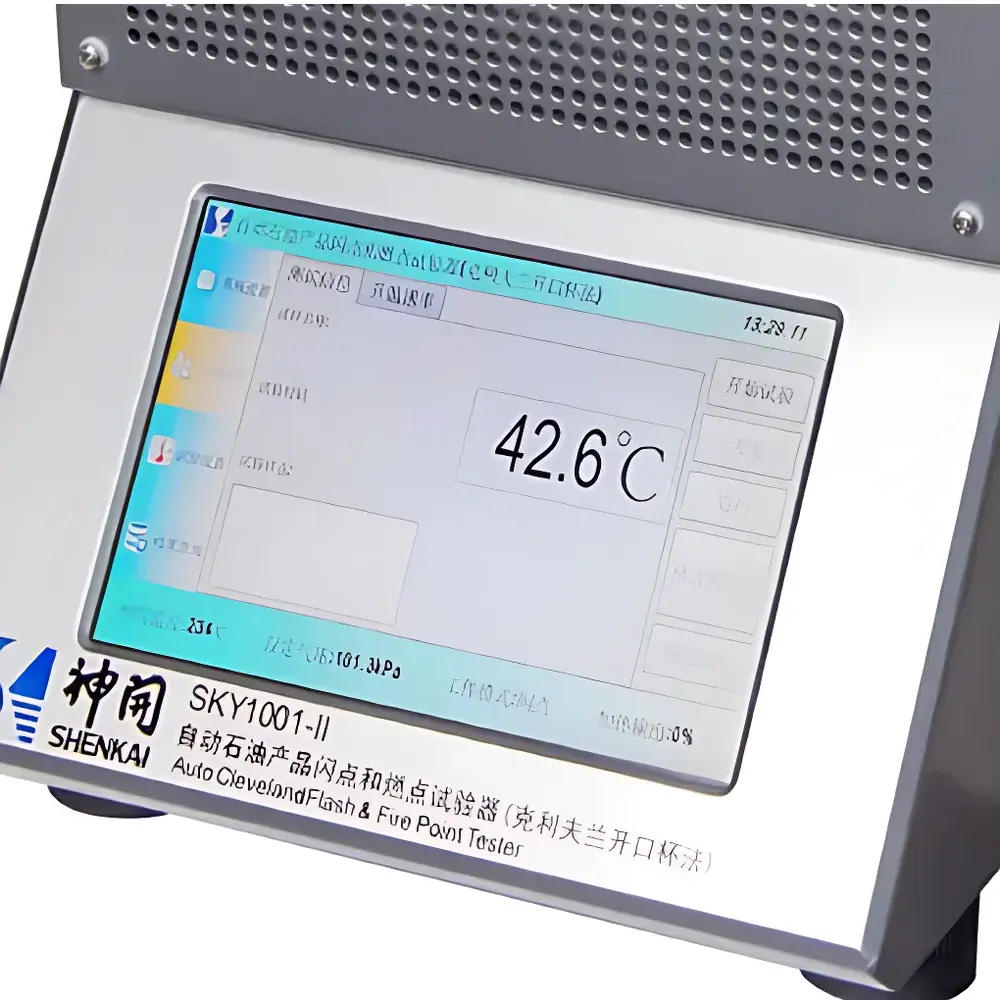
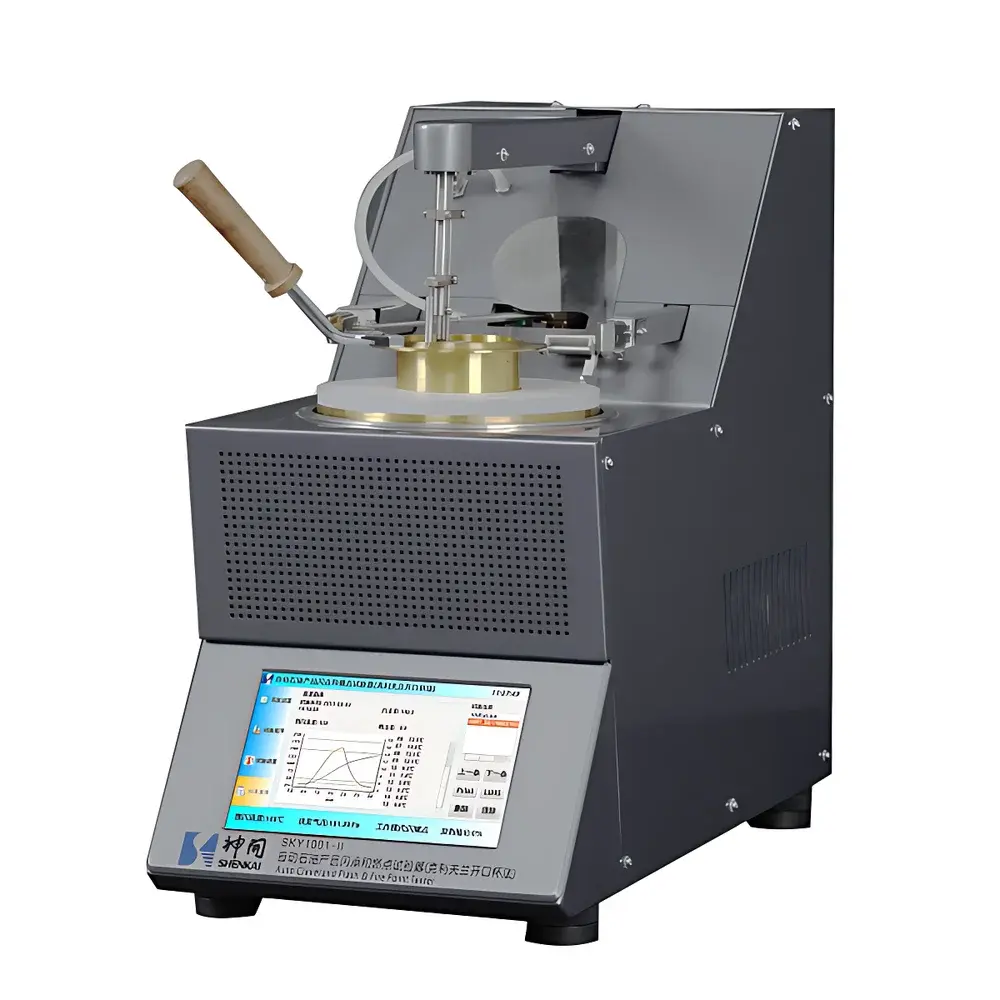
Shenkai SKY1001-II Cleveland Open Cup Automatic Flash Point and Fire Point Tester
| Brand | Shenkai |
|---|---|
| Model | SKY1001-II |
| Test Method | Cleveland Open Cup (COC) |
| Standards Compliance | ASTM D92, GB/T 3536, ISO 2592, IP 36 |
| Temperature Range | 79–400 °C |
| Display Resolution | 0.1 °C |
| Repeatability | ≤6 °C |
| Reproducibility | ≤8 °C |
| Safety Cutoff Temperatures | EFP+20 °C (Flash), EFP+50 °C (Fire), Absolute Limit: 400 °C |
| Heating Power | 800 W |
| Total Power | 900 W |
| Supply | AC 220 V ±10%, 50/60 Hz |
| Dimensions | 233 × 530 × 427 mm (W×D×H) |
| Weight | 19 kg |
| Cooling | Forced-air |
| Ignition Detection | Ionization flame sensing |
| Pressure Requirement for Fuel Gas | <10 kPa (LPG, butane, natural gas, or town gas) |
Overview
The Shenkai SKY1001-II Cleveland Open Cup Automatic Flash Point and Fire Point Tester is a fully automated benchtop instrument engineered for precise, repeatable, and compliant determination of flash point and fire point of petroleum-based liquids—including lubricating oils, residual fuel oils, silicone fluids—as well as non-petroleum materials such as food-grade oils, edible fats, and industrial chemicals. It implements the standardized Cleveland Open Cup (COC) method, a thermally controlled, manual-equivalent open-vessel test where sample temperature is ramped under defined heating rates, and ignition is introduced at predetermined intervals using a calibrated pilot flame. The instrument’s core measurement principle relies on detection of transient vapor ignition via ionization current monitoring—ensuring high sensitivity to momentary flame propagation while eliminating subjective visual interpretation. Designed for routine QC/QA laboratories in refineries, independent testing facilities, and regulatory compliance units, the SKY1001-II delivers traceable results aligned with internationally recognized test protocols.
Key Features
- Fully automated COC test sequence—including cup positioning, temperature ramping, flame introduction, sweep motion, ignition detection, fire point confirmation, post-test cooling, and system reset—executed without operator intervention.
- Four configurable test modes: Predefined Flash Point, Fire Point, Flash-Fire Point (dual endpoint), and Search Mode for unknown samples—each enforcing respective standard-specified heating rate profiles and flame application timing.
- 7-inch full-color capacitive touchscreen interface with multilingual support (English, Chinese, Russian) and intuitive workflow navigation optimized for GLP-compliant operation.
- High-stability PT100 platinum resistance thermometer (imported wire-wound type) with NIST-traceable calibration capability and real-time ambient pressure compensation for accurate vapor-phase temperature referencing.
- Fuzzy adaptive PID temperature control algorithm dynamically adjusts heater output to maintain ASTM D92–specified ramp rates (e.g., 5–6 °C/min up to 200 °C; 2–3 °C/min above), minimizing overshoot and thermal lag.
- Modular ignition assembly featuring plug-and-play electronic igniter and removable ionization ring—designed for rapid field replacement and residue-free maintenance between tests.
- Dual-layer safety architecture: programmable thermal cutoffs (EFP+20 °C for flash, EFP+50 °C for fire, hard limit at 400 °C), automatic flame extinguishing upon detection, forced-air cooling activation, and real-time fault diagnostics with on-screen alert codes.
Sample Compatibility & Compliance
The SKY1001-II is validated for use with viscous and low-volatility liquid specimens meeting the physical property scope of ASTM D92 and its harmonized equivalents (GB/T 3536, ISO 2592, IP 36). Compatible matrices include base oils, cylinder oils, bituminous cutbacks, biodiesel blends, synthetic esters, and food-grade triglyceride oils. It excludes highly volatile solvents (e.g., gasoline, acetone) requiring closed-cup methods (ASTM D56, D3278). All operational parameters—including heating rate tolerances, flame dimensions, sweep geometry, and dwell times—are preconfigured to satisfy clause-specific requirements of each referenced standard. The instrument supports audit-ready documentation per FDA 21 CFR Part 11 when integrated with validated LIMS environments, including electronic signatures, change logs, and immutable result archives.
Software & Data Management
Test data—including raw temperature/time profiles, detected flash/fire events, atmospheric pressure inputs, operator ID, and calibration timestamps—are stored internally with ≥5,000-test capacity. Results export via RJ-45 Ethernet interface in CSV or XML format compatible with major LIMS platforms (e.g., LabWare, Thermo Fisher SampleManager). Optional firmware upgrade enables secure TLS 1.2 communication, role-based user access control (admin/operator/auditor), and audit trail generation compliant with ISO/IEC 17025:2017 Clause 7.7. Calibration records—including PT100 verification logs and pressure sensor drift checks—can be archived alongside test reports to fulfill metrological traceability requirements.
Applications
- Refinery quality control: verification of flash point specifications for finished lubricants and distillate fractions prior to shipment.
- Fuel certification: assessment of residual fuel oil stability and handling safety per MARPOL Annex VI and ISO 8217.
- Regulatory submissions: generation of flash/fire point data required by OSHA Hazard Communication Standard (29 CFR 1910.1200) and REACH Annex VII.
- Product development labs: screening of additive packages’ impact on thermal stability and flammability thresholds.
- Third-party testing labs: accredited testing per ISO/IEC 17025 for flash point reporting in technical data sheets and safety data sheets (SDS).
FAQ
What standards does the SKY1001-II comply with?
It fully implements ASTM D92, GB/T 3536, ISO 2592, and IP 36 for Cleveland Open Cup flash and fire point testing.
Can the instrument operate with different fuel gases?
Yes—it accepts liquefied petroleum gas (LPG), butane, natural gas, or town gas at regulated inlet pressure ≤10 kPa.
Is atmospheric pressure correction applied automatically?
Yes—the built-in barometric sensor performs real-time pressure compensation during temperature calculation per ASTM D92 Annex A1.
How is flash point detection achieved?
Via ionization flame sensing: a low-current DC circuit monitors conductivity changes in the flame zone, triggering detection at sub-second response latency.
Does the system support remote monitoring or network integration?
Yes—RJ-45 Ethernet port enables direct LIMS connectivity, scheduled report exports, and centralized firmware updates in multi-instrument lab deployments.
Related Products





