
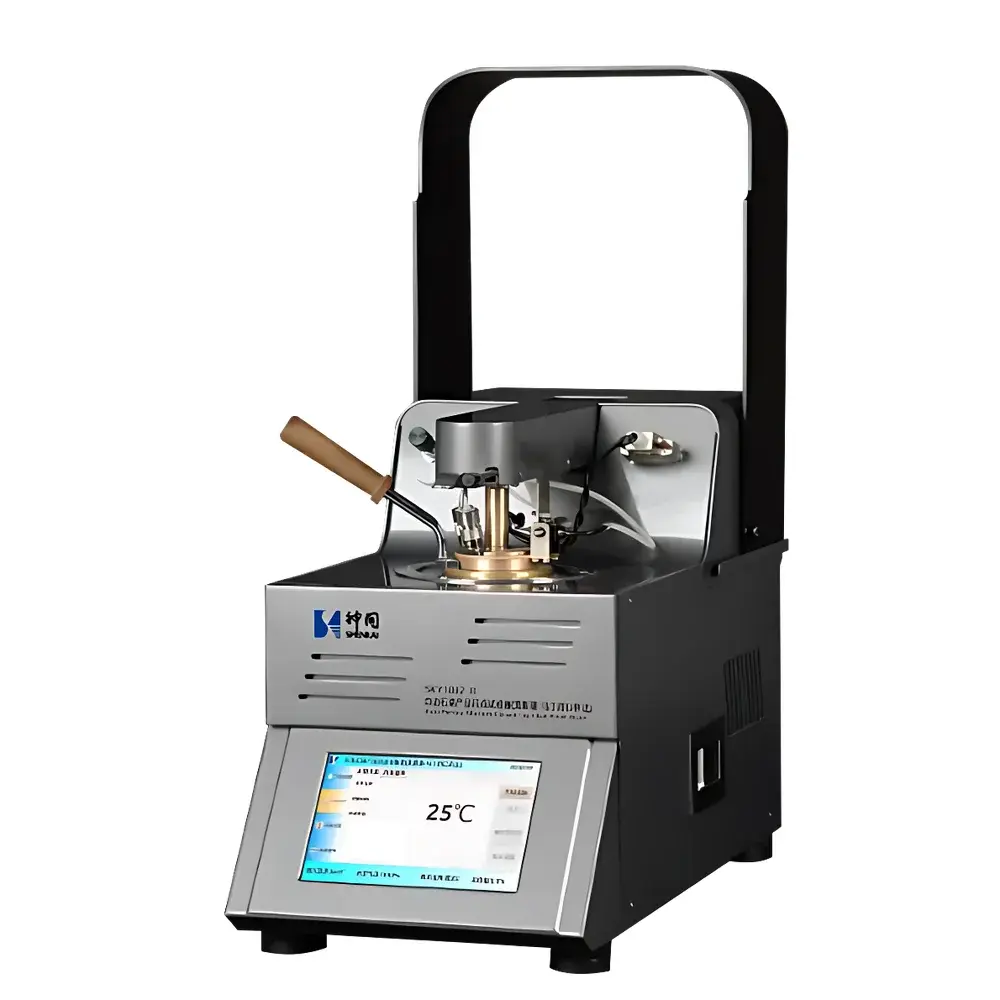
Shenkai SKY1002-II Automatic Flash Point Tester (Pensky-Martens Closed Cup Method)
| Brand | Shenkai |
|---|---|
| Origin | Shanghai, China |
| Model | SKY1002-II |
| Operation | Fully Automatic |
| Compliant Standards | ASTM D93, GB/T 261, ISO 2719, IP 34 |
| Flash Point Range | 40–370 °C |
| Temperature Display Resolution | 0.1 °C |
| Heating Rates | Step A: 5–6 °C/min |
| Step B | 1.0–1.5 °C/min |
| Step C | 2.5–3.5 °C/min |
| Stirring Speeds | Step A: 90–120 r/min |
| Step B | 250 ±10 r/min |
| Step C | 90–120 r/min |
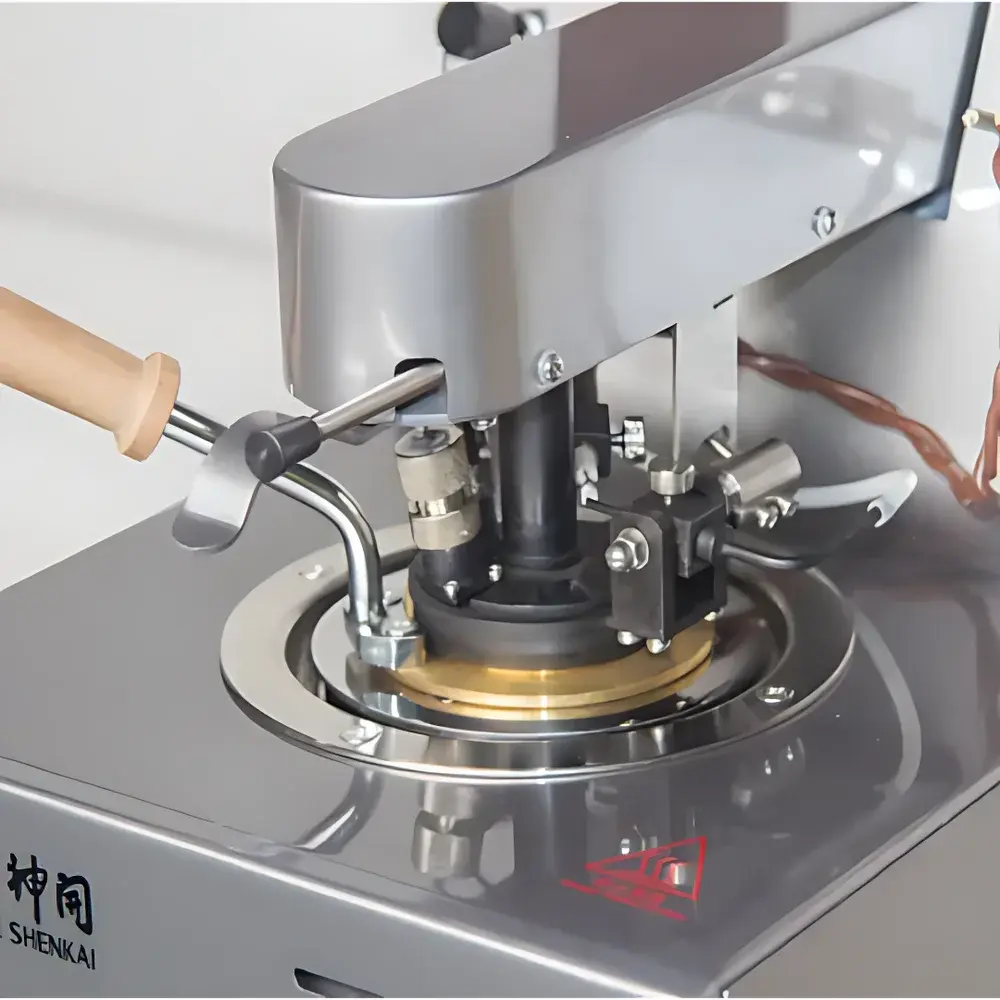
| Ignition Modes | Electronic or Gas (LPG, butane, natural gas <10 kPa) |
| Safety Cut-off | EFP+20 °C (flash mode), absolute limit 400 °C |
| Cooling | High-efficiency forced-air system |
| Data Interface | RJ-45 for LIMS integration |
| Power Supply | AC 220 V ±10%, 50/60 Hz |
| Dimensions (W×D×H) | 265 × 525 × 365 mm |
| Net Weight | 20 kg |
Overview
The Shenkai SKY1002-II Automatic Flash Point Tester implements the standardized Pensky-Martens closed-cup method to determine the flash point of petroleum products, residual fuel oils, biodiesel blends, lubricants, bituminous materials, food-grade oils, and industrial chemicals. Flash point—defined as the lowest temperature at which vapors above a sample ignite momentarily when exposed to an ignition source—is a critical safety parameter governed by internationally harmonized test protocols. This instrument operates in strict accordance with ASTM D93 (Standard Test Method for Flash Point by Pensky-Martens Closed Cup Tester), GB/T 261 (Chinese national standard equivalent), ISO 2719, and IP 34. Its core measurement principle relies on controlled heating of a sealed sample cup under continuous stirring, followed by periodic introduction of an ignition source at defined temperature intervals. Detection is performed via thermocouple-based flame sensing, ensuring high repeatability and compliance with regulatory requirements for hazard classification, transportation labeling (UN TDG, GHS), and process safety management.
Key Features
- Fully automated operation powered by iSKvator™ intelligent control architecture—user initiates testing after cup placement and method selection, with no manual intervention required during ramp, stir, ignition, or detection phases.
- Five pre-programmed test modes: Standard Steps A, B, and C per ASTM D93, plus two rapid-scan variants optimized for preliminary flash point estimation (A-Rapid and B-Rapid).
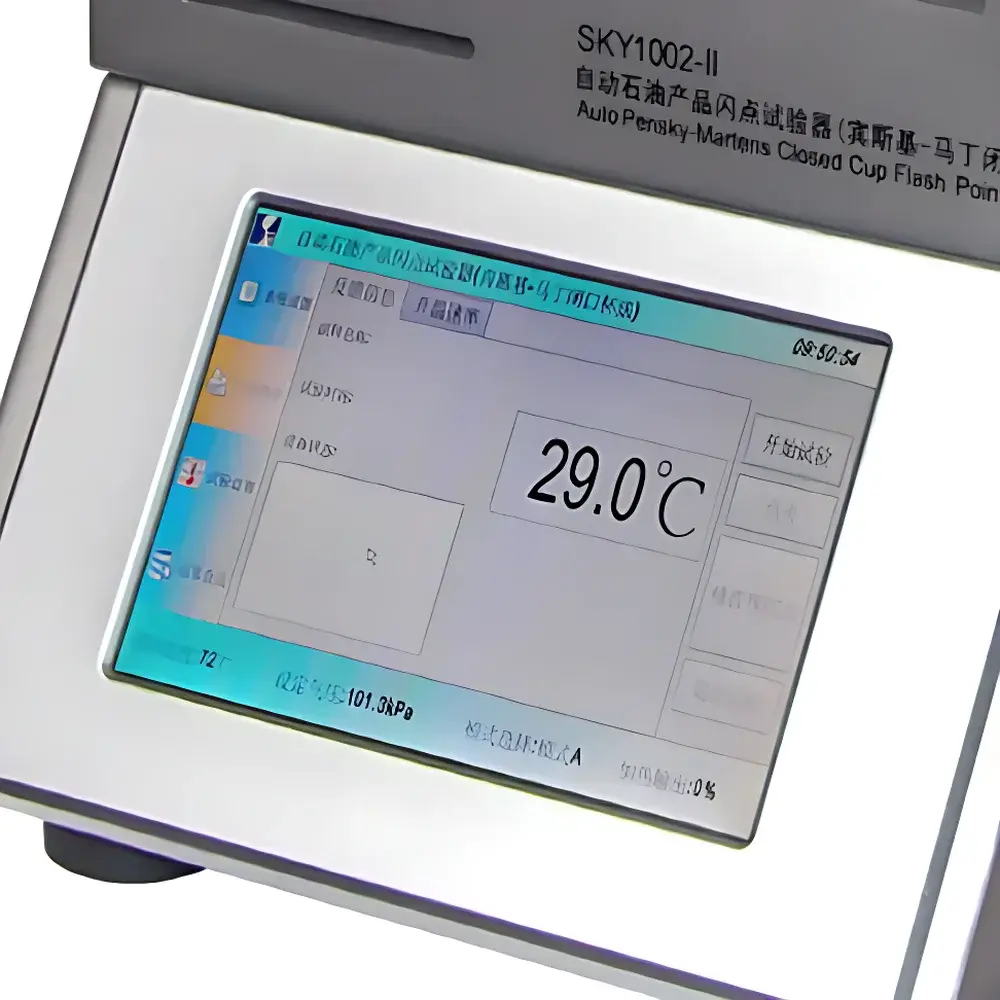
- 7-inch full-color capacitive touchscreen interface supporting English, Chinese, and Russian languages—designed for intuitive navigation in multi-national laboratory environments.
- High-stability glass-encapsulated PT100 platinum resistance thermometer (imported) for precise sample temperature monitoring with ±0.1 °C resolution and traceable calibration capability.
- Fuzzy adaptive heating algorithm dynamically adjusts power output to maintain prescribed ramp rates within tolerance, with real-time graphical display of temperature vs. time profiles.
- Dual ignition system: switchable between low-energy electronic spark (≤50 W) and regulated gas flame (LPG, butane, or pipeline natural gas at <10 kPa)—enabling method flexibility and operational redundancy.
- Integrated atmospheric pressure compensation and automatic temperature offset correction ensure accuracy across varying altitudes and ambient conditions.
- Comprehensive safety architecture includes dual thermal cut-offs (EFP+20 °C and hard limit at 400 °C), auto-cooling activation upon fault, gas solenoid valve interlock, and real-time self-diagnostic alerts.
- Forced-air cooling system reduces inter-test interval by >40% compared to passive dissipation, supporting high-throughput QC workflows.
Sample Compatibility & Compliance
The SKY1002-II accommodates a broad spectrum of liquid and semi-viscous samples, including distillate fuels (diesel, kerosene), heavy residual oils, biofuels (FAME, HVO), synthetic lubricants, asphalt binders, edible oils, and organic solvents. It meets all mechanical, thermal, and procedural requirements specified in ASTM D93 Annex A1 (for low-volatility materials) and Annex A2 (for viscous products). The instrument’s design supports GLP-compliant operation: audit-trail-enabled firmware logs operator ID, test date/time, method parameters, raw temperature data, ignition events, and pass/fail determinations. All calibration procedures—including reference thermometer verification and barometric correction—are documented and exportable. The device is suitable for use in laboratories subject to FDA 21 CFR Part 11 (when paired with validated LIMS software), ISO/IEC 17025 accreditation, and internal QA/QC programs requiring full traceability.
Software & Data Management
Test data—including flash point result, observed ignition temperature, atmospheric pressure, EFP value, ramp rate, stir speed, and diagnostic flags—are stored locally in non-volatile memory (≥5,000 records). Data export is supported via RJ-45 Ethernet interface to laboratory information management systems (LIMS) using TCP/IP protocol with configurable CSV or XML schema mapping. Optional USB port enables direct report printing or offline data backup. Firmware supports remote firmware updates and method library expansion through secure authenticated channels. All stored records include timestamp, user login identifier, and instrument serial number to satisfy chain-of-custody requirements.
Applications
- Refinery quality control: rapid verification of flash point specifications for crude fractions, naphthas, and finished fuels.
- Biodiesel certification: compliance testing per EN 14213 and ASTM D6751 for flash point ≥90 °C.
- Lubricant formulation labs: screening of base oil blends and additive packages for volatility safety margins.
- Regulatory submission support: generation of auditable test reports for REACH, TSCA, and transport authorities (IMDG Code, IATA DGR).
- Research & development: kinetic analysis of vapor pressure behavior and thermal stability thresholds in novel hydrocarbon alternatives.
- Contract testing laboratories: high-volume routine analysis with minimal operator training burden and consistent inter-laboratory reproducibility.
FAQ
Which standards does the SKY1002-II fully comply with?
ASTM D93, GB/T 261, ISO 2719, and IP 34—covering both standard and rapid-scan methodologies.
Can the instrument operate without external gas supply?
Yes—the integrated electronic ignition system eliminates dependency on combustible gases, enabling safe operation in gas-restricted facilities.
Is atmospheric pressure compensation mandatory for accurate results?
Yes—flash point values are pressure-dependent; the built-in barometric sensor automatically applies correction per ASTM D93 Section 8.2.
What is the minimum sample volume required?
Typically 50–70 mL depending on cup geometry and test mode—consistent with Pensky-Martens closed-cup standard specimen requirements.
How is data integrity ensured during LIMS transmission?
All communications use checksum-verified packet framing; failed transfers trigger automatic retry and event logging for audit review.




