
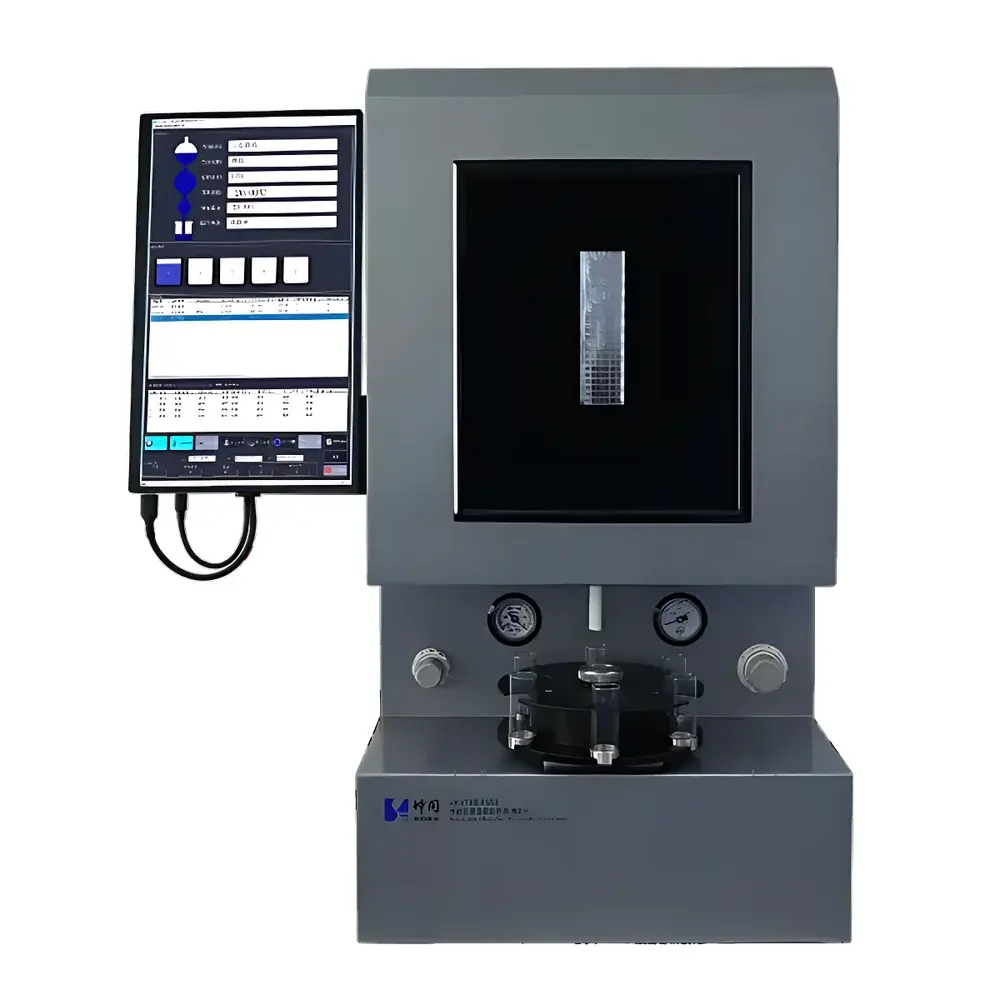
Shenkai SKY1003-VIII Fully Automated Low-Temperature Kinematic Viscosity Tester
| Brand | Shenkai |
|---|---|
| Origin | Shanghai, China |
| Model | SKY1003-VIII |
| Temperature Control Range | −40 °C to +20 °C |
| Temperature Stability | ±0.02 °C |
| Kinematic Viscosity Range | 1–3000 mm²/s (cSt) |
| Sample Volume | 13–15 mL |
| Bath Capacity | ~2 L |
| Cooling Method | Compressor-based |
| Bath Medium | Low-temperature silicone oil |
| Timing Resolution | 0.01 s |
| Auto-sampler | 6-position |
| Capillary Type | Proprietary modified Ubbelohde viscometer |
| Compliance | ASTM D445, ASTM D446, ASTM D1655, ISO 3104, ISO 3105, IP 71, DEF STAN 91-91, GB/T 265, GB/T 30515 |
| Cleaning System | Dual-solvent, programmable, with automatic warm-back rinse and dry-air purge |
| Safety Features | Low solvent detection, over-temperature protection, high/low bath level monitoring |
| Interface | USB, RJ45 |
| Power | ≤1000 W |
| Dimensions (W×D×H) | 660 × 620 × 790 mm |
| Net Weight | 82 kg (including bath medium) |
Overview
The Shenkai SKY1003-VIII Fully Automated Low-Temperature Kinematic Viscosity Tester is an engineered solution for precise, reproducible measurement of kinematic viscosity in petroleum-based fluids under controlled sub-ambient conditions. It operates on the principle of capillary flow timing—specifically, the efflux time of a defined volume of sample through a calibrated modified Ubbelohde capillary viscometer immersed in a thermally stabilized bath. This method conforms rigorously to the hydrodynamic foundation of ASTM D445 and ISO 3104, where kinematic viscosity (ν) is derived from the product of the capillary constant (C) and measured efflux time (t), corrected for kinetic energy correction and thermal expansion. Designed for operational robustness in QC/QA and regulatory-compliant laboratories, the SKY1003-VIII delivers traceable, method-validated results across a broad temperature range (−40 °C to +20 °C), with thermal stability maintained at ±0.02 °C—critical for low-temperature jet fuel and aviation lubricant testing per ASTM D1655 and DEF STAN 91-91.
Key Features
- iSKvator™ automation architecture enabling fully unattended operation: auto-sampling, bath temperature equilibration, capillary immersion, efflux timing, dual-solvent cleaning, warm-back rinse, and dry-air purging—eliminating manual intervention during sequence execution.
- Proprietary modified Ubbelohde capillaries with 100× dynamic range per tube (1–3000 mm²/s), reducing tube-swapping frequency and enhancing inter-test consistency.
- Integrated 15.6-inch industrial-grade touchscreen HMI with embedded OS; supports local test method storage, parameter configuration, and real-time diagnostics—no external PC required for routine operation.
- NTC-based temperature sensing system immune to optical interference, ensuring accurate bath and sample temperature registration regardless of sample color, turbidity, or ambient lighting conditions.
- Dual-solvent cleaning module with user-definable solvent sequences, automated solvent-level monitoring, and temperature-compensated rinse cycles to prevent residual cross-contamination.
- Corrosion-resistant fluid path materials compatible with chlorinated and aromatic solvents (e.g., toluene, xylene, trichloroethylene), supporting rigorous cleaning protocols mandated by military and aviation specifications.
- Onboard calibration utilities for both bath temperature (via certified NIST-traceable reference probe) and capillary constants (using certified standard oils per ISO 4268), supporting internal verification prior to regulated runs.
Sample Compatibility & Compliance
The SKY1003-VIII accommodates transparent, translucent, and opaque petroleum products—including Jet A-1, JP-8, diesel fuels, transmission fluids, hydraulic oils, and base stocks—without optical pre-treatment. Its design satisfies the physical and procedural requirements of multiple international standards: ASTM D445 (standard test method for kinematic viscosity), ASTM D1655 (jet fuel specification requiring −20 °C viscosity), DEF STAN 91-91 (UK MoD aviation fuel testing), ISO 3104 (petroleum products—determination of kinematic viscosity), and GB/T 265 (Chinese national standard). All hardware and firmware components are engineered to support GLP/GMP-aligned workflows, including electronic audit trails, user access control, and data integrity safeguards consistent with FDA 21 CFR Part 11 expectations when integrated into validated LIMS environments.
Software & Data Management
The embedded software platform provides full lifecycle test management: method creation, sample registration (with barcode support), queue scheduling (including priority override), real-time efflux curve visualization, and post-run validation alerts (e.g., outlier detection based on ASTM repeatability limits). Raw timing data, temperature logs, and calibration records are stored in encrypted binary format with SHA-256 hashing. Export options include CSV, PDF reports (with digital signature fields), and structured XML for seamless LIMS ingestion via TCP/IP or USB transfer. Audit trail functionality captures operator ID, timestamp, action type, and parameter changes—retained for ≥36 months with configurable archival policies. Temperature and capillary calibration logs are versioned and digitally signed to satisfy traceability requirements under ISO/IEC 17025.
Applications
This instrument is deployed in refinery QC labs for batch release of distillate fuels; in OEM lubricant development labs assessing low-temperature pumpability; in aviation maintenance depots verifying fuel conformance prior to aircraft refueling; and in third-party certification bodies conducting accredited testing per ISO/IEC 17025. Its −40 °C capability enables evaluation of arctic-grade hydraulic fluids and synthetic ester-based aviation oils, while the 6-position autosampler supports high-throughput screening of multi-grade formulations. The system’s compatibility with deep-colored crudes and oxidized used oils—enabled by non-optical NTC sensing—extends utility beyond conventional clear-fuel applications into condition monitoring and re-refining R&D.
FAQ
Does the SKY1003-VIII support ASTM D1655 Annex A2 for −20 °C jet fuel testing?
Yes—the instrument maintains thermal stability within ±0.02 °C at −20 °C and includes pre-configured test templates compliant with Annex A2 timing tolerances and sample handling protocols.
Can capillary constants be imported from external calibration certificates?
Yes—users may manually enter or import capillary constants (C-values) with uncertainty budgets, and the system applies them dynamically during viscosity calculation.
Is the dry-air purge system moisture-controlled to prevent condensation at −40 °C?
Yes—the integrated desiccant dryer ensures dew point < −60 °C; combined with heated purge lines, it eliminates frost formation inside capillaries during cold-cycle recovery.
How is data integrity ensured during power interruption?
All active test states and raw sensor logs are written to non-volatile memory every 2 seconds; upon restart, the system resumes from last stable checkpoint without data loss.
What validation documentation is supplied with the instrument?
Factory-issued IQ/OQ documentation, NIST-traceable temperature verification report, capillary calibration certificate (per ISO 4268), and software verification summary compliant with IEC 62304 Class B.






