
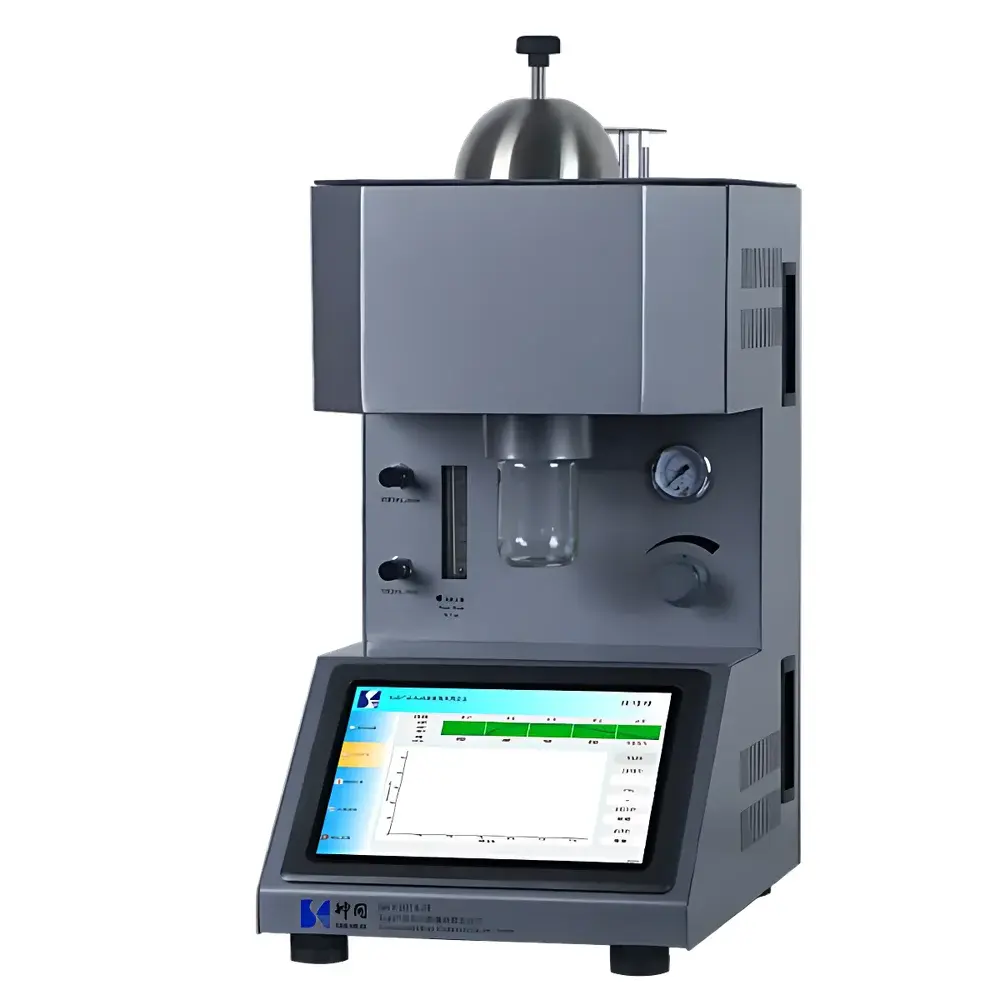
Shenkai SKY1011-III Automated Micro Carbon Residue Tester
| Brand | Shenkai |
|---|---|
| Origin | Shanghai, China |
| Model | SKY1011-III |
| Standards Compliance | ASTM D4530, GB/T 17144, ISO 10370, IP 398 |
| Carbon Residue Range | 0.10–30.0 % (m/m) |
| Sample Capacity | 12 positions |
| Crucible Temp. Range | Ambient to 500 °C |
| Temp. Stability at 500 °C | ±2.0 °C |
| Hold Time at 500 °C | 15 min |
| N₂ Flow Control | 100–1000 mL/min (auto-switched between 150 & 600 mL/min) |
| Pressure Regulation | 0–392 kPa |
| Sample Volume | up to 3 g (dependent on expected residue) |
| Data Storage | ≥500,000 test records |
| Interface Options | USB, RS-232, RJ-45 Ethernet |
| Power | AC 220 V ±10%, 50/60 Hz, 1200 W |
| Dimensions (W×D×H) | 320 × 455 × 660 mm |
| Net Weight | 32 kg |
Overview
The Shenkai SKY1011-III Automated Micro Carbon Residue Tester is an engineered solution for quantifying the carbon residue content of petroleum products under controlled thermal decomposition conditions. Based on the micro-method principle defined in ASTM D4530 and equivalent international standards (ISO 10370, IP 398, GB/T 17144), the instrument subjects a precisely weighed sample to programmed heating in an inert nitrogen atmosphere, followed by pyrolysis at 500 °C for 15 minutes. The residual coke mass—expressed as mass percent—is calculated automatically from pre- and post-test gravimetric measurements. Unlike traditional Conradson carbon residue (CCR) apparatuses requiring large sample volumes and manual intervention, the SKY1011-III delivers high reproducibility with minimal operator dependency, reduced sample consumption (≤3 g), and full automation of temperature ramping, gas flow sequencing, and cooling cycles.
Key Features
- iSKvator™ intelligent control architecture enabling one-touch initiation of complete test sequences—including purge, heating, isothermal hold, and cooldown phases
- 10-inch full-color capacitive touchscreen interface with real-time graphical display of furnace temperature profile, elapsed time, and stage progression
- Programmable dual-stage nitrogen flow control (150 mL/min for purging, 600 mL/min during pyrolysis) via precision mass flow controllers with integrated secondary pressure regulation
- Simultaneous processing of up to 12 samples using standardized glass crucibles (2 mL and 4 mL options) housed in a thermally uniform Φ85 mm × 105 mm cylindrical furnace
- Automated data acquisition: supports direct integration with analytical balances via RS-232 or USB; optional LIMS-compatible data capture eliminates manual transcription errors
- Robust safety architecture including overtemperature cutoff (>550 °C), runaway heating detection, and 60-minute fail-safe timeout if target temperature is not reached
- Modular design of the coking furnace and condensate collector (200 mL threaded borosilicate glass vial) enables rapid field maintenance without specialized tools
- Comprehensive audit-ready data management: timestamped test logs, user ID tracking, and immutable storage of ≥500,000 records with search, export (CSV/Excel), and filtering capabilities
Sample Compatibility & Compliance
The SKY1011-III is validated for use with distillates, residual fuels, lubricating oils, and cracked feedstocks where carbon residue serves as a critical indicator of coke-forming tendency during refining, combustion, or catalytic processing. Its operational parameters fully satisfy the procedural requirements of ASTM D4530 (Standard Test Method for Determination of Carbon Residue (Micro Method)), ISO 10370 (Petroleum products — Determination of carbon residue — Micro method), IP 398 (Carbon residue of petroleum products — Micro method), and GB/T 17144 (Petroleum products — Determination of carbon residue — Micro method). All critical functions—including temperature ramp rate control, dwell time accuracy (<0.1 s timing resolution), and nitrogen flow repeatability—are traceable to NIST-calibrated references. The system supports GLP-compliant workflows through configurable user access levels, electronic signatures, and 21 CFR Part 11–ready audit trails when paired with validated software modules.
Software & Data Management
The embedded firmware features a deterministic real-time operating system ensuring deterministic execution of thermal profiles and gas switching events. Data handling complies with laboratory informatics best practices: all raw sensor values (furnace thermocouple output, flow meter readings, balance inputs) are logged at 1 Hz resolution alongside metadata (operator ID, sample ID, calibration status, environmental ambient readings). Export formats include CSV and XML for seamless ingestion into LIMS platforms (e.g., LabWare, STARLIMS, Thermo Fisher SampleManager). Optional software packages provide statistical process control (SPC) dashboards, trend analysis across batches, and automated report generation aligned with ISO/IEC 17025 documentation requirements. Firmware updates are delivered via secure HTTPS and verified using SHA-256 checksums.
Applications
- Refinery QC/QA labs monitoring feedstock quality and predicting fouling potential in FCC units and hydroprocessing reactors
- Fuel specification verification for marine diesel (ISO 8217), aviation turbine fuel (ASTM D1655), and heavy fuel oil (ISO 8217 Annex A)
- Lubricant formulation R&D assessing thermal stability and deposit formation propensity under simulated engine conditions
- Independent testing laboratories performing contract analyses for regulatory compliance (EPA, IMO MARPOL Annex VI, EU Fuel Quality Directive)
- Research institutions studying coke yield correlations with asphaltene content, Conradson number, and H/C ratio
FAQ
What standards does the SKY1011-III comply with?
ASTM D4530, ISO 10370, IP 398, and GB/T 17144 — all implemented with full procedural fidelity, including specified heating rates, soak durations, and inert gas flow protocols.
Can the instrument integrate with our existing LIMS?
Yes. Native support for ASTM E1384-compliant data exchange is provided via RS-232, USB virtual COM port, or TCP/IP (RJ-45); configuration templates are available for major LIMS vendors.
Is manual weighing required?
No. The system accepts direct balance input via serial or USB connection; optional certified balance interfaces ensure automatic weight capture and calculation of % carbon residue without transcription.
How is temperature uniformity ensured across all 12 crucible positions?
The proprietary furnace geometry, combined with axial symmetry and calibrated multi-point thermocouple feedback, maintains ≤±1.5 °C inter-position variation at 500 °C — verified per ASTM D4530 Annex A3.
What maintenance intervals are recommended?
Routine inspection of gas fittings and crucible seating every 200 tests; annual recalibration of thermocouples and flow meters using accredited traceable standards; condensate collector replacement after each batch.





