
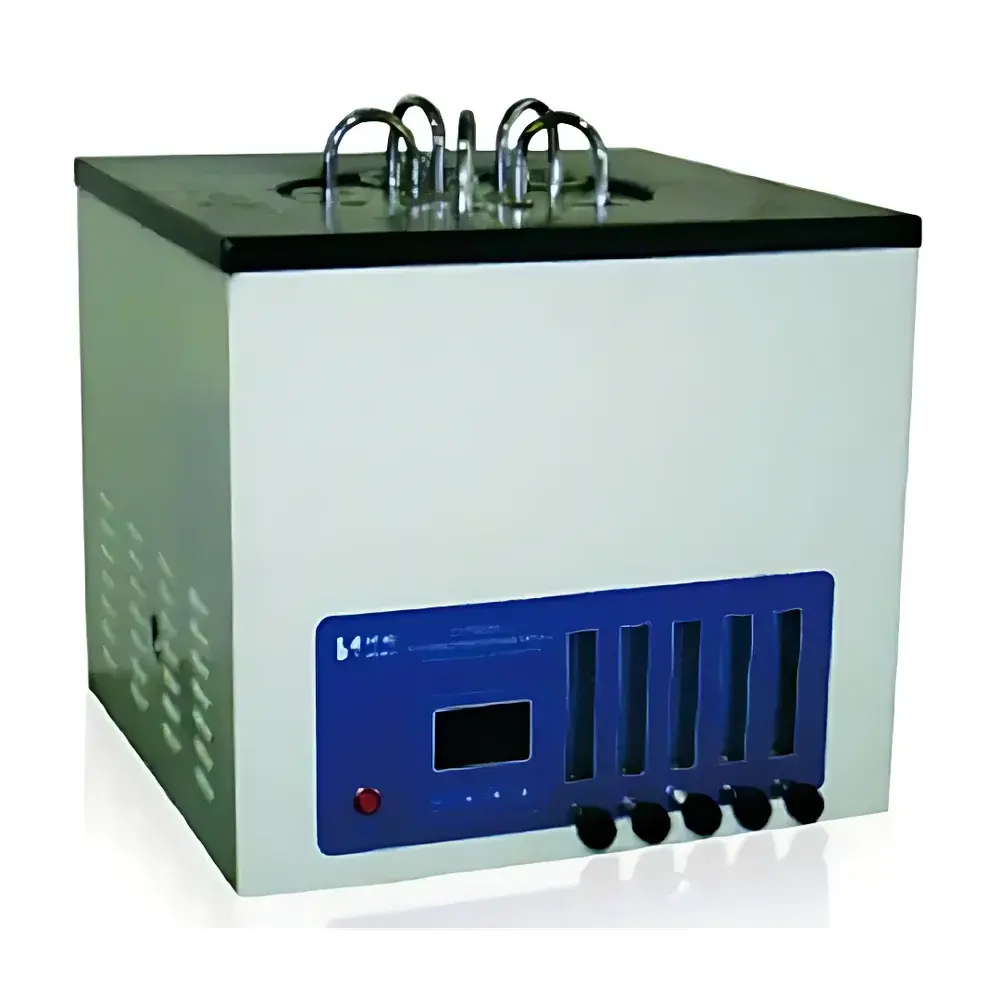
Shenkai SYP2008-II Jet Evaporation Apparatus for Fuel Gum Content Determination
| Brand | Shenkai |
|---|---|
| Origin | Shanghai, China |
| Model | SYP2008-II |
| Evaporation Bath | 5-position metal bath |
| Temperature Control Range | 160–165 °C (bath), 150–160 °C (test port) |
| Air Pressure | ≤35 kPa |
| Air Flow per Port | 36 L/min ± 3.6 L/min |
| Heating Power | 3300 W |
| Power Supply | 220 VAC ±10%, 50 Hz ±1 Hz |
| Dimensions | 420 × 420 × 400 mm |
| Standards Compliance | GB/T 8019, ISO 6246, ASTM D381 |
Overview
The Shenkai SYP2008-II Jet Evaporation Apparatus is a precision-engineered instrument designed for the quantitative determination of gum content in aviation turbine fuels, automotive gasoline, and other volatile distillate fuels—particularly those containing oxygenates (e.g., alcohols, ethers) or deposit-control additives. It operates in strict accordance with the jet evaporation principle defined in GB/T 8019, ISO 6246, and ASTM D381. In this method, a precisely metered fuel sample is introduced into a preheated evaporation chamber where controlled hot air is directed across its surface at standardized flow and pressure conditions. Volatile components are rapidly removed by convective drying, leaving behind non-volatile residue—commonly referred to as “actual gum”—which is gravimetrically quantified after cooling and weighing. The apparatus replicates the thermal and oxidative stress conditions encountered during fuel storage and engine intake system operation, making it a critical tool for quality assurance in refinery laboratories, fuel blending facilities, and regulatory testing centers.
Key Features
- Five-position thermostatically controlled metal evaporation bath engineered for parallel sample processing—enabling efficient throughput without cross-contamination or thermal interference between ports.
- Intelligent digital temperature controller with LCD interface ensures stable bath temperature maintenance within ±0.5 °C of setpoint (160–165 °C); individual test port temperatures monitored at 150–160 °C to meet standard-defined thermal gradients.
- Dedicated mass-flow calibrated rotameters for each of the five air inlets—providing real-time, independent visualization and adjustment of airflow at 36 L/min ± 3.6 L/min per port, traceable to NIST-traceable calibration protocols.
- Integrated two-stage pressure regulation and particulate filtration system—reducing inlet air pressure to ≤35 kPa while removing moisture and hydrocarbon aerosols to prevent condensation artifacts and ensure consistent evaporation kinetics.
- High-power (3300 W), uniformly distributed heating architecture with overtemperature cutoff and thermal fuse redundancy—supporting rapid thermal equilibration and long-term operational stability under continuous laboratory use.
- Ergonomic stainless-steel housing with front-accessible controls, heat-shielded viewing window, and integrated audible/visual end-of-test alarm—designed for compliance with IEC 61010-1 safety requirements for electrical equipment used in laboratory environments.
Sample Compatibility & Compliance
The SYP2008-II accommodates standard 50 mL glass crucibles (ASTM D381-compliant) and accepts neat fuels, oxygenated blends (e.g., E10, MTBE-containing gasoline), and additive-treated distillates without modification. Its thermal profile and airflow dynamics have been validated against reference materials certified under ISO Guide 34 and NIST SRM 2720 (Gasoline Reference Material). The instrument meets essential requirements for GLP-compliant testing environments: all temperature and timing parameters are digitally logged with timestamped audit trails; airflow calibration certificates are supplied with each unit; and hardware design supports full traceability per ISO/IEC 17025:2017 Clause 6.4 (Equipment).
Software & Data Management
While the SYP2008-II operates as a stand-alone benchtop instrument, its digital temperature controller and timer module support RS-232 serial output for optional integration with LIMS or ELN platforms. Logged data—including start time, target temperature, actual bath temperature (recorded every 10 s), elapsed evaporation time, and alarm triggers—is exportable in CSV format. For laboratories operating under FDA 21 CFR Part 11 requirements, third-party validation packages—including IQ/OQ documentation, electronic signature configuration, and audit trail review protocols—are available upon request and compatible with common validation frameworks (e.g., GAMP 5).
Applications
- Quality control of finished gasoline and jet fuel prior to dispatch from refineries and terminals.
- Stability assessment of ethanol-blended fuels (E15, E85) and ether-containing formulations under accelerated oxidative conditions.
- Verification of deposit-control additive performance in OEM-specified fuel formulations.
- Regulatory conformance testing for national fuel specifications (e.g., China’s GB 17930, ASTM D4814, DEF STAN 91-91).
- Research on gum formation mechanisms via controlled variable studies (e.g., temperature ramping, airflow modulation) using the instrument’s programmable setpoints.
FAQ
What standards does the SYP2008-II validate against?
It is fully compliant with GB/T 8019–2023, ISO 6246:2021, and ASTM D381–22—covering both “actual gum” (non-volatile residue after evaporation) and “apparent gum” (residue including entrained volatiles) measurement modes.
Can the instrument handle fuels with high ethanol content?
Yes—the airflow and thermal control parameters are optimized for oxygenated fuels up to E85; crucible pre-conditioning and post-evaporation desiccation protocols are included in the operator manual to minimize hygroscopic error.
Is calibration certification provided with the unit?
Each SYP2008-II ships with factory calibration reports for temperature sensors (±0.3 °C accuracy at 160 °C) and airflow meters (±2% full-scale), traceable to CNAS-accredited laboratories.
How is safety ensured during extended operation?
The system incorporates dual thermal cutouts, grounded chassis, IP20-rated enclosure, and pressure-relief venting in the air supply manifold—all verified per EN 61010-1:2010.
What maintenance intervals are recommended?
Rotameter cleaning and filter replacement every 200 test cycles; annual verification of temperature sensor drift and airflow linearity using NIST-traceable references.





