
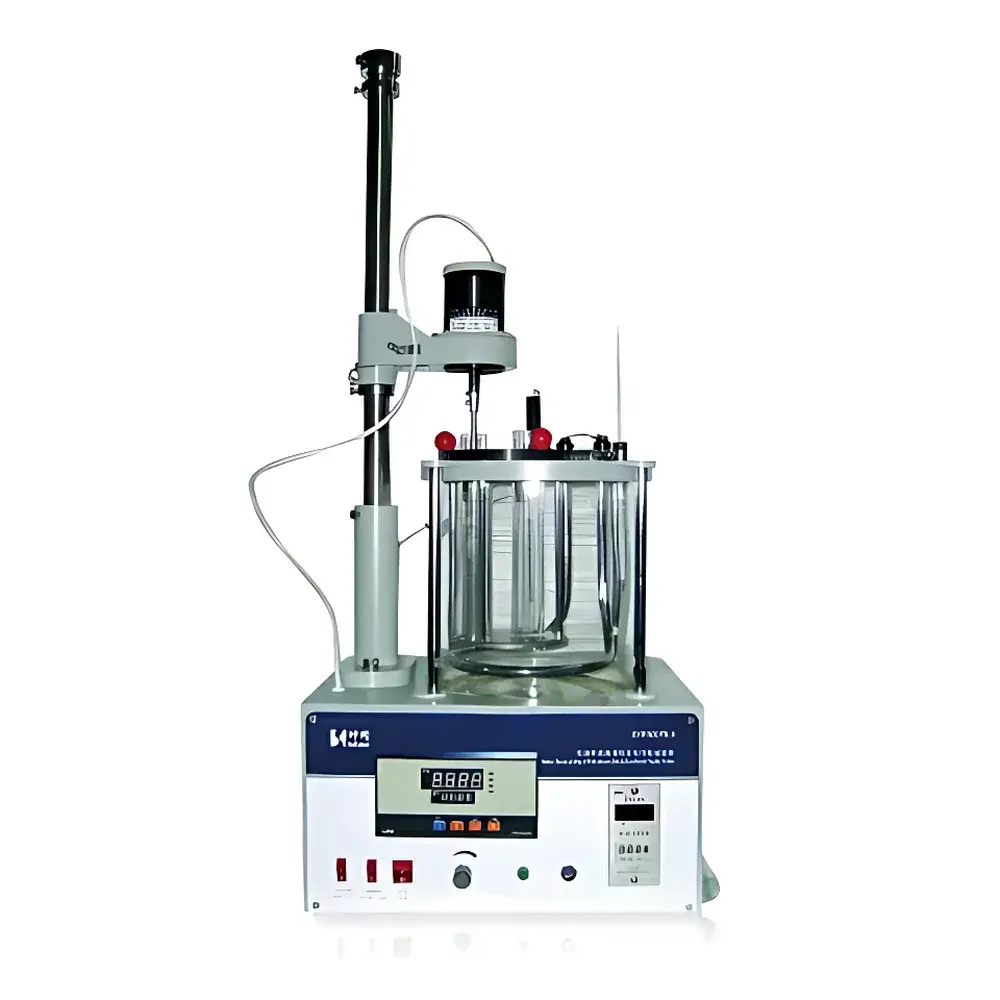
Shenkai SYP3007B-II Petroleum Demulsibility Tester
| Brand | Shenkai |
|---|---|
| Origin | Shanghai, China |
| Model | SYP3007B-II |
| Standard Compliance | GB/T 7305, ASTM D1401, SY/T 5654 |
| Test Temperatures | 54 °C ±1 °C and 82 °C ±1 °C |
| Viscosity Range | 28.8–90 mm²/s (at 40 °C) for 54 °C test |
| Bath Dimensions | Φ240 mm × 255 mm (hardened heat-resistant borosilicate glass) |
| Cylinder Dimensions | Φ32 mm × 230 mm (borosilicate glass), scale range 5–100 mL, graduation interval 1.0 mL, red reference line at 6 mm above bottom |
| Stirrer Blade | stainless steel, 120 mm ±1.5 mm (L) × 19 mm ±0.5 mm (W) × 1.5 mm (T) |
| Stirrer Shaft | stainless steel, Φ6 mm |
| Motor Speed | 1500 ±15 rpm |
| Heating Power | 500 W |
| Power Supply | 220 V ±10 %, 50 Hz ±1 Hz |
| Stirring Duration Control | programmable time relay with audible alert |
| Sample Capacity | three simultaneous test positions with independent thermal pre-conditioning capability |
Overview
The Shenkai SYP3007B-II Petroleum Demulsibility Tester is a precision-engineered laboratory instrument designed to quantify the water separation behavior of petroleum-based and synthetic lubricants under standardized thermal and mechanical agitation conditions. It operates on the principle of controlled emulsion destabilization—measuring the time required for an oil–water mixture to separate into distinct, measurable phases following defined stirring and settling protocols. This measurement directly reflects the demulsibility performance of industrial lubricants, a critical parameter influencing equipment reliability, corrosion control, and long-term system integrity in turbines, hydraulic systems, and gearboxes. The instrument strictly implements the physical test methodology specified in GB/T 7305 (Chinese National Standard), ASTM D1401 (Standard Test Method for Determining the Demulsibility Characteristics of Turbine Oils), and SY/T 5654 (Technical Specification for Petroleum Demulsibility Testers), ensuring data traceability and inter-laboratory comparability across global quality assurance frameworks.
Key Features
- Triple-position test configuration with independently rotatable, lockable sample ports—enabling concurrent testing of up to three samples while maintaining thermal equilibrium in standby cylinders via passive bath conduction.
- High-stability thermostatic bath constructed from hardened borosilicate glass (Φ240 mm × 255 mm), engineered for uniform thermal distribution and resistance to thermal shock during repeated temperature transitions between 54 °C and 82 °C.
- Digital PID temperature controller with ±1 °C accuracy and real-time display, integrated with a continuously variable magnetic stirrer for precise agitation intensity control across the full operational range.
- Stirrer assembly fabricated entirely from corrosion-resistant austenitic stainless steel (AISI 316 grade), including blade (120 mm × 19 mm × 1.5 mm) and shaft (Φ6 mm), ensuring dimensional stability and inertness against hydrocarbon and aqueous phase interactions.
- Programmable electromechanical timer with audible end-of-cycle notification and automatic motor cutoff—eliminating operator dependency and supporting unattended operation during standardized 30-minute agitation periods.
- Ergonomic vertical column design with upper/lower positioning rings for repeatable stirrer immersion depth, reducing setup variability and improving inter-test reproducibility without manual re-alignment.
Sample Compatibility & Compliance
The SYP3007B-II accommodates petroleum oils and synthetic fluids with kinematic viscosity ranging from 28.8 mm²/s to ≥90 mm²/s measured at 40 °C. For low-to-mid viscosity oils (28.8–90 mm²/s), testing occurs at 54 °C ±1 °C; for high-viscosity formulations (>90 mm²/s), the protocol mandates 82 °C ±1 °C to ensure adequate fluid mobility during agitation. All test cylinders conform to dimensional and material specifications outlined in ASTM D1401: borosilicate glass construction (Φ32 mm × 230 mm), calibrated volume scale (5–100 mL, 1.0 mL increments), and a permanent red reference line located 6 mm above the base—critical for consistent meniscus reading and phase boundary assessment. Instrument validation aligns with SY/T 5654 requirements for mechanical robustness, thermal uniformity, and timing fidelity—making it suitable for ISO/IEC 17025-accredited laboratories performing routine QC or regulatory submission testing.
Software & Data Management
While the SYP3007B-II operates as a standalone benchtop instrument with analog-digital hybrid controls (no embedded microprocessor or network interface), its operational parameters are fully compatible with external laboratory information management systems (LIMS) and electronic lab notebooks (ELN). Temperature setpoints, agitation duration, and manual phase separation observations (e.g., “30 mL water layer at 15 min”) can be logged in accordance with GLP and GMP documentation practices. For facilities requiring audit-ready records, the instrument supports integration with time-stamped digital loggers or video recording systems to capture visual separation kinetics—facilitating compliance with FDA 21 CFR Part 11 when paired with appropriate electronic signature workflows and metadata tagging.
Applications
This tester serves core functions in lubricant formulation R&D, manufacturing QC, and in-service oil condition monitoring. Typical use cases include evaluating additive package efficacy (e.g., demulsifier concentration optimization), verifying batch-to-batch consistency of turbine oils per OEM specifications (e.g., GEK 32568, Siemens TLV 9013), assessing degradation-induced emulsion stability loss in field-used hydraulic fluids, and supporting root-cause analysis of water-related bearing failures. Its adherence to ASTM D1401 ensures compatibility with international procurement contracts and third-party certification programs such as API RP 686 or DIN 51586.
FAQ
What standards does the SYP3007B-II comply with?
It conforms to GB/T 7305, ASTM D1401, and SY/T 5654 for demulsibility testing of petroleum and synthetic lubricants.
Can the instrument test oils with viscosity exceeding 90 mm²/s at 40 °C?
Yes—when testing high-viscosity oils, the standard requires operation at 82 °C ±1 °C instead of 54 °C.
Is the temperature bath actively stirred, and how is uniformity ensured?
The bath employs a variable-speed magnetic stirrer with continuous rotation; combined with borosilicate glass geometry and PID-controlled heating, it achieves ≤±0.3 °C spatial gradient across the cylinder array.
How is repeatability maintained across multiple operators?
Fixed-positioning rings, calibrated stirrer blade geometry, and programmable timing eliminate subjective variables—ensuring <2% RSD in replicate demulsibility time measurements under controlled ambient conditions.
Are replacement cylinders and stirrer blades available as consumables?
Yes—original-specification borosilicate cylinders (Φ32 mm × 230 mm) and stainless steel stirrer assemblies are supplied as certified spare parts with dimensional and material traceability documentation.





