
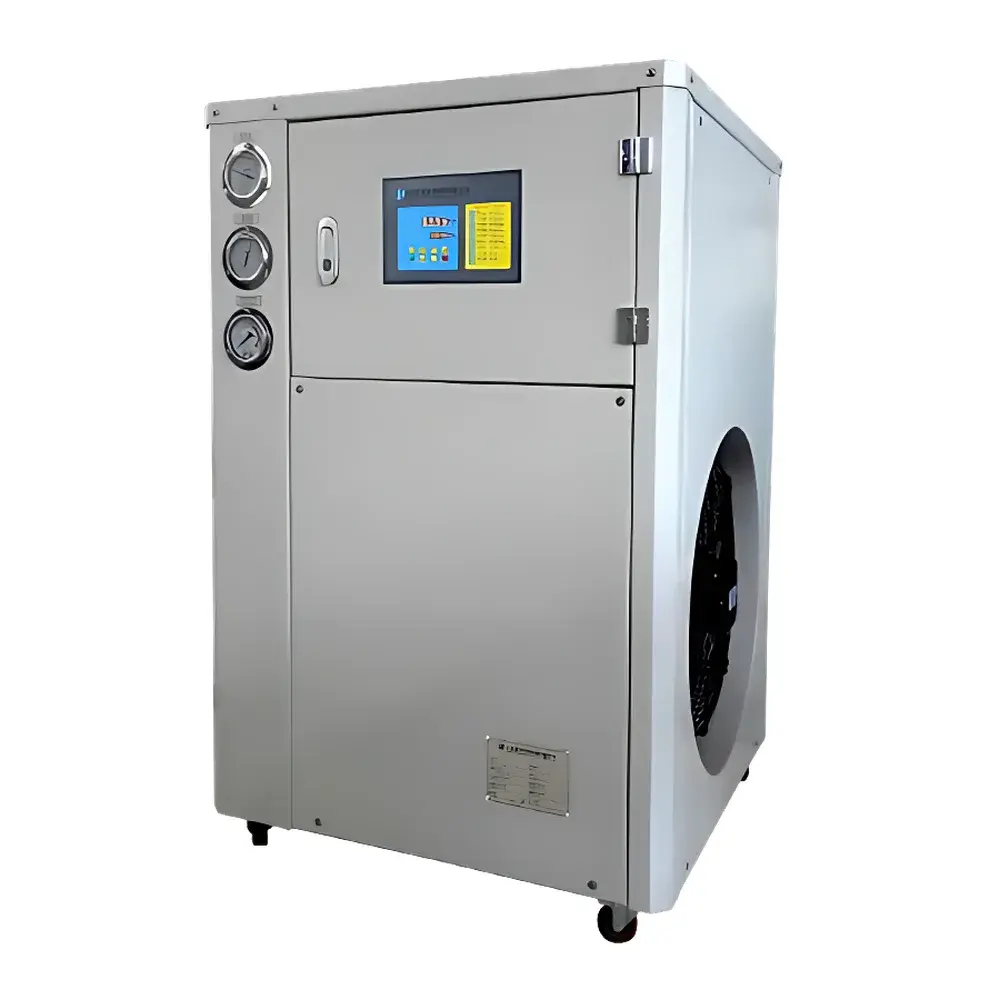
Shenkai SYP9001-IV Circulating Chiller
| Brand | Shenkai |
|---|---|
| Origin | Shanghai, China |
| Manufacturer Type | Authorized Distributor |
| Country of Origin | China |
| Model | SYP9001-IV |
| Instrument Type | Integrated Circulating Chiller |
| Cooling Method | Water-Cooled |
| Compressor Type | Hermetic Scroll Compressor |
| Temperature Control Range | 5–35 °C |
| Temperature Stability | ±3 °C |
| Refrigeration Capacity | 9 kW |
| Total Electrical Power Input | 3.5 kW |
| Pump Flow Rate | 1.37 m³/h |
| Pump Head | 44 m |
| Reservoir Volume | 60 L |
| Airflow (for auxiliary cooling system) | 2900 m³/h |
| Power Supply | 380–415 V, 50 Hz |
| Safety Protections | High/Low Pressure Switches, Phase Failure & Reverse Phase Protection, Undervoltage Lockout, Overload & Motor Thermal Protection, Freeze Protection |
Overview
The Shenkai SYP9001-IV Circulating Chiller is an integrated, water-cooled temperature control system engineered for stable thermal management in analytical instrumentation requiring precise and continuous coolant delivery. Designed specifically to support octane number analyzers (e.g., ASTM D2699/D2700) and cetane number testers (e.g., ASTM D613/D6890), this chiller maintains consistent bath temperatures within a regulated range of 5–35 °C with ±3 °C stability—critical for reproducible combustion quality testing in petroleum laboratories. Its thermodynamic architecture employs a hermetic scroll compressor, eliminating shaft seal leakage risks common in semi-hermetic units, and integrates a 60-liter stainless steel reservoir with internal flow monitoring and freeze protection logic. Unlike open-loop tap-water cooling, the SYP9001-IV recirculates conditioned fluid through closed-loop circuits, minimizing water consumption, reducing ambient heat load, and preventing scaling or corrosion in sensitive calorimetric and ignition test systems.
Key Features
- Hermetic scroll compressor with integrated motor—no dynamic seals, ensuring long-term refrigerant containment and operational reliability
- Multi-head compressor configuration enabling stepwise capacity modulation to match variable thermal loads and reduce inrush current during startup
- Factory-charged with refrigerant and synthetic lubricant; pre-installed flow switch and pressure transducers eliminate field commissioning delays
- Dual-stage safety architecture: high/low refrigerant pressure cutoffs, three-phase electrical monitoring (phase loss, reverse phase, undervoltage), motor thermal overload protection, and automatic shutdown below 5 °C coolant temperature
- Low-vibration mechanical design requiring only basic elastomeric isolation pads—no structural anchoring or dedicated foundation needed
- Self-contained hydraulic circuit with 44-meter pump head and 1.37 m³/h flow rate, compatible with standard 1-inch NPT or ISO 228 threaded connections
Sample Compatibility & Compliance
The SYP9001-IV is validated for continuous operation with ASTM-compliant gasoline and diesel fuel testing apparatuses, including but not limited to: CFR F1/F2/F3 octane rating engines, AVL 520/530 cetane testers, and equivalent ignition quality analyzers. Its temperature stability profile meets the thermal conditioning requirements specified in ASTM D976 (calculated cetane index), ASTM D4814 (gasoline specifications), and ISO 5167 (fluid flow measurement standards where chilled coolant serves as reference medium). The unit conforms to IEC 61000-6-2 (immunity) and IEC 61000-6-4 (emission) for industrial environments and supports GLP-compliant lab infrastructure when paired with external data loggers meeting FDA 21 CFR Part 11 audit trail requirements.
Software & Data Management
While the SYP9001-IV operates via a local digital controller with LED display and tactile keypad (no embedded Ethernet or USB interface), it provides analog 4–20 mA output signals for remote temperature and flow status monitoring. Integration with centralized laboratory information management systems (LIMS) or SCADA platforms is achieved using optional DIN-rail-mounted signal converters compliant with Modbus RTU (RS-485). All safety interlocks—including low-flow detection, high discharge temperature, and freeze condition—are hardwired to dry-contact alarm terminals for connection to building management systems (BMS) or emergency shutdown relays. Event logging is supported externally via third-party DAQ modules recording timestamped values of setpoint deviation, compressor run time, and fault code history.
Applications
- Primary coolant source for CFR engine-based octane and cetane testers in refinery QC labs and independent fuel certification facilities
- Temperature stabilization of calorimeters, viscometers, and distillation analyzers requiring constant bath conditions between 5–35 °C
- Support cooling loop for laser-based spectrometers (e.g., FTIR, Raman) where thermal drift affects spectral resolution
- Secondary heat rejection loop in combined-cycle environmental test chambers simulating tropical or arctic operating conditions
- Process cooling for small-scale chemical synthesis reactors where exothermic control must remain decoupled from facility chilled water infrastructure
FAQ
What is the minimum allowable ambient temperature for continuous operation?
The unit is rated for indoor installation only, with ambient operating range of 10–40 °C and maximum relative humidity of 80% non-condensing.
Can the chiller be integrated into a building’s BACnet network?
Native BACnet support is not included; however, third-party protocol gateways (e.g., BACnet/IP to Modbus RTU) enable interoperability with enterprise-level HVAC control systems.
Is the reservoir fluid path compatible with glycol-water mixtures?
Yes—the system accepts aqueous solutions up to 30% propylene glycol by volume; concentration adjustments require recalibration of the onboard temperature sensor’s immersion depth compensation.
Does the unit comply with CE marking requirements?
It meets the essential health and safety requirements of the EU Machinery Directive 2006/42/EC and Low Voltage Directive 2014/35/EU; CE documentation is available upon request for qualified end-users.
What maintenance intervals are recommended for the scroll compressor?
Compressor oil analysis is advised every 8,000 operating hours; routine filter-drier replacement and refrigerant charge verification should occur annually under continuous duty cycles.



