
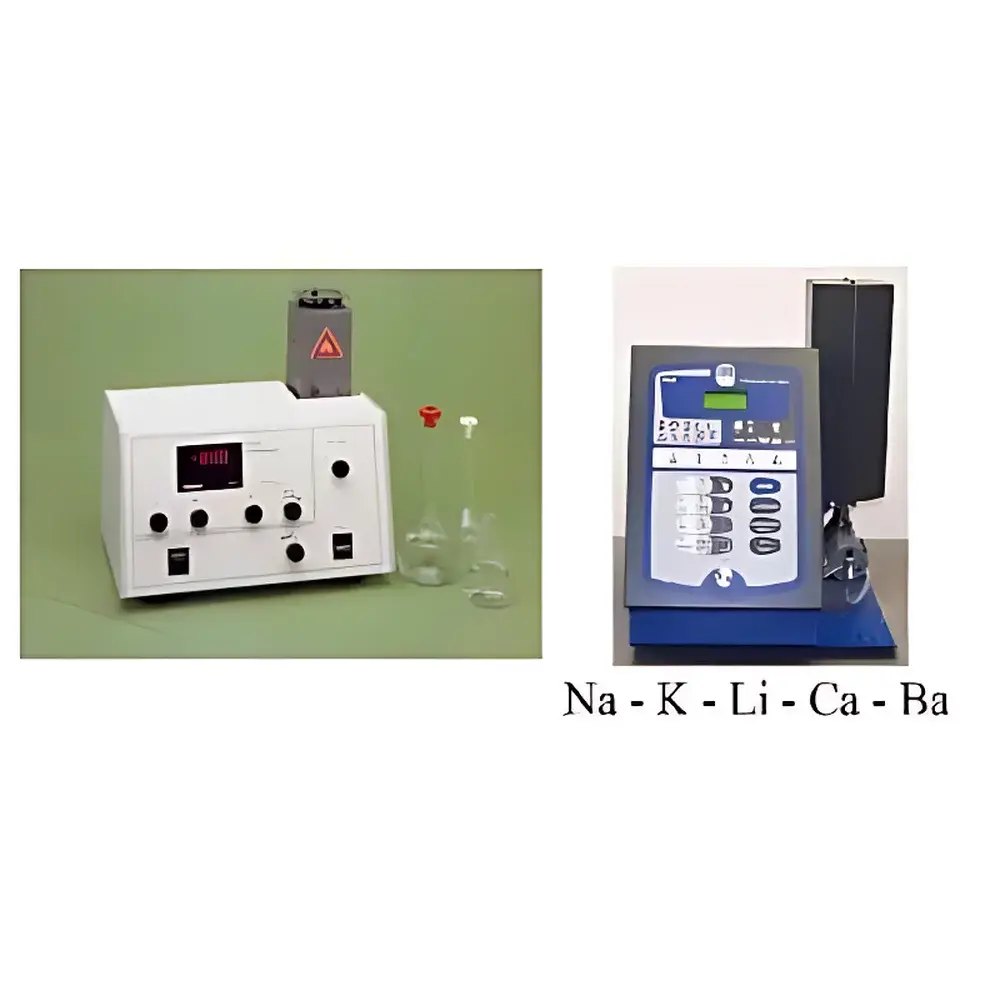
Sherwood Scientific PFP7 and PFP7-C Flame Photometers | WBW PLUS Flame Photometer | 86LA Luminance Meter
| Origin | Imported |
|---|---|
| Manufacturer Type | Authorized Distributor |
| Model | PFP7 / PFP7-C / WBW PLUS / 86LA |
| Measurement Range (PFP7-C) | Na 120–160 mmol/L (linearized), K 0–10.0 mmol/L |
| Detection Limit | Na < 0.2 ppm, K < 0.2 ppm, Li < 0.25 ppm, Ca < 15 ppm, Ba < 30 ppm |
| Repeatability | < 1% CV (20 consecutive samples, 10 ppm Na set to 50) |
| Linearity | Better than ±2% (3 ppm Na/K, 5 ppm Li set to 100) |
| Recorder Output | 1.00 V nominal at reading 100.0 |
| Power Supply | 90–125 V or 190–250 V, 50/60 Hz |
| Air Supply | Oil- and moisture-free, 6 L/min at 1 kg/cm² (14 psi) |
| Fuel Compatibility | Propane, butane, natural gas, LPG |
| Dimensions | 420 × 360 × 300 mm |
| Weight | 8 kg |
Overview
The Sherwood Scientific PFP7 and PFP7-C are benchtop single-channel flame photometers engineered for precise, reproducible quantification of alkali and alkaline earth metals—including sodium (Na), potassium (K), lithium (Li), calcium (Ca), and barium (Ba)—in aqueous solutions. Based on atomic emission spectroscopy (AES), these instruments atomize and excite sample ions in a controlled premixed air–fuel flame; element-specific emission is isolated via interference filters and measured by a photomultiplier tube. The PFP7 serves as a general-purpose instrument optimized for Na and K analysis in environmental, industrial, and educational laboratories. The PFP7-C variant incorporates clinical-grade electronics with enhanced linearity and calibrated output scaling, enabling direct mmol/L readouts for serum Na and K after standardized 100:1 or 200:1 dilution—fully compliant with routine clinical chemistry workflows. Both models feature electronic flame failure detection, dual-stage sensitivity control (coarse and fine), and broad fuel flexibility (propane, butane, natural gas, or LPG), ensuring operational resilience across global laboratory infrastructures.
Key Features
- Atomic emission-based quantification with high spectral selectivity via precision interference filters
- Standard Na and K filters included; optional Ca, Ba, and Li filters available for multi-element expansion
- Electronic flame supervision circuitry with automatic shutdown upon flame extinction—meets IEC 61010-1 safety requirements
- Dual-range sensitivity adjustment for optimal signal-to-noise ratio across low- and high-concentration samples
- Stable, low-temperature flame design minimizing oxide formation and spectral interferences
- Analogue recorder output (1.00 V @ reading 100.0) compatible with chart recorders, data loggers, or legacy LIMS interfaces
- Robust mechanical architecture (8 kg mass, steel-reinforced chassis) for vibration-damped operation in shared lab environments
Sample Compatibility & Compliance
The PFP7 and PFP7-C accept clarified, filtered aqueous samples—including serum, plasma, urine, plant digests, soil extracts, and process water—with no requirement for organic solvent compatibility. Sample introduction is via fixed-capillary nebulization into an all-stainless-steel burner head. Clinical use of the PFP7-C aligns with CLIA-waived testing principles for electrolyte measurement and supports GLP-compliant documentation when paired with audit-trail-enabled external recording systems. While not FDA 510(k)-cleared as an IVD device, its performance specifications meet or exceed the analytical criteria defined in CLSI EP9-A3 for method comparison and CLSI C38-A2 for flame photometric electrolyte assays. Interference studies confirm <0.5% cross-sensitivity from equimolar concentrations of Na, K, or Li—validating specificity per ISO 15197:2013 Annex B guidelines for ion-selective measurement principles.
Software & Data Management
These are standalone analogue instruments with no embedded microprocessor or digital display firmware. Quantitative results are read directly from the front-panel analog meter (0–100 scale) and converted to concentration using pre-established calibration curves. For traceability, users are advised to maintain hard-copy calibration logs per ISO/IEC 17025:2017 Clause 7.7. The 1 V recorder output enables integration with third-party data acquisition systems supporting IEEE 1451.2 or Modbus RTU protocols—facilitating alignment with FDA 21 CFR Part 11–compliant environments when paired with validated software and electronic signature controls. No proprietary drivers or vendor-specific software are required.
Applications
- Clinical diagnostics: Routine serum/plasma Na⁺ and K⁺ quantification in hospital core labs and point-of-care satellite units
- Agricultural science: Soil extract analysis for exchangeable K⁺ and Na⁺ in fertility assessment (ASTM D5092)
- Pharmaceutical QC: Monitoring residual alkali metals in active pharmaceutical ingredients (APIs) per USP
- Food & beverage: Salt content verification in dairy, canned goods, and infant formula (AOAC 985.32)
- Environmental monitoring: Surface water and wastewater Na/K ratios as indicators of anthropogenic contamination
- Academic teaching: Hands-on instruction in atomic spectroscopy fundamentals, calibration theory, and flame chemistry
FAQ
What sample preparation is required for serum analysis on the PFP7-C?
Serum must be diluted 100-fold or 200-fold with deionized water or a low-ionic-strength diluent prior to aspiration. No protein precipitation or filtration is needed due to the instrument’s robust nebulizer design.
Can the PFP7-C be used for whole blood or urine without modification?
Urine may be analyzed directly after 1:10 dilution; whole blood requires prior centrifugation and serum separation—no hemolysate analysis is supported.
Is calibration traceable to NIST standards?
Yes—calibration solutions should be prepared from NIST-traceable stock standards (e.g., NIST SRM 3198 for Na, SRM 3199 for K) following ISO Guide 35 protocols.
Does the instrument support regulatory audit requirements?
While the hardware itself lacks digital audit trails, full compliance with ISO/IEC 17025 and CLIA is achievable through documented calibration, maintenance logs, and external data capture systems meeting 21 CFR Part 11 Annex 11 criteria.
What maintenance intervals are recommended?
Nebulizer capillary cleaning every 8 hours of operation; burner head inspection and descaling every 40 hours; annual verification of flame stability and filter transmission using certified reference materials.





