
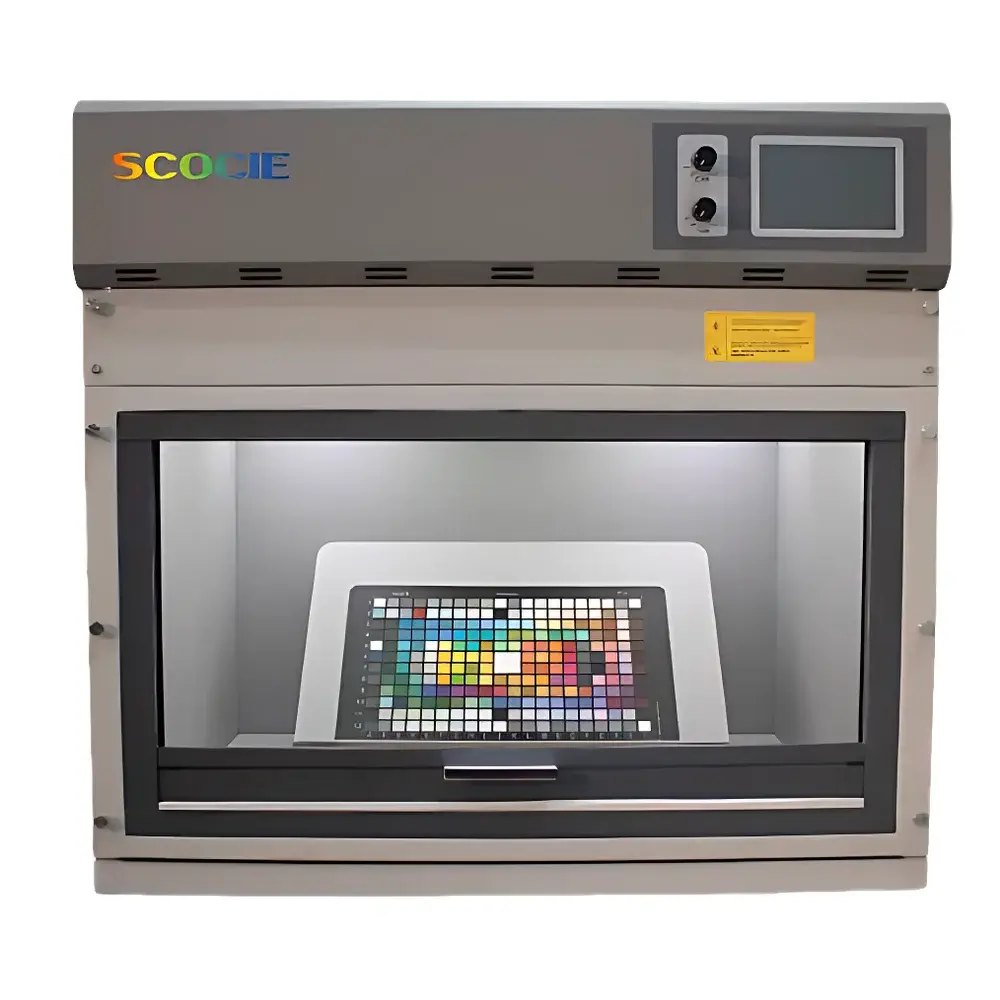
Shike FastnessGrade Advanced Colorfastness & Appearance Analyzer
| Origin | Shanghai, China |
|---|---|
| Manufacturer Type | Authorized Distributor |
| Product Origin | Domestic (China) |
| Model | FastnessGrade |
| Price Range | USD 28,000 – 42,500 |
| Instrument Type | Benchtop Spectrophotometer |
| Optical Geometry | 0°/45° Integrating Sphere |
| Light Source | High-Stability LED Array |
| Spectral Range | 350–700 nm |
| Spectral Resolution | ≤1 nm |
| Repeatability (ΔE*ab) | ≤0.03 |
| Compliance | ISO 105-A02, ISO 105-X12, ISO 105-B02, ISO 105-F10, AATCC Test Method 8, 16, 61, 88, 116, 165 |
Overview
The Shike FastnessGrade Advanced Colorfastness & Appearance Analyzer is a benchtop spectral imaging instrument engineered for objective, quantitative assessment of textile and material colorfastness properties. Unlike conventional visual evaluation systems reliant on human observers under standardized lighting, the FastnessGrade integrates calibrated RGB imaging with spectrophotometric measurement in a single optical platform. It operates on the principle of spatially resolved spectral reflectance capture—acquiring full-spectrum data (350–700 nm) from both test specimens and multi-fiber reference fabrics under controlled 0°/45° illumination geometry. This enables traceable, repeatable quantification of chromatic deviation (ΔL*, Δa*, Δb*, ΔE*ab), metamerism index (MI), and grayscale correlation—critical parameters defined in ISO 105 and AATCC standards. The system is not a simple colorimeter; it functions as a hybrid metrology platform combining CIE-compliant spectral analysis, digital image-based grading, and standardized light simulation—making it suitable for GLP-compliant laboratories requiring audit-ready documentation and inter-laboratory reproducibility.
Key Features
- Integrated dual-mode operation: simultaneous spectrophotometric measurement (CIE L*a*b*, ΔE*ab, MI) and high-resolution RGB image acquisition for morphology-aware grading
- 0°/45° integrating sphere optics with NIST-traceable LED array (CCT 5000 K, CRI ≥95), eliminating lamp aging drift and enabling stable long-term calibration
- Digital fastness grading engine compliant with ISO 105-A02 (gray scale), ISO 105-X12 (rubbing), ISO 105-B02 (lightfastness), and AATCC TM16/61/88/116/165
- Automated multi-sample imaging: up to 6 textile swatches per frame, with individual ROI segmentation and independent grade assignment
- Embedded standard illuminants: D65, A, F2, F7, F11, and UV-augmented modes for fluorescence compensation and whiteness evaluation
- Onboard spectral calibration verification using built-in ceramic tile reference and daily auto-zero function
Sample Compatibility & Compliance
The FastnessGrade accepts flat, flexible specimens up to 150 mm × 150 mm—including woven/knitted textiles, leather, nonwovens, coated papers, and polymer films. Its imaging field-of-view accommodates standard ISO/AATCC test specimens (e.g., 100 mm × 40 mm for rubbing tests, 100 mm × 25 mm for lightfastness exposure). All grading algorithms are validated against ISO 105 reference standards: blue wool scales (for lightfastness), gray scales (for staining and color change), and pilling reference images (ISO 12945-1). The instrument supports full compliance with ISO/IEC 17025 documentation requirements—each measurement includes embedded metadata (timestamp, operator ID, calibration status, illuminant ID, geometry, integration time) and generates PDF reports with embedded spectral curves and annotated images. Data integrity meets FDA 21 CFR Part 11 requirements via electronic signature support, audit trail logging, and role-based access control.
Software & Data Management
FastnessGrade Control Suite v4.x is a Windows-based application supporting both local operation and networked deployment. It provides real-time spectral visualization, batch processing of image sets, statistical process control (SPC) charting (X-bar/R, Cpk), and automated report generation in PDF/XLSX formats. Raw spectral data (.jdx, .csv) and annotated TIFF images are stored with SHA-256 checksums for forensic traceability. The software includes a configurable database module compatible with SQL Server or SQLite, enabling integration with LIMS platforms via ODBC or REST API. Audit trails record all user actions—including grade overrides, calibration events, and report exports—with immutable timestamps. For enterprise environments, optional TLS-encrypted cloud sync allows synchronized grade libraries and cross-site method validation across geographically distributed QC labs.
Applications
The FastnessGrade serves as a primary metrology tool in textile R&D, dye house quality assurance, apparel manufacturing QA, and third-party testing laboratories. Specific use cases include: objective evaluation of dry/wet crocking resistance (ISO 105-X12); quantitative lightfastness classification against blue wool standards (ISO 105-B02); automated pilling grade assignment (ISO 12945-1); metamerism assessment for automotive interior trims; color consistency monitoring in food packaging printing (ISO 12647-2); and spectral characterization of fluorescent whitening agents (FWAs) in detergents and paper. Its ability to decouple observer variability makes it particularly valuable for supplier qualification programs requiring zero-defect color matching and for regulatory submissions demanding documented measurement uncertainty.
FAQ
Does FastnessGrade replace human grading entirely?
It replaces subjective visual grading for standardized test methods where ISO/AATCC permit instrumental evaluation—but retains the option to overlay human-assigned grades for method correlation studies.
Can it measure metamerism index (MI) and whiteness indices?
Yes. It calculates CIE Whiteness (W10), Tint (T10), and Metamerism Index (MI) per CIE 15:2018 and ASTM E308, including UV component control for fluorescence compensation.
Is calibration traceable to national standards?
All factory calibrations are performed using NIST-traceable standards; users receive a certificate of calibration with uncertainty budget per ISO/IEC 17025 Annex A.
What sample preparation is required for rubbing tests?
Standard ISO 105-X12 specimens must be mounted on rigid backing cards and placed under the imaging stage after mechanical abrasion using certified crockmeters—no additional optical preparation is needed.
How does it handle textured or uneven surfaces?
The 0°/45° geometry minimizes specular reflection artifacts; software applies adaptive ROI masking and local luminance normalization to ensure consistent grading across pile height variation and surface relief.





