
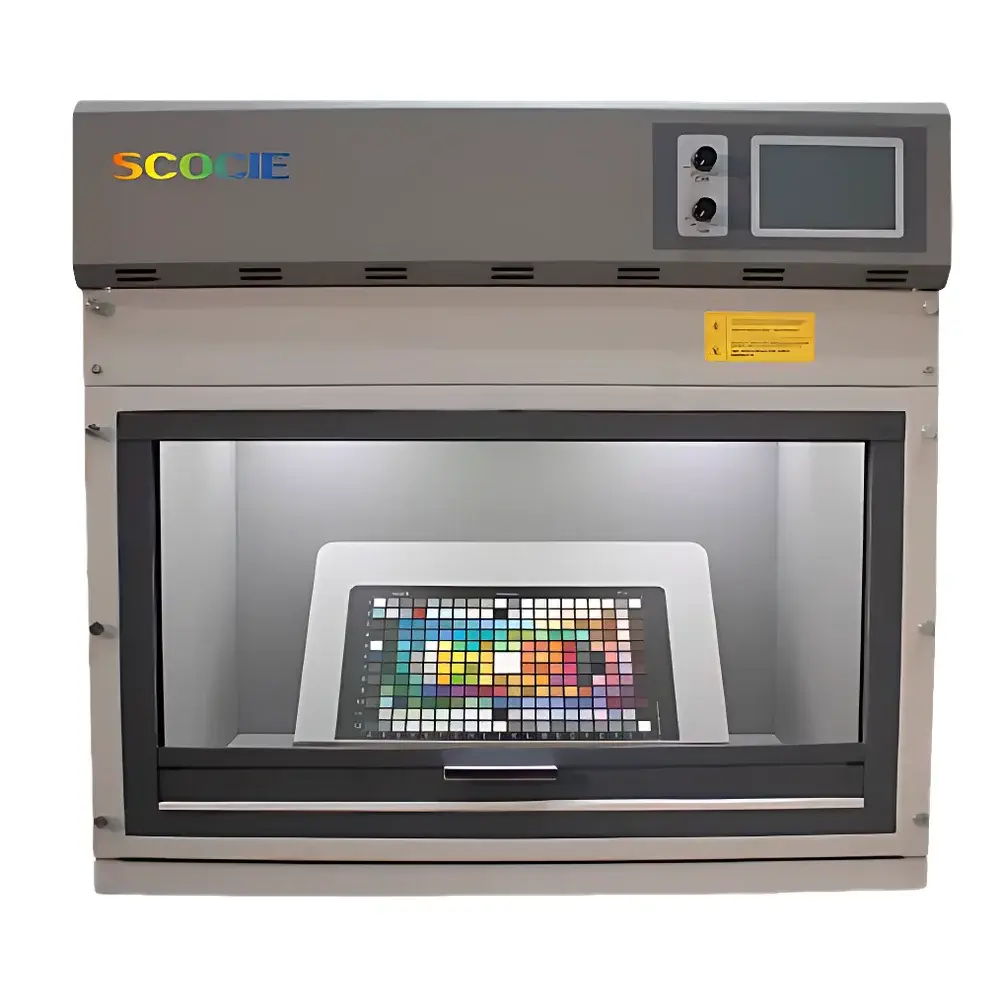
Shike FastnessGrade Digital Colorfastness Analyzer
| Origin | Shanghai, China |
|---|---|
| Manufacturer Type | Distributor |
| Model | FastnessGrade |
| Price Range | USD 28,000 – 42,000 |
| Instrument Type | Benchtop Spectrophotometer |
| Optical Geometry | 0/45° Integrating Sphere |
| Light Source | LED Array |
| Spectral Range | 350–700 nm |
| Repeatability (ΔE*ab) | ≤0.03 |
Overview
The Shike FastnessGrade Digital Colorfastness Analyzer is a benchtop spectrophotometric imaging system engineered for objective, standardized evaluation of textile and material colorfastness properties. Unlike conventional visual assessment methods relying on human observers under controlled lighting, the FastnessGrade integrates high-fidelity RGB imaging with calibrated spectral measurement to quantify chromatic changes induced by standardized physical or environmental stressors—including washing, rubbing, light exposure, and abrasion. Its core measurement principle combines CIE-compliant 0/45° reflectance geometry with multi-spectral LED illumination (350–700 nm), enabling precise capture of both spectral reflectance data and spatial texture information. The instrument operates in full compliance with ISO 105, AATCC TM16, ISO 105-B02, ISO 105-X12, and ISO 12945-1/2 test protocols—ensuring traceable, reproducible results suitable for quality assurance, regulatory reporting, and inter-laboratory comparison.
Key Features
- Dual-mode operation: simultaneous spectrophotometric colorimetry (CIELAB, ΔE*ab, whiteness/yellowness indices) and high-resolution digital image acquisition for texture-based grading (e.g., pilling, surface abrasion)
- Integrated standard light simulation: programmable D65, A, F2, F7, and U30 illuminants compliant with ISO/CIE lighting standards, eliminating reliance on separate viewing booths
- Automated multi-sample analysis: up to six specimens per imaging cycle, with synchronized reference calibration against certified grayscale and blue wool standards
- LED-based illumination system: stable, cool-running, and wavelength-stable light source with <0.1% intensity drift over 10,000 hours—ensuring long-term photometric consistency
- Embedded GLP-compliant audit trail: timestamped operator ID, instrument calibration logs, sample metadata, and raw spectral/image data retention per measurement
- Modular software architecture supporting FDA 21 CFR Part 11–compliant electronic signatures and role-based user access control
Sample Compatibility & Compliance
The FastnessGrade accommodates flat, flexible, and semi-rigid substrates ranging from woven/knitted textiles and nonwovens to coated papers, leather, polymer films, and food surfaces (e.g., baked goods, fruit skins). Specimen dimensions up to 150 × 150 mm are supported with automatic edge detection and ROI masking. All colorfastness evaluations conform to internationally recognized test methodologies: ISO 105-C06 (wash fastness), ISO 105-X12 (rubbing fastness), ISO 105-B02 (light fastness using blue wool references), and ISO 12945-1 (pilling resistance via Martindale or ICI pilling testers). Instrument performance validation follows ISO/IEC 17025 requirements, with factory-certified traceability to NIM (National Institute of Metrology, China) and optional UKAS-accredited calibration reports available upon request.
Software & Data Management
The FastnessGrade Control Suite (v4.2+) provides a unified interface for test method selection, image capture, spectral analysis, and automated grading. Each test sequence generates a structured XML report containing raw reflectance curves (10 nm intervals), CIE XYZ/L*a*b* values, grayscale correlation coefficients, and annotated comparative images aligned to ISO 105-A02 grayscale charts. Data export supports CSV, PDF/A-2, and industry-standard QDX formats compatible with LIMS and SAP QM modules. Network deployment enables centralized database synchronization across geographically dispersed labs; all image and spectral archives are encrypted at rest and support AES-256 encryption in transit. Audit logs record every parameter change, result override, and calibration event—fully satisfying GLP, GMP, and ISO 9001 documentation requirements.
Applications
- Textile & Apparel: Objective grading of wash, rub, light, and perspiration fastness per ISO/AATCC specifications; real-time feedback for dye formulation optimization
- Printing & Packaging: Quantitative evaluation of ink migration, scuff resistance, and UV-curable coating stability under accelerated aging
- Food Science: Non-destructive assessment of Maillard reaction progression in baked products, ripeness staging in horticultural produce, and pigment degradation kinetics
- Coatings & Plastics: Monitoring chromatic shift in automotive clearcoats, architectural paints, and medical-grade polymers exposed to xenon arc or QUV testing
- R&D Laboratories: Correlation studies between instrumental fastness grades and sensory panel outcomes; development of custom grading algorithms for novel fiber blends
FAQ
Does FastnessGrade replace human grading entirely?
It does not eliminate trained personnel but replaces subjective visual interpretation with metrologically traceable, repeatable measurements. Final pass/fail decisions remain under QA supervisor review per internal SOPs.
Can it be used for non-textile materials such as painted metal or ceramic glazes?
Yes—provided the surface is non-specular and within the 0–90% reflectance range. Optional matte spray application may be required for highly glossy substrates.
Is spectral data export compatible with third-party color management systems?
All spectral scans are exported as ASCII text files (CSV) with wavelength headers and reflectance columns, fully interoperable with GretagMacbeth Color iMatch, X-Rite Color iQC, and Baseline SpectraVision workflows.
How often does the instrument require recalibration?
A daily white tile verification is recommended; full NIST-traceable recalibration is advised every 12 months or after 5,000 measurements—whichever occurs first.
Does the system support multi-language UI and reporting?
English and Chinese interfaces are included by default; additional languages (German, Spanish, Japanese) are available via licensed firmware modules.





