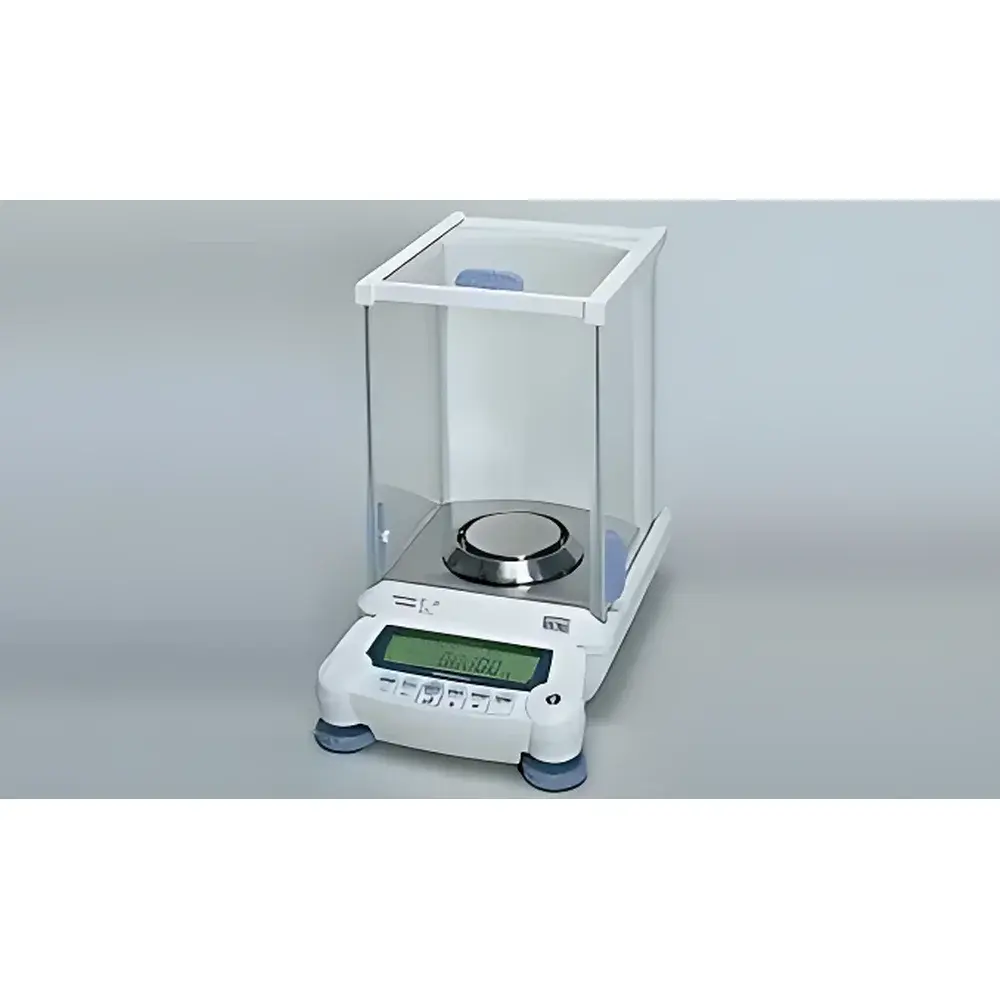
Shimadzu AUY Series Analytical Balance
| Brand | Shimadzu |
|---|---|
| Origin | Japan |
| Model Series | AUY |
| Capacity | 120 g / 220 g / 320 g |
| Readability | 0.1 mg |
| Pan Diameter | ≈ Ø80 mm |
| Dimensions (W × D × H) | ≈ 330 × 220 × 310 mm |
| Weight | ≈ 7 kg |
| Power Consumption | ≈ 7 VA |
| Interface | RS-232C, Data I/O, Keyboard Input |
| Features | PSC Automatic Calibration, Scheduled Calibration, Motorized Internal Calibration, Built-in Real-Time Clock, ISO-Compliant Print Output, Direct-View Window, Interval Timing Output, Full Digital Control, Density Determination (Optional), Piece Counting & Unit Conversion, Analog Display Mode, Optional Rechargeable Battery Support |
Overview
The Shimadzu AUY Series Analytical Balance is an entry-level high-precision weighing instrument engineered for routine laboratory applications requiring reliable sub-milligram resolution and long-term stability. Built upon Shimadzu’s proprietary Uni Bloc aluminum monolithic mass sensor architecture, the AUY platform eliminates traditional multi-component strain gauge assemblies—reducing mechanical hysteresis, thermal drift, and sensitivity to off-center loading. This monolithic design delivers exceptional repeatability (<0.05 mg standard deviation under GLP-controlled conditions) and rapid stabilization times (typically <2 seconds to ±0.1 mg at full capacity), making it suitable for QC environments where throughput and consistency are critical. Unlike competitive models relying on external calibration weights or manual intervention, the AUY integrates motorized internal calibration with Programmable Self-Calibration (PSC), enabling automatic verification and adjustment before each weighing cycle—or at user-defined intervals—without operator involvement.
Key Features
- Uni Bloc Monolithic Sensor: Single-piece aluminum load cell structure ensures minimal creep, superior shock resistance, and immunity to micro-fracture degradation over time.
- PSC (Programmable Self-Calibration): Fully automated calibration sequence triggered by time, temperature shift (>1.5°C), or user command; traceable to internal reference mass certified per ISO/IEC 17025-accredited procedures.
- Digital Environmental Compensation: Real-time correction for ambient temperature fluctuations and air density variations during density determination workflows.
- GLP/GMP-Ready Operation: Built-in real-time clock, audit trail logging (via RS-232), and ISO-compliant print output support compliant data recording for regulated environments.
- Flexible Connectivity: Standard RS-232C port supports direct integration with LIMS, ELN, and statistical process control software; optional analog output module available for PLC interfacing.
- Ergonomic Design: Wide viewing-angle backlit LCD with direct-view window enables unobstructed observation of sample placement without parallax error; keypad layout optimized for gloved operation.
Sample Compatibility & Compliance
The AUY Series accommodates standard analytical samples in crucibles, weighing boats, or tared containers up to Ø80 mm diameter. Its draft shield-compatible design (sold separately) meets ASTM E898–22 requirements for static weighing accuracy in non-controlled environments. All units are manufactured in Shimadzu’s ISO 9001-certified facility in Kyoto, Japan, and comply with international electromagnetic compatibility (EMC) standards IEC 61326-1 and safety standard IEC 61010-1. For regulated pharmaceutical or clinical laboratories, the balance supports 21 CFR Part 11-compliant data integrity when paired with validated third-party data capture software featuring electronic signature and audit trail functionality.
Software & Data Management
Data export follows NIST-traceable ASCII formatting via RS-232C, compatible with Microsoft Excel, LabWare LIMS, and Thermo Fisher SampleManager. The built-in interval timing function allows programmable serial output at fixed intervals (e.g., every 10 s) for continuous monitoring applications such as evaporation rate studies or desiccation kinetics. Optional Shimadzu WinCT-Balance software provides enhanced reporting—including statistical summaries (mean, SD, RSD, min/max), calibration history graphs, and customizable certificate templates aligned with ISO/IEC 17025 Clause 7.7 requirements. All calibration events—including date, time, operator ID (if entered), and deviation values—are permanently stored in non-volatile memory.
Applications
- Pharmaceutical raw material assay and formulation batch release testing
- Chemical reagent dispensing and standard solution preparation (USP & EP volumetric accuracy validation)
- Environmental lab soil/sediment moisture content analysis (ASTM D2216)
- Food quality control: moisture loss tracking, additive dosage verification
- Academic research labs requiring cost-effective yet metrologically sound mass measurement
- Calibration laboratory secondary standard transfer (with appropriate uncertainty budgeting)
FAQ
Does the AUY Series support external calibration with certified weights?
Yes—manual external calibration using Class E2 or better weights is supported via dedicated calibration mode, though PSC is recommended for daily operational verification.
Is the internal calibration mass traceable to national standards?
The motorized calibration mass is factory-adjusted against NMI-Japan (National Metrology Institute of Japan) reference standards; calibration certificates are available upon request.
Can the AUY operate on battery power?
An optional rechargeable Ni-MH battery pack enables portable use for up to 8 hours; runtime varies with backlight intensity and calibration frequency.
What is the maximum permissible error (MPE) per OIML R 76?
At 120 g capacity (AUY120), MPE = ±0.2 mg (Class I); at 320 g (AUY220/AUY320), MPE = ±0.4 mg—fully compliant with OIML R 76-1:2021 Annex C tolerances.
How does the “Direct View Window” improve measurement integrity?
The optically aligned transparent panel minimizes visual distortion during sample handling, reducing positioning errors and supporting ISO 17025 clause 7.8.2 requirements for operator-induced uncertainty mitigation.